Fréjus
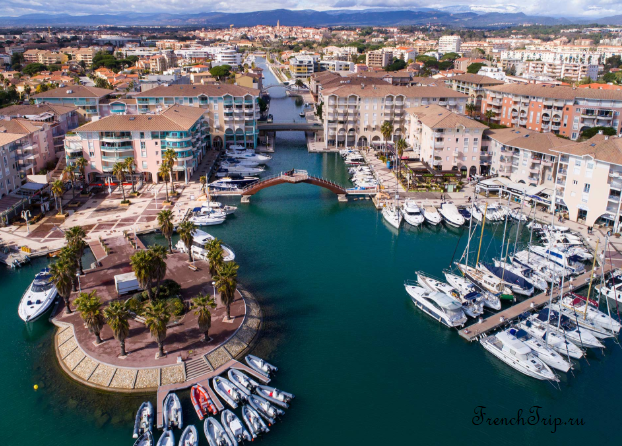
Fréjus sits at the western end of the French Riviera, where the red rock of the Esterel meets the sand of the gulf. It has two things that its neighbours do not: a Roman town and long sand beaches — which is a rare combination on this coast.
The town holds the official label Ville d’Art et d’Histoire, and the cathedral cloister is listed as a national monument.
Roman Fréjus
Julius Caesar founded Forum Julii here in 49 BC, and Augustus made it a naval base — the fleet captured at the battle of Actium was brought to this harbour. For a while it was one of the most important ports in the western Mediterranean, until the harbour silted up and the sea retreated.
What survives is unusually complete for a town of this size:
- The amphitheatre — first century, one of the oldest in Gaul, still used for concerts and events
- The theatre — partly rebuilt, also in use in summer
- The aqueduct — arches strung along the road east of town, once carrying water 40 km from the Siagnole
- The Porte des Gaules and the Lanterne d’Auguste — the old harbour gate and a marker at the entrance to the vanished port
The amphitheatre is smaller, and less well preserved, than the arenas at Nîmes and Arles.
The cathedral close
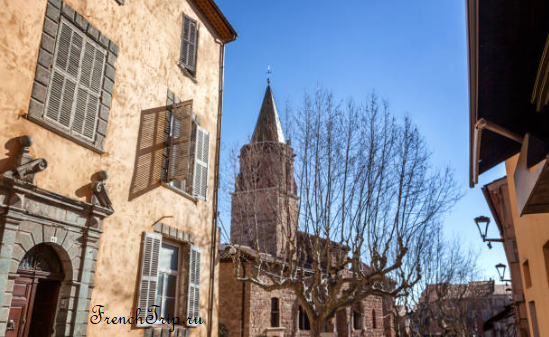
The old town grew up around Place Formigé, next to the cathedral, and keeps much of its medieval street plan.
The heart of the old town is an ensemble rather than a single building: the tenth-century cathedral, the bishop’s palace, and — the reason to come — the fifth-century baptistery, one of the oldest surviving buildings in France, with its original columns.
The cloister next to it has a painted wooden ceiling from the fourteenth century, covered in several hundred small scenes of animals, monsters and grotesques. It is the sort of thing people travel to Italy for and do not expect on the Riviera.
The baptistery was built for full-immersion baptism, and those being baptised went under the water in a deep basin sunk into the floor at its centre.
The bishop’s palace, next to the cathedral, now houses the town hall, painted a faded orange, and a parish church a short walk away dates from the fifteenth century.
Away from the centre
A short way out from the centre, Fréjus has a pagoda in Chinese style and the Missiri mosque, built in Sudanese style, along with a memorial to the war in Indochina.
Beaches
Fréjus-Plage runs for several kilometres of sand, joining onto Saint-Raphaël’s beaches at the eastern end. It is a family beach — gently shelving, with a promenade of cafés behind it — and free along most of its length.
For the dramatic coast, go east into the Esterel: red porphyry cliffs and small coves. See the best beaches in the region.
Port-Fréjus
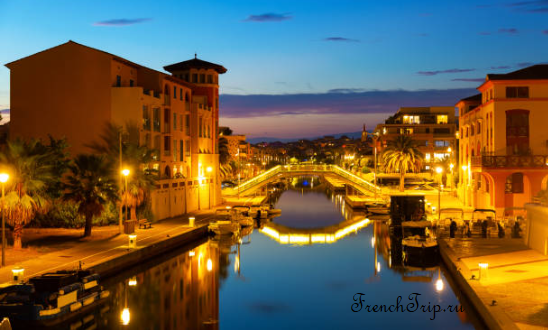
The modern marina between the old town and the beach, built in the 1980s in a Provençal style around the water. Restaurants and bars line the quays, and it is where the town spends its evenings.
Getting there
- By train — Fréjus has its own station on the coastal line. Direct trains from Nice, Antibes, Cannes, Menton and Monaco. Note that Saint-Raphaël next door has a separate station with more services, including TGV — it is 3 minutes away by train and often the better arrival point.
- Night train — a direct overnight service links Paris (Gare d’Austerlitz) with Fréjus and Saint-Raphaël.
- By bus — a dense coastal network, including the connection to Saint-Tropez.
- By air — Nice Côte d’Azur, about an hour, with a direct coach to Saint-Raphaël.
- By car — the A8 passes just north. See parking in France.
Markets
Fréjus has one of the better market calendars on this coast — the main one in the old town on Wednesday and Saturday mornings, and others at Port-Fréjus and Saint-Aygulf through the week. The full Provençal market schedule has the details.
Stalls sell local produce, lavender goods, table linen, and clothing — often local linen in pastel shades — alongside imported goods, much as at Provençal markets generally.
What to eat
Coastal Provençal cooking: fish from the port, bouillabaisse, aïoli, and the Côtes de Provence rosé from the vineyards immediately inland. More in Provençal cuisine.
Around Fréjus
- Saint-Raphaël — 3 minutes by train, and effectively the same town
- The Esterel massif — hiking through the red rock, with the coast below
- Saint-Tropez — around the gulf, or by boat from Saint-Raphaël in season
- Cannes — 25 minutes east
- Gorges du Verdon — about two hours inland
- Nice — under an hour by car
- Grasse — the perfume town, about 40 minutes inland
- Antibes — around 45 minutes east
- The Malpasset dam — ruins in the hills above the town; the dam collapsed in 1959 and flooded Fréjus
When to go
May to October for the beaches; the Roman sites are better out of high summer, when there is no shade among the stones. July and August fill the coast; September is the best compromise — warm sea, thinner crowds.
Where to park in Fréjus
| Car park | Spaces | Fee | From centre |
|---|---|---|---|
| Parc de Stationnement de la Porte Dorée | 90 | — | 200 m |
| Place Paul Vernet | — | paid | 210 m |
| Clos de la Tour | — | paid | 220 m |
| Parking Aubenas multi-storey | — | — | 240 m |
| Place Agricola | — | paid | 280 m |
| Parking de la gare | 25 | — | 280 m |
| Les moulins | — | free | 310 m |
| Parking de la Poste | — | — | 460 m |
Nearby
Other places on this site within easy reach, as the crow flies:
- Roquebrune-sur-Argens — 8 km
- Sainte-Maxime — 16 km
- Fayence — 21 km
- Port Grimaud — 22 km
- Gassin — 26 km
- Ramatuelle — 26 km
Weather in Fréjus
| Month | Day | Night | Rainfall |
|---|---|---|---|
| January | +13° | +4° | 70 mm |
| February | +14° | +4° | 52 mm |
| March | +16° | +6° | 50 mm |
| April | +19° | +9° | 70 mm |
| May | +22° | +12° | 44 mm |
| June | +26° | +16° | 32 mm |
| July | +29° | +19° | 16 mm |
| August | +29° | +19° | 27 mm |
| September | +26° | +15° | 81 mm |
| October | +21° | +12° | 116 mm |
| November | +17° | +8° | 132 mm |
| December | +14° | +5° | 97 mm |
This page in Russian: Fréjus (Фрежюс)
Updated: