Saint-Tropez
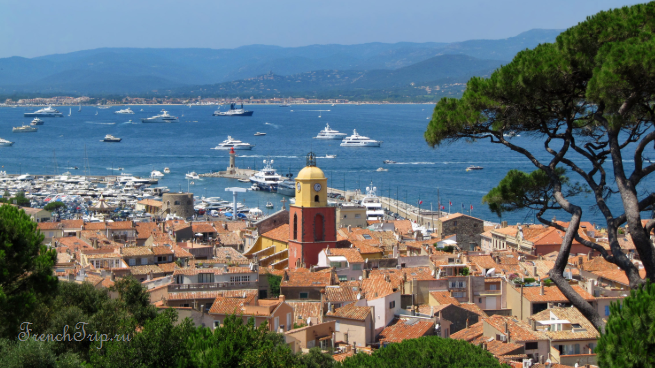
Saint-Tropez is the best-known resort on the French Riviera, and still recognisably the fishing village it was. Pastel houses face the old port, the citadelle stands on the hill above the old town, and the yachts moored along the quay are the reason half the visitors come.
It lies 76 km west of Cannes, near Fréjus and Saint-Raphaël, on the far side of the Gulf of Saint-Tropez.
The town’s reputation was built in stages. Paul Signac came in the 1890s and painted it; in the 1940s and 50s it became a summer annexe of the Paris Left Bank — Juliette Gréco, Boris Vian, Sartre, Picasso. Then Brigitte Bardot and And God Created Woman in 1956 turned it into shorthand for the glamorous South of France, and it has never quite escaped that.
Getting to Saint-Tropez
This is the awkward part, and worth reading before you plan. Saint-Tropez sits off the main transport routes and has no railway station of its own. Every approach involves a change.
By train and bus
The nearest station is Saint-Raphaël, on the main coastal line. From there bus 7601 runs to Saint-Tropez — about an hour and a quarter, longer in summer traffic. See regional trains in France.
From Nice airport
There is a direct coach from Nice Côte d’Azur airport to Saint-Raphaël, roughly two hours, and then the bus onward. A taxi the whole way is expensive — expect a fare in the hundreds of euros.
By car
The most practical way, and the only sensible one if you want the beaches. But the peninsula has a single road in, and in July and August it is genuinely congested — an hour to cover the last few kilometres is normal. Parking in town is paid and limited; see parking in France and toll roads.
By boat
Passenger boats cross the gulf from Sainte-Maxime and Saint-Raphaël in season. In high summer this is often the fastest way in, and much the most pleasant: you arrive at the old port rather than in a queue of traffic.
What to see
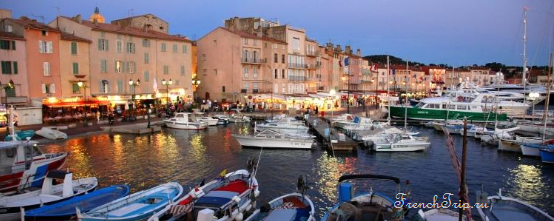
The old town and the port
Many of the buildings around the port are listed monuments. The quay is the promenade — busiest in the early evening, when the yachts put their tables out on deck and the crowd walks past looking at them.
Citadelle de Saint-Tropez
The seventeenth-century fortress on the hill is the main defensive work in the Var, and now houses the Musée d’histoire maritime. The walk up is short and the view over the gulf is the best in town.
Musée de l’Annonciade
A former chapel with an outstanding collection of modernist painting — Signac, Derain, Bonnard, Matisse — much of it painted in and around the town. It is the quietest place in Saint-Tropez in August, which tells you something about the average visitor.
Musée de la Gendarmerie et du Cinéma
The old gendarmerie on Place Blanqui, where the Le Gendarme de Saint-Tropez films were shot, is now a museum about the town on screen.
Place des Lices
The square behind the port, with plane trees and pétanque, and the market on Tuesday and Saturday mornings — one of the good ones on this coast.
Beaches
The town beaches are small, part sand and part shingle, and within walking distance. The famous ones are not in the town at all.
Plage de Pampelonne runs for about five kilometres along the peninsula, roughly 9 km from the centre. It is divided into separate beaches — some run by restaurants and beach clubs with loungers to hire, some free and open, and one traditionally naturist near the northern end. The sand is pale and the water is the colour that put the coast on postcards.
Getting there: a bus runs from the Gare Routière, but it leaves you a kilometre or so from the water and there are only a handful of services a day. A car is far easier, with paid parking behind the beach. Taxis cost more than the bus by an order of magnitude.
See also the best beaches in Provence-Alpes-Côte d’Azur and the ten most beautiful beaches in France.
What to eat
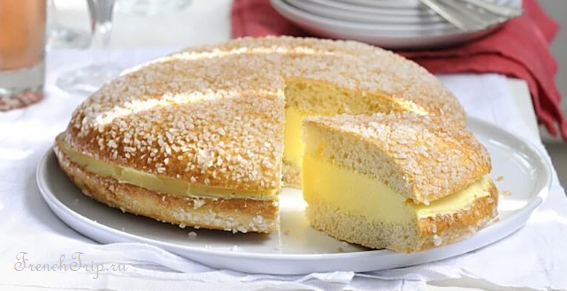
The town has its own cake. Tarte tropézienne is a brioche split and filled with a cream somewhere between crème pâtissière and buttercream, invented by a Polish baker in the 1950s and named, the story goes, by Bardot herself during the filming of And God Created Woman.
Otherwise the cooking is Provençal and coastal: grilled fish, soupe de poisson with rouille, ratatouille, and the rosé of the Côtes de Provence, which is made in the vineyards immediately behind the town. More in Provençal cuisine.
When to go
July and August are the high season and the town is at its most crowded and most expensive. May, June and September are far better: the sea is warm enough by June, the traffic is bearable, and the restaurants are the same.
Late September brings Les Voiles de Saint-Tropez, the classic yacht regatta — the harbour fills with sailing boats rather than motor yachts, and it is the one week when the town looks like its own postcards for a good reason.
See when to visit Provence and the festival calendar.
Nearby
- Ramatuelle and Gassin — hilltop villages just inland, above the Pampelonne vineyards
- Port Grimaud — a modern village built on canals across the gulf; see the Port Grimaud guide
- Sainte-Maxime — across the water, and the boat back is part of the appeal
- Saint-Raphaël and Fréjus — the nearest railway and Roman remains
For more of the region, see what to do in Provence.
Where to park in Saint-Tropez
| Car park | Spaces | Fee | From centre |
|---|---|---|---|
| Parking du XVème Corps | 80 | paidmax 3.4 h | 350 m |
| Parking des Lices underground | — | paid | 520 m |
| Parking du Nouveau Port | — | paid | 610 m |
Weather in Saint-Tropez
| Month | Day | Night | Rainfall |
|---|---|---|---|
| January | +14° | +3° | 96 mm |
| February | +15° | +3° | 76 mm |
| March | +17° | +5° | 70 mm |
| April | +20° | +8° | 82 mm |
| May | +24° | +11° | 59 mm |
| June | +29° | +14° | 32 mm |
| July | +32° | +17° | 14 mm |
| August | +32° | +17° | 21 mm |
| September | +28° | +13° | 74 mm |
| October | +23° | +11° | 136 mm |
| November | +17° | +7° | 178 mm |
| December | +14° | +4° | 121 mm |
Updated: