Cannes
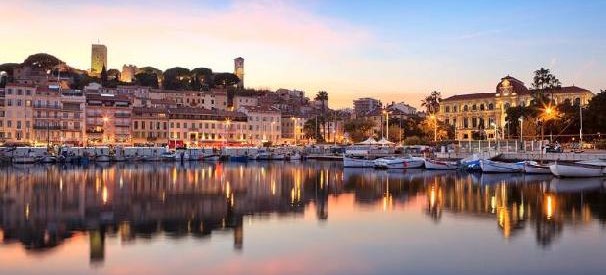
Cannes sits on the French Riviera, in the Provence-Alpes-Côte d’Azur region, halfway between Nice and Saint-Tropez. It began as a fishing village and became one of the most expensive resorts in Europe — and, for two weeks every May, the centre of the film world.
The town is busiest during the Cannes Film Festival in mid-May, when the Palais des Festivals at the end of the Croisette fills with actors and directors. Prices double, rooms sell out months ahead, and much of the seafront is closed to the public. If you are coming for the beaches rather than the red carpet, avoid that fortnight.
Getting to Cannes
By plane. The nearest airport is Nice Côte d’Azur, about 25 km east — the second busiest in France after Paris. Buses run from the airport directly to Cannes bus station in roughly 50 minutes.
By train. Cannes has an SNCF station on the main coastal line. Direct trains run from Paris by TGV in about 5 hours 30 minutes, and there are frequent regional services from Nice (about 30 minutes), Antibes (15 minutes) and Monaco (1 hour). See regional trains in France for how the TER network works.
By car. The A8 motorway runs past the town. Note that it is a toll road, and that parking in Cannes is expensive and scarce in summer — most visitors leave the car in a paid underground car park near the centre.
By bus. The coastal bus network along the Riviera is cheap and frequent, and connects Cannes with Nice, Antibes, Grasse and the smaller towns between them.
Tourist office
- 1 Boulevard de la Croisette, 06400 Cannes
- Tel. +33 4 92 99 84 22
- Open daily 10:00–19:00
- cannes-destination.fr
What to see in Cannes
Le Suquet — the old town
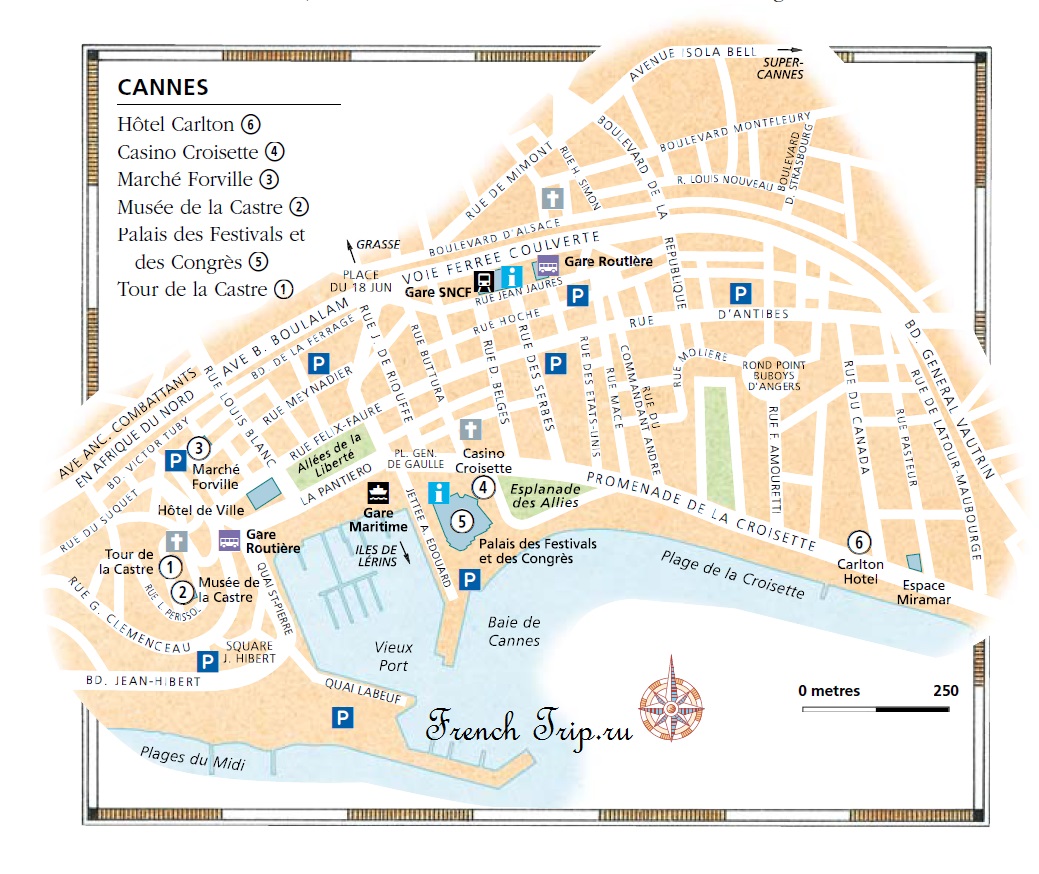
The oldest part of Cannes is a network of narrow streets climbing the hill west of the port, lined with restaurants and small shops. The reward is at the top: the ruins of the medieval castle and the best view over the bay and the Lérins islands.
Marché Forville
The covered market is the place to see what Provençal cooking actually uses — fish landed that morning, vegetables from the hinterland, olives and cheeses. It stands at the western end of rue Meynadier, one of the best food streets on the coast. Closed on Mondays outside the summer season.
Palais des Festivals
At the western end of the Croisette stands the building that made the town famous. Outside the festival it is an ordinary conference centre, but the red-carpet steps and the handprints of film stars on the pavement around it are there all year.
The port
Rows of yachts belonging to owners who may or may not be famous. The genuinely enormous boats tend to moor at Antibes rather than here.
La Croisette
The seafront promenade, and the reason many people come. The grandest hotels and the most expensive shops in town line it, along with the private beaches that belong to them. Walking it end to end takes about half an hour.
Îles de Lérins
Two islands in the bay, twenty minutes offshore, and the best half-day trip from Cannes.
Saint-Honorat is the smaller one, still home to a working Cistercian monastery. The monks make wine and liqueurs, sold at the abbey shop — an unusual souvenir, and one that does not exist anywhere else. There are also the ruins of a fortified monastery on the shore.
Sainte-Marguerite is larger and has the fort where the Man in the Iron Mask was held, plus shops, bars and restaurants. It is popular for snorkelling.
Ferries leave roughly every hour from the old port. Ticket prices and timetables change from year to year — check the current ones at the port or at the tourist office before you go.
Beaches
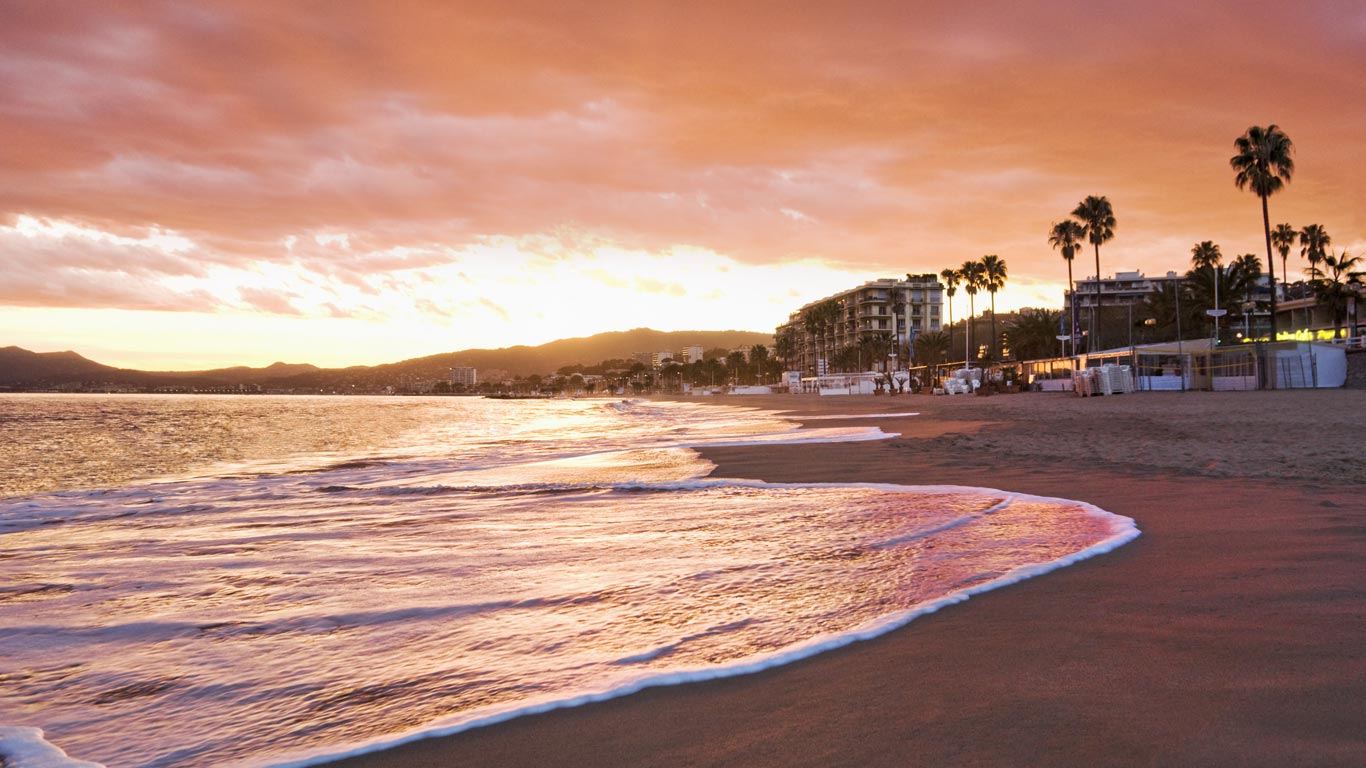
The beaches along the Croisette are mostly private and belong to the hotels: you pay for a sunbed and the strip of sand around it. There are free public sections between them, and a longer public beach west of the port, past the old town. Most of the coast here is sand rather than the pebbles you find further east around Nice.
For alternatives along this stretch of coast, see the best beaches in Provence-Alpes-Côte d’Azur.
Where to eat
Restaurants on the Croisette charge for the view. Better value is inland — around rue Meynadier and in the old town, where local Provençal cooking is easier to find at ordinary prices.
What to look for on the menu: soupe au pistou, ratatouille, pissaladière, grilled fish with local olive oil, and the aïoli that comes with almost everything. More on this in Provençal cuisine.
With the food, the wines of the coast: the rosés of Côtes de Provence, which are drunk here more than anything else. See wine routes in France.
Around Cannes
Cannes works well as a base for the western Riviera. Within an hour by train or bus:
- Antibes — old town inside Vauban’s ramparts, the Picasso museum, and the largest yacht harbour on the coast
- Grasse — the perfume town, 30 minutes inland and noticeably cooler in summer
- Saint-Paul-de-Vence — hilltop village, galleries, and the Fondation Maeght
- Nice — 30 minutes by train, and the transport hub for the whole coast
- Monaco and Menton — an hour east, at the Italian border
Further afield, see what to do in Provence and the festival calendar — the Riviera has far more of them than the film festival alone.
When to go
May and September are the best months: the sea is warm enough, the crowds are thinner and prices are lower than in July and August. Avoid the festival fortnight in mid-May unless that is why you are coming. Winter is quiet, mild and cheap, but many beach restaurants close.
See when to visit Provence for month-by-month temperatures.
Where to park in Cannes
| Car park | Spaces | Fee | From centre |
|---|---|---|---|
| Parking Pantiero underground | 560 | paid | 80 m |
| Suquet-Forville multi-storey | 950 | paid | 330 m |
| Parking Palais underground | 924 | paid | 360 m |
| Parking Vauban multi-storey | — | paid | 420 m |
| Place des Orangers | — | — | 460 m |
| Parc Laubeuf | 346 | paid | 500 m |
| Parking Vallombrosa | 24 | paid | 540 m |
| Parking Saint-Nicolas underground | 420 | — | 600 m |
Weather in Cannes
| Month | Day | Night | Rainfall |
|---|---|---|---|
| January | +14° | +4° | 82 mm |
| February | +14° | +4° | 57 mm |
| March | +16° | +6° | 60 mm |
| April | +18° | +9° | 78 mm |
| May | +22° | +13° | 52 mm |
| June | +26° | +16° | 32 mm |
| July | +28° | +19° | 19 mm |
| August | +29° | +19° | 24 mm |
| September | +25° | +15° | 92 mm |
| October | +21° | +12° | 134 mm |
| November | +17° | +8° | 145 mm |
| December | +14° | +5° | 105 mm |
Updated: