Arles
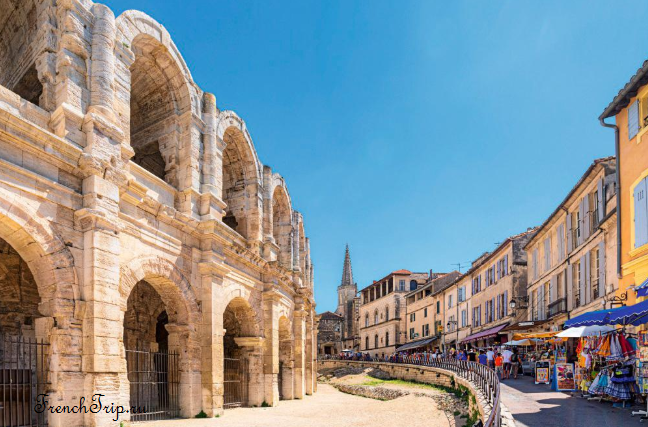
Arles sits on the Rhône in western Provence, south of Avignon and between Marseille and Nîmes. It has two claims on your attention: it was one of the great cities of Roman Gaul, and Van Gogh painted 300 canvases here in fifteen months.
It is also the gateway to the Camargue, the delta immediately south — which is why there are bulls in the arena and white horses on the postcards.
The Roman and Romanesque monuments of Arles are on the UNESCO World Heritage list.
Roman Arles
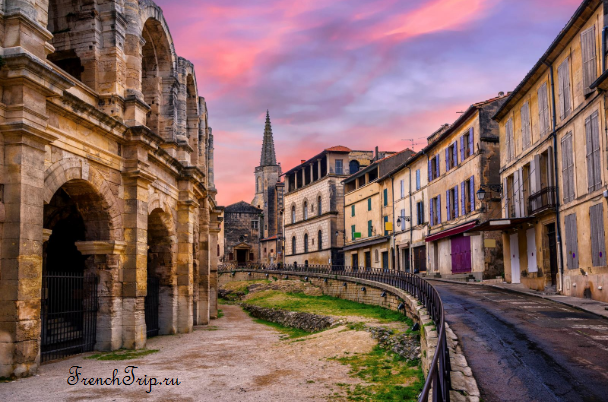
Les Arènes
The amphitheatre, built in the first century, held around 20,000 people. What makes it unusual is what happened next: in the Middle Ages the town moved inside it, walling up the arches and building two hundred houses and two chapels in the arena. Three of the medieval defensive towers survive on top, and climbing one gives the best view over the roofs.
It is still in use — for bullfights during the ferias and for concerts.
Théâtre Antique
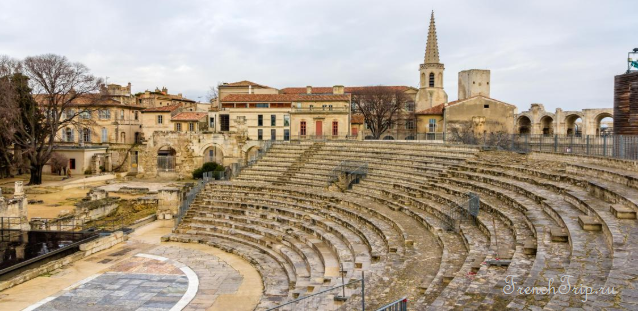
Augustus began it in the first century BC. Very little is left standing — two Corinthian columns, and the tiers — because the stone was quarried for churches and walls. The Venus of Arles, now in the Louvre, was dug up here in 1651. One ticket covers both the theatre and the amphitheatre.
The rest of it
- The Cryptoporticus — the underground galleries that supported the Roman forum, running beneath the town
- The Baths of Constantine — fourth-century imperial baths by the river
- Alyscamps — the Roman necropolis, an avenue of stone sarcophagi outside the walls, painted by both Van Gogh and Gauguin
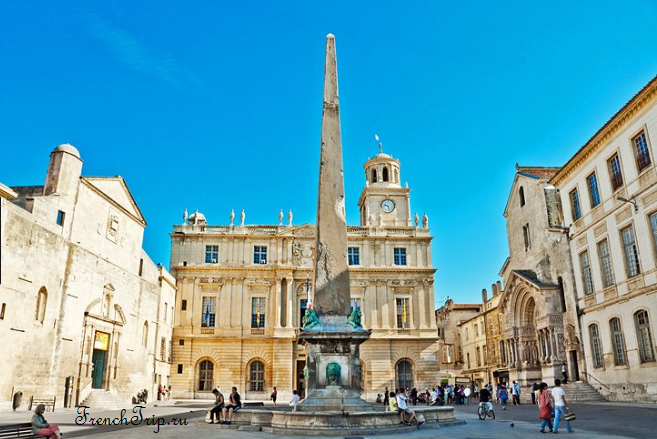
- The obelisk — 15 m of red granite from the Roman circus, now standing on Place de la République
- Musée départemental Arles antique — the archaeological museum, with the mosaics and a complete Roman barge raised from the Rhône in 2010
Saint-Trophime
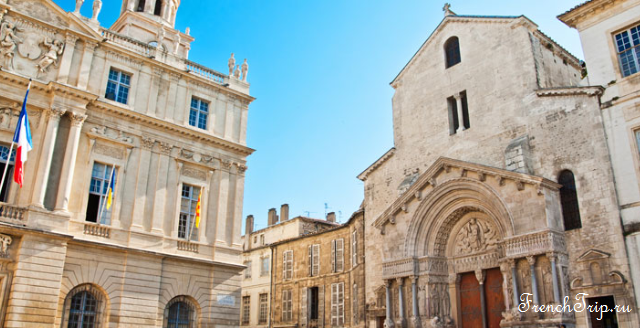
On Place de la République: a twelfth-century church whose west portal is one of the finest pieces of Romanesque sculpture in France — a Last Judgement across the whole front, with the damned filing off to the right in a chain. The cloister beside it, half Romanesque and half Gothic, is quieter than anything else in the centre.
Van Gogh in Arles
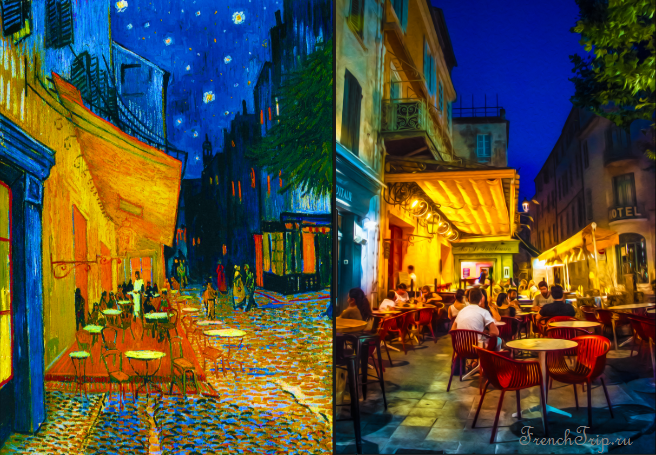
Vincent van Gogh arrived in February 1888 looking for southern light and stayed until May 1889. In those fifteen months he painted around 300 works, including The Yellow House, The Bedroom, the sunflowers, the Alyscamps, the drawbridge and Café Terrace at Night. Gauguin came to join him in October and left in December, after the episode with the ear.
None of the paintings are in Arles — they are in Amsterdam, Paris, New York. What is here are the places, and the town has marked them with panels showing the canvas at the spot it was painted:
- Place du Forum — the café of Café Terrace at Night, on the site of the Roman forum under plane trees. It trades on it heavily.
- Espace Van Gogh — the hospital where he was treated after cutting his ear, its courtyard garden replanted to match his painting of it
- The Alyscamps, the Rhône quay of Starry Night over the Rhône, and the Langlois bridge south of town (rebuilt, and not on the original spot)
The Fondation Vincent Van Gogh Arles runs exhibitions that pair one or two loaned Van Goghs with contemporary artists responding to him — worth checking what is on.
The tourist office sells a walking map of the ten sites for a euro or so.
Also worth seeing
- Musée Réattu — in a Knights of Malta priory on the river, with 57 drawings Picasso gave the town
- Place du Forum and the Grand Hôtel Nord-Pinus, where the bullfighters stay
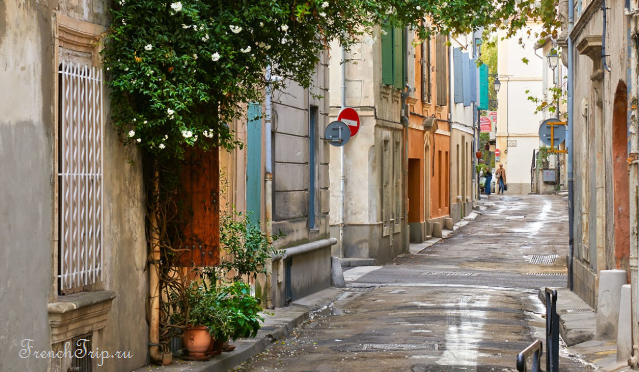
- The old streets north of the arena, which are the pleasant part of walking here
- LUMA Arles — Frank Gehry’s crumpled steel tower on the old railway yards, visible from everywhere and not to everyone’s taste
Markets
The Saturday market is one of the largest in Provence: 2.5 km of stalls and around 400 traders along Boulevard des Lices, Georges-Clemenceau and Émile-Combes, 8:00 to 12:45. There is a smaller version on Wednesday mornings on Boulevard Émile-Combes, and a brocante on the first Wednesday of the month.
What to eat

Arles has its own dishes on top of the Provençal repertoire: saucisson d’Arles, grilled viande de taureau (bull, from the Camargue), bœuf gardianne stewed with red wine and olives, catigot d’anguilles — eel — and tomme d’Arles, a sheep’s cheese sold under several names depending on how long it has aged.
See Provençal cuisine and French wines.
Festivals
- Feria de Pâques and Feria du Riz — Easter and September, bullfighting in the arena and the whole town in the streets
- Rencontres d’Arles — the international photography festival, July to September, which takes over every available building and is the town’s biggest cultural event
- Fête du costume — early July, a tribute to the Arlésienne costume, a tradition revived by the poet Frédéric Mistral
- Reine d’Arles — a new Queen of Arles elected every three years in May, another Mistral invention, from 1930
- La Pégoulade — a costume parade on the last Friday of June, going back to 1830
Getting to Arles
- By train — regional trains roughly hourly from Avignon (20 min), Nîmes (20 min) and Marseille (about 55 min). The station is a short walk north of the centre.
- By bus — local services to Saint-Martin-de-Crau, Salin-de-Giraud, Saintes-Maries-de-la-Mer and Tarascon, at a flat fare of about a euro.
- By car — park outside the ring and walk in; the centre is narrow and mostly one-way. See parking in France.
The centre is small enough to cross on foot in twenty minutes, which makes Arles a good base for the whole area.
Around Arles
- The Camargue — flamingos, bulls and white horses, starting immediately south
- Saintes-Maries-de-la-Mer — the pilgrimage town on the delta coast
- Avignon — 20 minutes by train
- Nîmes — 20 minutes the other way, with a better-preserved arena
- Les Baux-de-Provence and the Alpilles — half an hour north-east
When to go
April to June and September to October. July and August are hot and the photography festival fills the town; the ferias fill it differently. Winter is quiet, and the Roman stones look better without the glare.
See when to visit Provence and thematic routes in Provence.
Where to park in Arles
| Car park | Spaces | Fee | From centre |
|---|---|---|---|
| Place Henri de Bornier | — | paid | 90 m |
| Parking Rempart de Villeneuve-Zone verte | — | paid | 190 m |
| Parking Zone Blanche | — | paid | 250 m |
| Zone Jaune | — | paid | 270 m |
| Parking Zone Verte | — | paid | 270 m |
| Parking Zone Rouge | — | paid | 280 m |
| Place André Suares | — | paid | 290 m |
| Zone Rouge | — | paidmax 2.5 h | 320 m |
Weather in Arles
| Month | Day | Night | Rainfall |
|---|---|---|---|
| January | +11° | +3° | 51 mm |
| February | +12° | +4° | 33 mm |
| March | +17° | +6° | 37 mm |
| April | +19° | +9° | 63 mm |
| May | +24° | +12° | 47 mm |
| June | +28° | +16° | 31 mm |
| July | +31° | +19° | 28 mm |
| August | +31° | +18° | 32 mm |
| September | +26° | +15° | 96 mm |
| October | +21° | +12° | 89 mm |
| November | +15° | +7° | 92 mm |
| December | +11° | +4° | 43 mm |
Updated: