Nice
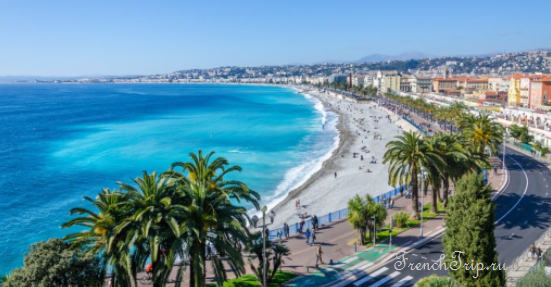
Nice is the capital of the French Riviera and the practical base for the whole coast: the region’s airport is here, the coastal railway runs through it, and almost everything between Cannes and the Italian border is within an hour.
It is also a city in its own right rather than a resort — an old Italian town with a French seafront bolted on. Nice belonged to the House of Savoy until 1860, and the old quarter still looks and eats more Italian than French.
The mild winter is part of the point. The city was built as a winter resort for northern Europeans in the nineteenth century, which is why the grand hotels face the sea and the season peaks twice.
Nice has also drawn Russian visitors since the middle of the nineteenth century, a fashion said to have been set by the dowager empress Alexandra Feodorovna, and it has never really faded since.
Getting to Nice and around
From the airport
Nice Côte d’Azur is the busiest airport in France after the Paris pair, and unusually close to the city — about 7 km along the coast.
- Tram line 2 runs from both terminals to the port and the centre. It is the cheapest and usually the fastest option.
- Express buses serve the centre and onward destinations along the coast.
- Nice Saint-Augustin station is beside the airport, with regional trains along the coast — useful if you are heading straight to Antibes, Cannes or Monaco without going into Nice.
By train
Nice-Ville is on the main coastal line: Monaco is about 20 minutes, Cannes 30, Menton 35, and the Italian border a little over an hour. TGV services run to Paris. See trains in France and how the regional network works.
Around the city
Nice is walkable. The old town, the port, the seafront and the hill are all within half an hour of each other on foot, and the tram covers the rest. A car is a liability rather than an asset here — see parking in France if you have one.
What to see
Promenade des Anglais
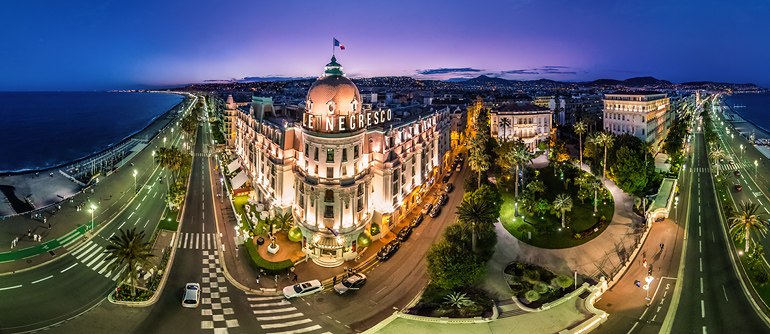
The seafront avenue, seven kilometres of it, with palms in front of Belle Époque hotels — the Negresco and the Westminster among them. The beaches below are pebble, not sand, in grey and blue: worth knowing before you pack, because it changes what shoes you need and whether you want a mat.
Many of the cafés and restaurants along the promenade have terraces looking straight out over the bay.
Beaches
The city beaches are shingle — large, flat stones — rather than sand; a few private beaches bring sand in instead. Pack sandals for the stones and something to sit on. Public beaches have free showers and there is a beach-volleyball court on imported white sand. The sea deepens quickly just offshore and can run a real current, so it is not really a beginner’s swim. Private beach clubs rent loungers and run their own restaurants and bars, at a price. For sand without qualification, the nearby towns of Villefranche-sur-Mer, Antibes and Cannes do better — Villefranche-sur-Mer is often reckoned particularly good for families; see also the region’s best beaches.
Vieux Nice
The old town is a knot of narrow streets between the hill and the sea, with pale ochre facades and turquoise shutters. It is the part of the city that gives away its Italian past — in the architecture, in the food, and in the fact that dinner starts late.
Locals sometimes call the old town Nissa la bella — old Nice the beautiful — after the Niçard-language anthem of the city. Ice cream is taken seriously here too, and the local version is said by some to rival the Italian ice cream just over the border.
Colline du Château
The castle itself is long gone, but the hill above the old town is a park with a waterfall and the classic view down over the terracotta roofs and the curve of the Baie des Anges. There is a lift up from the seafront end for those who would rather not climb.
Cours Saleya
The market square at the edge of the old town: flowers and produce every day except Monday, when it becomes an antiques market instead. Mornings only.
By evening the square turns into one of the busiest strips of restaurants, bars and café terraces in the old town.
Museums
Nice has an unusually good spread for a city this size — Matisse and Chagall both have museums here, and the Musée des Beaux-Arts and the modern art museum are worth the detour if the weather turns.
The Matisse museum is in Cimiez, the hill district north of the centre, and sets out some of his best-known work along a single route through the building. Cimiez also holds the archaeological museum and the International Museum of Naive Art.
Nice Carnival
The carnival in February is one of the biggest in France and the reason the city has a second high season in winter. Two weeks of parades, floats and the bataille de fleurs — flowers thrown from the floats into the crowd. Hotels book up well ahead; see the festival calendar.
It is among the largest of France’s carnivals before Lent; see carnivals in France for how it compares. The rest of the year has its own calendar: a pop-culture festival in February, a sacred-music festival and a midsummer music festival in June, an Ironman triathlon also in June, free open-air concerts running through the summer, a jazz festival in July, an alternative classical-music festival in November, and a Christmas market in December.
What to eat
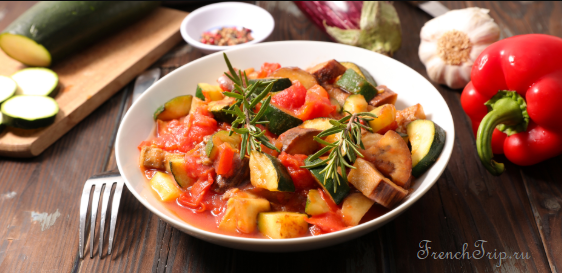
Nice has its own cooking, distinct from the rest of Provence and closer to Liguria. The things to look for:
- Socca — a thin chickpea-flour pancake baked on a copper tray over wood, served hot in torn pieces with black pepper. Street food, best from a stall in the old town, and gone by early afternoon.
- Salade niçoise — the real one has no cooked vegetables and no lettuce, whatever your local version does.
- Pan bagnat — the same salad packed into a round loaf soaked in olive oil. The local lunch.
- Ratatouille and pissaladière, the onion and anchovy tart.
- Soupe de poisson with rouille, croutons and grated cheese.
More in Provençal cuisine and traditional dishes of France.
What to drink
Nice sits inside Côtes de Provence AOC, which produces about three quarters of all Provençal wine and is overwhelmingly rosé — light, dry and cold, and the natural partner to everything above. There is a marked wine route through the vineyards behind the coast: see wine routes in France and the best-known French wines.
The wine route behind the coast has a name of its own — the Route des vins des Côtes de Provence — and takes in most of the appellation’s producers.
Shopping
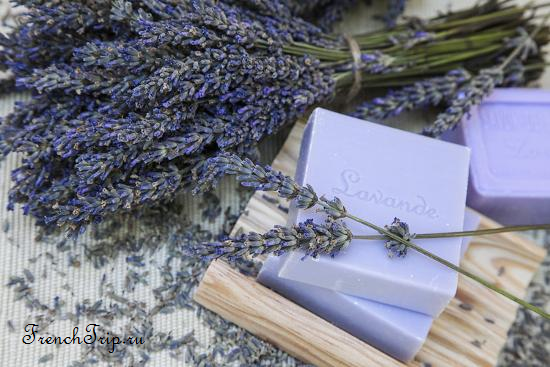
The old town is full of shops selling the standard Provençal repertoire — lavender, herbs, spices, soap, scented candles. The better version of the same thing is the market: local oil, cheese, charcuterie and honey travel well and are worth more than a souvenir.
The Provençal markets run on a fixed weekly rota across the region; the full market schedule is worth checking before you plan a day out.
Tapenade and other local sauces travel well too, and do more for a dinner back home than a souvenir shop’s magnets and trinkets ever could. Local soaps scented with herbs, and boxed sets of dried thyme, rosemary and lavender, are worth a look for the same reason. See souvenirs from Provence for more ideas.
Day trips from Nice
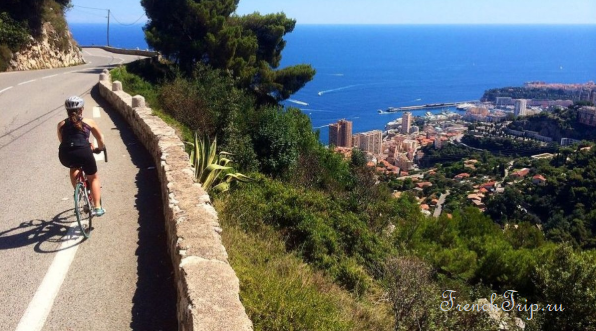
This is what Nice is best at. Everything below is an easy half or full day, mostly by train:
- Èze — the hilltop village, 20 minutes east
- Monaco — 20 minutes by train
- Villefranche-sur-Mer — the deep bay immediately east, ten minutes away
- Antibes — old town, ramparts and the Picasso museum
- Cannes — 30 minutes west
- Menton — 35 minutes, at the Italian border, with the mildest climate on the coast
Three corniche roads run east from the city at different heights. The Grande Corniche, the highest, follows the Roman Via Julia and has the widest views — it is the drive people remember.
When to go
May, June and September are the best months: warm sea, tolerable crowds, lower prices. July and August are hot and full. February brings the carnival. Winter is mild, quiet and cheap, and the museums are empty — which is exactly why the city was built.
Where to park in Nice
| Car park | Spaces | Fee | From centre |
|---|---|---|---|
| Parking Nicetoile underground | 2,200 | paid | 50 m |
| Parking Longchamp underground | — | — | 140 m |
| Place Eugène Mo | — | paid | 210 m |
| Parc Autos Hancy multi-storey | — | paid | 320 m |
| Parking Louvre underground | 350 | paid | 340 m |
| Massena underground | — | paid | 380 m |
| Parking Mozart underground | 300 | paid | 520 m |
| Parking Corvésy multi-storey | — | paid | 560 m |
Nearby
Other places on this site within easy reach, as the crow flies:
- Saint-Jean-Cap-Ferrat — 5 km
- Aéroport de Nice — 6 km
- La Turbie — 12 km
- Saint-Paul-de-Vence — 12 km
- Vence — 13 km
- Biot — 16 km
Weather in Nice
| Month | Day | Night | Rainfall |
|---|---|---|---|
| January | +13° | +6° | 74 mm |
| February | +13° | +6° | 54 mm |
| March | +15° | +8° | 51 mm |
| April | +17° | +11° | 69 mm |
| May | +21° | +14° | 40 mm |
| June | +25° | +18° | 36 mm |
| July | +27° | +21° | 14 mm |
| August | +28° | +21° | 17 mm |
| September | +25° | +18° | 81 mm |
| October | +21° | +14° | 128 mm |
| November | +17° | +10° | 138 mm |
| December | +14° | +7° | 90 mm |
This page in Russian: Ницца (Nice)
Updated: