Monaco
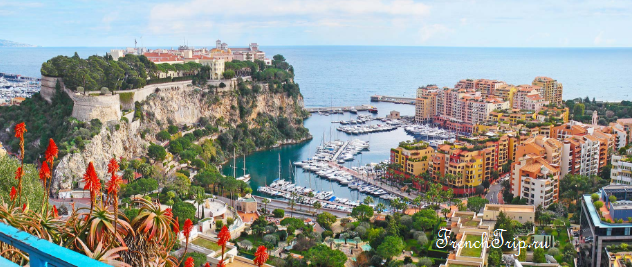
Monaco is the second-smallest country in the world and the most densely populated. It occupies 2 km² of the French Riviera near the Italian border, is entirely surrounded by France, and has belonged to the Grimaldi family since 1297 — one of the longest continuous reigns in Europe.
Somerset Maugham, who lived nearby, called it “a sunny place for shady people”. The line has stuck because it is roughly half true: this is a genuine principality with a genuine history, wrapped in the most concentrated display of money on the Mediterranean.
The four quarters
Monaco divides into four, and knowing which is which saves confusion:
- Monaco-Ville — the old town, on a rock 60 m above the sea, usually just called Le Rocher. The palace, the cathedral and the oceanographic museum are here, and it is the only part that looks medieval.
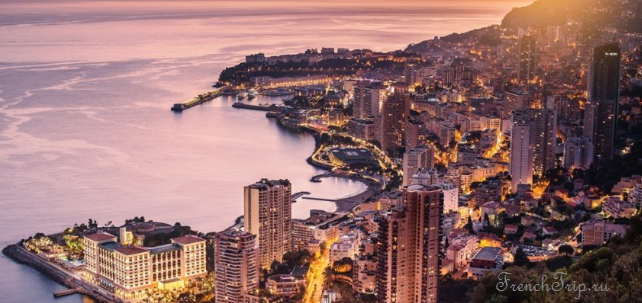
- Monte-Carlo — north-east, and what most people mean by Monaco: the casino, the grand hotels, the shopping.
- La Condamine — the harbour district between the two, with Port Hercule and the market.
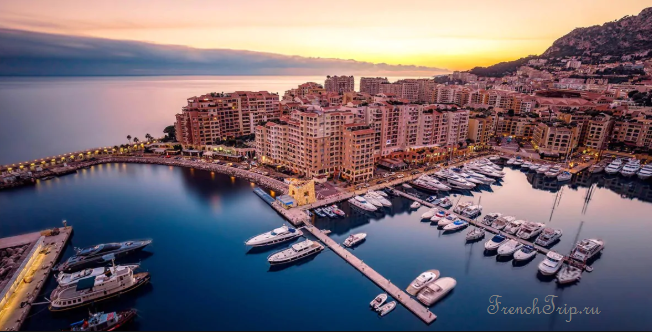
- Fontvieille — reclaimed from the sea, with the second harbour, the stadium and several museums.
Monaco-Ville — the Rock
The Prince’s Palace
Begun as a Genoese fortress in 1191 and Grimaldi property since the end of the thirteenth century. Because Monaco was small and its neighbours were not, the family had to build a fortress rather than a pleasure palace — which is why it looks the way it does, and why it is unusual: the same dynasty has occupied the same building for over 700 years. The state apartments open to visitors in summer.
The changing of the guard on the Place du Palais happens daily at 11:55, and is the free set-piece everyone comes for.
Musée Océanographique
Founded over a century ago by Prince Albert I, a serious oceanographer, and built into the cliff face above the sea. The aquarium below holds water from 90 seas and is one of very few anywhere keeping live coral, which normally does not survive captivity. Jacques Cousteau directed it for over thirty years. Allow around two and a half hours.
Cathédrale Notre-Dame-Immaculée
Built in 1875 in white stone from La Turbie, on the site of a thirteenth-century church. It holds altarpieces by the Niçois painter Louis Bréa and the tombs of the princes — including Grace Kelly, which is what most visitors are there to see.
Also on the Rock
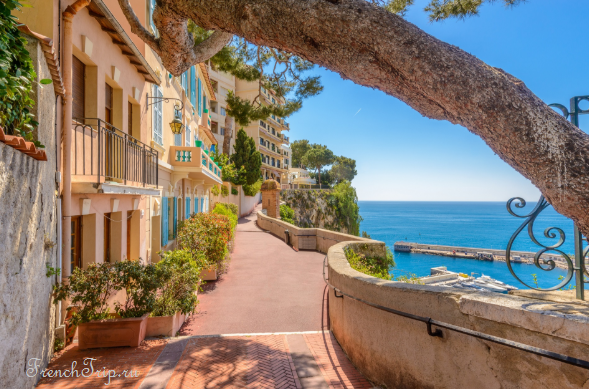
Fort Antoine (1710), the eighteenth-century carabinier barracks, the Jardin Saint-Martin — pines, agaves and bronze sculpture on the cliff edge, with the sea below — and the Napoleon museum in a wing of the palace.
Monte-Carlo
The Casino
The reason Monaco is rich. Prince Charles III decided in 1856 that a casino would solve the state’s finances; the first attempt failed, so he brought in François Blanc, who had run the casino at Bad Homburg. The present Belle Époque building went up in 1879 to designs by Charles Garnier, architect of the Paris opera.
It worked so well that the Grimaldis stopped levying income tax on residents — a situation that has held ever since, and which explains a great deal about the place. The operating company, now Groupe Monte-Carlo SBM, still owns it.
You can walk into the atrium free; the gaming rooms charge admission and enforce a dress code, and Monegasque citizens are not allowed to gamble. It has appeared in Never Say Never Again, GoldenEye and a good deal else.
Opéra de Monte-Carlo
The Salle Garnier, attached to the casino and by the same architect, opened in January 1879 with Sarah Bernhardt on the stage. It was built in eight months, which required closing the casino for the duration. The interior carries work by Picasso, Léon Zack and Yves Brayer among others, and the Ballets Russes were based here under Diaghilev.
Hôtel de Paris
On the Place du Casino since 1864, and holder of the largest private wine cellar in the world — around half a million bottles in tunnels under the building. In 1987 Prince Rainier III asked a 31-year-old Alain Ducasse to open a restaurant in it; by 1990 Le Louis XV had three Michelin stars, the first hotel restaurant ever to hold them.
The Grand Prix
The Monaco Grand Prix has run since 1929 and has been part of the Formula One world championship since 1950. The circuit is the public street plan — Sainte-Dévote, the hill to Casino Square, the tunnel, the harbour chicane — closed for the weekend and unchanged in its essentials for ninety years.
Practical consequence: for about two weeks either side of the race in late May, hotel prices multiply, much of the principality is fenced off and several museums close. Plan around it in one direction or the other.
Gardens and the rest
- Jardin Exotique — thousands of succulents on a cliff face, with a stalactite cave beneath it and the best view over the whole principality
- Japanese Garden — 7,000 m² by the sea, with the stone, water, tea house and lanterns brought from Japan
- Rue Princesse Caroline — the pleasant pedestrian street in La Condamine, orange trees and cafés
- Prince Rainier III’s car collection at Fontvieille — around a hundred cars and six state carriages
- Nouveau Musée National — modern art in two villas, Paloma and Sauber
- Stamp and coin museum — from Monaco’s first stamp of 1885 and coinage back to 1640; small, cheap and better than it sounds
Port Hercule
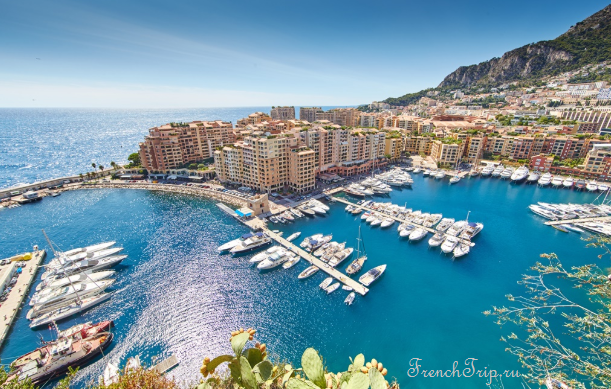
The natural harbour, extended artificially, plus the second basin at Fontvieille. Ninety-nine per cent of it belongs to the prince. Oddly, mooring fees here are lower than at neighbouring Riviera ports — though you may wait a couple of hours for a berth.
Grace Kelly
The marriage of Prince Rainier III to the American actress Grace Kelly in 1956 turned a small tax haven into a global brand. They had met at the Cannes film festival. There was also a constitutional motive: under a 1918 treaty, Monaco would have reverted to French protection if the Grimaldi line failed, so the birth of Prince Albert in 1958 was a matter of state as much as family.
Grace died in 1982 after losing control of her car on the corniche above the principality; Rainier died in 2005.
Getting to Monaco
- By train — the easiest way. Monaco-Monte-Carlo station is underground in the middle of the principality, with frequent local trains from Nice (about 20 minutes), Menton (10 minutes), Antibes and Cannes. Night trains run from Paris.
- By bus — the coastal 100 from Nice via Villefranche and Èze; slow, cheap and much the better view.
- By air — Nice Côte d’Azur, 30 minutes by road, or seven minutes by helicopter if that is the sort of trip you are having.
- By car — the corniche roads and the A8. Driving in is a poor idea: everything is one-way, steep and underground. Park at the border and take the train, or use the public lifts and escalators that connect the levels — they are free and they save a great deal of climbing.
What to know
- Monaco is not in the EU but uses the euro and is inside the Schengen area — in practice you cross without noticing.
- Dress codes are real in the casino and the grander hotels.
- The whole state is walkable end to end in about half an hour on the flat parts, and it is emphatically not flat. Use the lifts.
- A day trip from Nice is the standard way to do it, and it works.
Around Monaco
- Èze — the hilltop village 10 minutes west
- Menton — 10 minutes east, and the last town before Italy
- La Turbie — the Roman Trophy of the Alps on the ridge above
- Roquebrune-Cap-Martin — a medieval village and Le Corbusier’s cabin, next door
- Nice — 20 minutes by train
When to go
May to October, avoiding the Grand Prix fortnight unless that is why you are coming. Winter is mild and much cheaper, and the Rock is far more pleasant without the cruise crowds.
Where to park in Monaco
| Car park | Spaces | Fee | From centre |
|---|---|---|---|
| Parking du Chemin des Pêcheurs multi-storey | — | paid | 130 m |
| Parking de la Digue multi-storey | 84 | paid | 290 m |
| Parking du Quai Antoine 1er underground | 100 | paid | 310 m |
| Parking de l'Abbaye | — | paid | 430 m |
| Parking de la Condamine underground | — | paid | 510 m |
| Parking du Square Gastaud underground | — | paid | 580 m |
| d'Ostende underground | — | paid | 650 m |
| Parking du centre commercial underground | — | paid | 800 m |
Nearby
Other places on this site within easy reach, as the crow flies:
- La Turbie — 3 km
- Roquebrune-Cap-Martin — 4 km
- Saint-Jean-Cap-Ferrat — 9 km
- Aéroport de Nice — 19 km
- Saint-Paul-de-Vence — 25 km
- Vence — 25 km
Weather in Monaco
| Month | Day | Night | Rainfall |
|---|---|---|---|
| January | +13° | +6° | 74 mm |
| February | +13° | +6° | 54 mm |
| March | +15° | +8° | 51 mm |
| April | +17° | +11° | 69 mm |
| May | +21° | +14° | 40 mm |
| June | +25° | +18° | 36 mm |
| July | +27° | +21° | 14 mm |
| August | +28° | +21° | 17 mm |
| September | +25° | +18° | 81 mm |
| October | +21° | +14° | 128 mm |
| November | +17° | +10° | 138 mm |
| December | +14° | +6° | 90 mm |
This page in Russian: Monaco (Монако)
Updated: