Menton
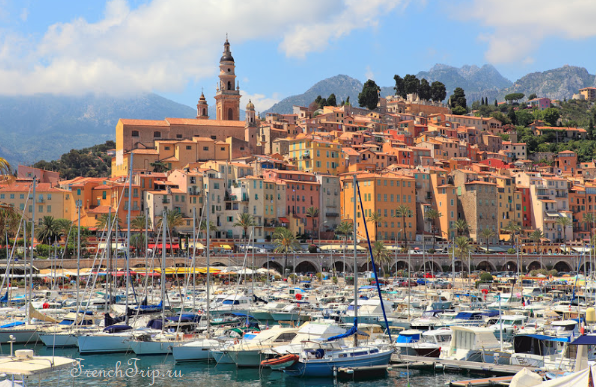
Menton is the last French town before Italy, and it looks it: ochre and pink facades stacked up the hillside, shutters in green, a bell tower over the roofs. It belonged to the princes of Monaco for five centuries and to Italy’s orbit before that, and it only became French in 1860.
It has the mildest climate on the French Riviera — a bowl of mountains behind it shuts out the north wind — which is why lemons grow here and why, in the nineteenth century, half of consumptive Europe came to spend the winter.
The lemon town
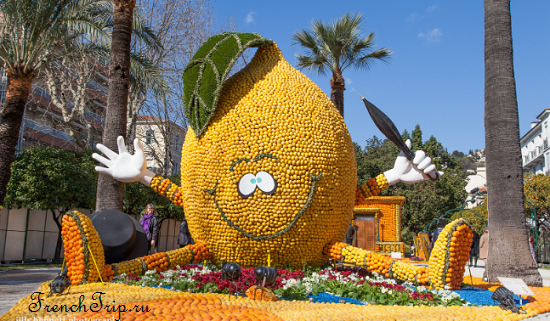
Menton’s lemons are a protected product and its own emblem, and for two and a half weeks in February the town builds enormous sculptures out of them — the Fête du Citron. Floats and figures several metres high, covered in citrus fruit wired on by hand, parade through the streets on the weekends and stand in the Jardins Biovès the rest of the time. Around 145 tonnes of lemons and oranges go into it each year, and a few hundred thousand people come to look.
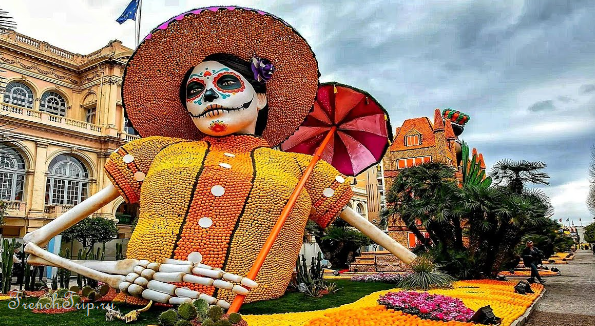
It runs at the same time as the Nice carnival, and the two are easily combined — see carnivals in France.
The lemons also have a political history: Menton and neighbouring Roquebrune broke away from Monaco in 1848 partly over the export tax on them, declared themselves a free town, and ended up French twelve years later — Napoleon III paid the Grimaldis four million francs in compensation.
What to see
The old town
Compact, steep and mostly pedestrian: stepped lanes between tall houses, running up from the harbour to the cemetery on top. Rue Longue, the spine of it, is the old Roman road — the Via Julia Augusta ran through here on its way from Piacenza to Arles.
Basilique Saint-Michel-Archange
The baroque church above the old town, begun in 1640 under Honoré II of Monaco and finished over the next two centuries. Its parvis, with the sea below and the town behind, is the setting for the Menton music festival every August. The Chapelle des Pénitents-Blancs just beyond it has the more elaborate facade of the two — turrets, friezes, garlands.
The Cocteau museums
Jean Cocteau — poet, playwright, film-maker, draughtsman — worked in Menton late in life, and the town has two of his sites: the Bastion, a seventeenth-century fort in the old harbour that he restored and decorated himself, and the Salle des Mariages in the town hall, whose walls he painted for couples getting married. The Salle is still in use and costs a couple of euros to see.
Cocteau also decorated the fishermen’s chapel at Villefranche-sur-Mer along the coast.
Musée des Beaux-Arts du Palais Carnolès
The former summer palace of the Grimaldis, now the town’s art museum — paintings from the thirteenth to the twentieth century, and a garden of citrus varieties around it. Free.
Gardens
Menton’s climate lets things grow that will grow nowhere else in France, and the town is full of gardens: the Jardin Exotique du Val Rahmeh, the Serre de la Madone, the Parc du Pian with its old olive grove, and the Villa Fontana Rosa, built by a Spanish novelist and tiled throughout in ceramics.
Cimetière du Vieux Château
The old cemetery occupies the site of the medieval castle on the summit, and the view from it over the coast is the best in town. It is also a document: the tuberculosis patients who did not recover are buried here, in terraces separated by nationality — English, German, Russian. William Webb Ellis, credited with inventing rugby, is among them.
The Russian Menton
A Russian colony formed here in the 1880s around a charitable society and a sanatorium known as the Maison Russe. Two buildings survive from it: the church of Notre-Dame-des-Affligés et Saint-Nicolas on Rue Paul Morillot, consecrated in 1892, with a Carrara marble iconostasis; and the small Russian chapel at the top of the cemetery, built in 1886 and restored in 2010 after decades of neglect.
Getting to Menton
- By train — Menton is on the coastal line, with frequent local trains from Nice (about 35 minutes), Monaco (10 minutes), Antibes and Cannes. Trains continue over the border to Ventimiglia in a quarter of an hour. See trains in Provence.
- By bus — a dense coastal network, and the cheapest way along the Riviera; see buses in Provence.
- By air — Nice Côte d’Azur, about 50 minutes away, with a direct coach.
- By car — the A8 and the three corniche roads. Parking in the old town is not realistic; use the car parks along the front. See parking in France.
Markets
The covered market — les Halles, on Quai de Monléon — runs every morning, with clothes added on Saturdays. There is a produce market on the Promenade du Maréchal Leclerc every morning and a flea market on Place aux Herbes on Fridays.
The real event, though, is across the border: Ventimiglia, 8 km east, holds one of the largest markets on this coast every Friday morning, and the trains from Menton are full of people going to it. San Remo has markets on Tuesday and Saturday, Bordighera on Thursday.
For the French side, see the shopping in Provence pages.
What to eat
Cooking here is halfway to Liguria: more olive oil and lemon than butter, stuffed vegetables, barbajuan, chard tart. Lemon goes into everything, including the tart everyone buys at least once.
Mirazur, on Avenue Aristide-Briand, is the reason some people come to Menton at all — Mauro Colagreco’s restaurant, which has held three Michelin stars and was named the best restaurant in the world in 2019. It works from its own terraced gardens above the town and books out months ahead. More generally, see Provençal cuisine.
Around Menton
- The perched villages — Sainte-Agnès, the highest coastal village in Europe at 800 m, and Gorbio, both a short drive up behind the town; see the most beautiful villages in France
- Roquebrune-Cap-Martin — the next town west, with a tenth-century keep
- Monaco — 10 minutes by train
- Èze — the hilltop village between here and Nice
- Italy — Ventimiglia, Bordighera and San Remo are all within half an hour by train
When to go
Menton is one of the few Riviera towns that genuinely works in winter — the reason it was built. February brings the lemon festival and the town is at its busiest and best; May, June and September are the pick for the beaches and the gardens. July and August are hot and full.
See when to visit Provence and festivals in Provence.
Tourist office
Palais de l’Europe, 8 avenue Boyer — menton-riviera-merveilles.fr
Where to park in Menton
| Car park | Spaces | Fee | From centre |
|---|---|---|---|
| Park Loredan Larchet underground | 300 | paid | 100 m |
| Parking Saint-Roch underground | 115 | free | 260 m |
| Place Docteur Théophile Fornari | — | paidmax 3 h | 300 m |
| Vieille Ville - Sablettes underground | — | paid | 440 m |
| Underground car park | 340 | paid | 740 m |
| Open car park | 26 | — | 940 m |
| Car park | 30 | — | 1.1 km |
| Car park | 40 | —max 3 h | 1.2 km |
Nearby
Other places on this site within easy reach, as the crow flies:
- Roquebrune-Cap-Martin — 4 km
- La Turbie — 9 km
- Saint-Jean-Cap-Ferrat — 17 km
- Aéroport de Nice — 27 km
- Saint-Paul-de-Vence — 32 km
- Vence — 32 km
Weather in Menton
| Month | Day | Night | Rainfall |
|---|---|---|---|
| January | +14° | +7° | 75 mm |
| February | +14° | +6° | 54 mm |
| March | +16° | +9° | 51 mm |
| April | +19° | +11° | 68 mm |
| May | +22° | +14° | 43 mm |
| June | +26° | +18° | 36 mm |
| July | +29° | +21° | 15 mm |
| August | +29° | +21° | 20 mm |
| September | +26° | +18° | 85 mm |
| October | +22° | +14° | 120 mm |
| November | +18° | +11° | 134 mm |
| December | +15° | +8° | 90 mm |
This page in Russian: Menton (Ментон)
Updated: