Toulon
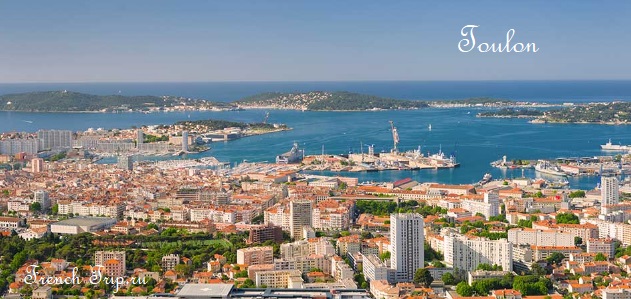
Toulon is France’s main Mediterranean naval port, the headquarters of the fleet, and the capital of the Var département in Provence. It sits on the coast east of Marseille, and with about 165,000 people it is the third largest city on this coast after Marseille and Nice.
It is also the least touristy of the three, which is much of its appeal: a working city with a real market, an old town of narrow streets and fountains, and a mountain behind it — and prices that reflect none of the Riviera glamour an hour to the east.
Nationally, Toulon is one of France’s larger cities: it ranks around fifteenth in the country by population.
Mont Faron
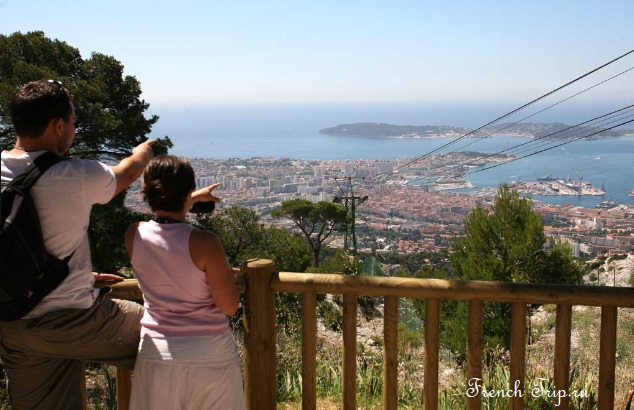
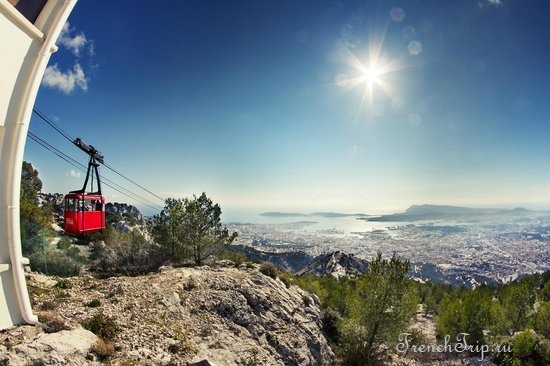
The mountain rises 584 m directly above the city, and the view from the top over the roadstead is the single best thing in Toulon. Two ways up:
- The cable car from the city — quick, and the obvious choice.
- The road — a narrow one-way loop climbing the western side and descending the eastern. It is one of the harder sections of the Paris–Nice and Tour Méditerranéen cycle races, which tells you what the gradient is like.
At the summit stands the Mémorial du Débarquement en Provence, a museum on the Allied landings on this coast in 1944.
A separate, lower corniche road, the corniche du Mont-Faron, runs along the mountain’s flank below the summit. Driven an hour or two before sunset, it gives views over the port, the city, the cliffs and the sea beyond.
The mountain also shelters the centre from the mistral, the cold wind that scours the rest of Provence in winter and spring — one reason Toulon feels milder than towns a short way inland.
What to see
The old town
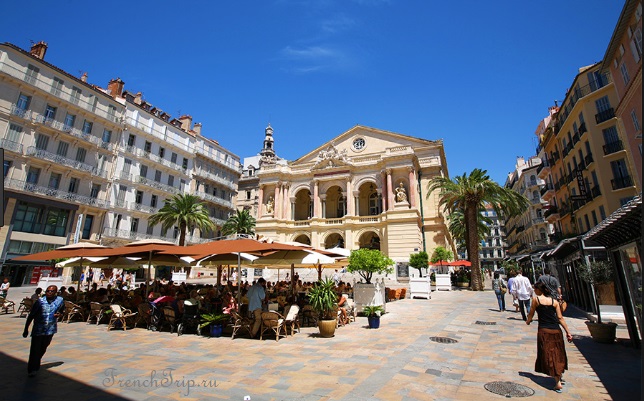
The pedestrian historic centre lies between the port, Boulevard de Strasbourg and Cours Lafayette: narrow lanes, a great many fountains — Toulon is known for them — and the cathedral. The morning market on Cours Lafayette is one of the best Provençal markets on the coast and, unlike most, is aimed at people who live here.
Arriving by car, the underground car park at Place de la Liberté is a convenient start: walk down Boulevard de Strasbourg and turn into Rue Berthelot for the pedestrian zone centred on Rue d’Alger.
The market spreads through streets lined with plane trees around Cours Lafayette every morning.
The cathedral, Sainte-Marie-Majeure on Rue Émile Zola, has a Romanesque core from the eleventh and twelfth centuries, substantially enlarged in the seventeenth; the nave is Gothic and dim, and the façade and bell tower are eighteenth-century.
On Place Puget, look for the atlantes — sculpted male figures used as columns — supporting the balcony of the Hôtel de Ville; the same motif appears on the front of the naval museum nearby.
The Vauban fortifications
From 1678 Vauban built an elaborate ring of defences around the city. The section along what is now Boulevard de Strasbourg was demolished in the mid-nineteenth century to let the city expand, but much survives — including the Porte d’Italie, one of the oldest gates, through which Napoleon set out on the Italian campaign in 1796.
Other stretches of Vauban’s national network of fortifications are listed as UNESCO World Heritage; the Toulon defences are not among them.
The upper town
Between Boulevard de Strasbourg and the station is the nineteenth-century quarter, laid out under Louis-Napoléon. The plan was begun by Baron Haussmann, who was prefect of the Var in 1849 before he rebuilt Paris — the boulevards here are a small rehearsal for what he did later.
The quarter’s buildings include the opera house, Place de la Liberté, the Grand Hôtel, the Jardins Alexandre Ier, the Chalucet hospital, the law courts and the old station building, now a Galeries Lafayette store.
The harbour
The rade of Toulon is one of the finest natural harbours in the Mediterranean, which is why the navy is here. Boat tours run around the naval base — the only way to see the warships properly — and ferries cross to Saint-Mandrier and La Seyne.
Quai Stalingrad, facing the roadstead, is lined with tall modern buildings, unlike the older streets around the cathedral.
Museums
The Musée de la Marine, by the port, holds the naval museum’s collection of ship models and other naval pieces. The Musée de Toulon covers painting from the sixteenth century to the present, with a notably strong holding of Provençal and Italian work, plus religious art. The Musée du Vieux Toulon is more modest, tracing the city’s history through trade, shipbuilding and the navy.
Beaches
Plage du Mourillon, 2 km east of the centre, is the city beach: several stretches of imported sand with pines behind, playgrounds and cafés. It is a family beach rather than a scenic one, and free.
The spectacular coast is a little further: the calanques east towards Le Pradet, and the peninsula of Giens with the salt flats and the crossing to the Îles d’Hyères. See also the best beaches in the region.
Getting to Toulon
By train. Toulon is on the main coastal line with direct TGV services from Paris (about 4 hours) and frequent regional trains to Marseille (under an hour), Saint-Raphaël and Nice. The station is a short walk from the centre. See trains in France.
By bus. Intercity coaches connect Toulon with Nice, Marseille and their airports, and are sometimes cheaper than the train, though slower.
By air. Toulon-Hyères airport is about 25 km east, with mostly domestic flights; most international visitors arrive via Marseille or Nice.
By car. The A50 and A57 meet here. Parking in the centre is paid and the old town is largely pedestrian — use one of the car parks by the port. See parking in France.
By sea. Ferries run to Corsica and Sardinia from the commercial port.
What to eat
This is Provençal cooking with a strong fishing-port accent: soupe de poisson, bouillabaisse at the harbour restaurants, the cade toulonnaise — a chickpea-flour flatbread, cousin to the socca of Nice — and chichi frégi, sugared doughnut sticks sold at the beach.
The Var is also serious wine country: this is the heart of Côtes de Provence rosé. More in Provençal cuisine and wine routes in France.
A note on the city
Toulon has a reputation among French travellers as rougher than its neighbours, and the area immediately around the station and parts of the old town are shabby. In practice the centre is unremarkable by the standards of any port city — ordinary care at night is enough. The city has been steadily restoring the old town for two decades and it shows.
Around Toulon
- Îles d’Hyères — Porquerolles and Port-Cros, national park islands with the clearest water on this coast; see Porquerolles and Port-Cros
- Bormes-les-Mimosas — a hillside village of flowers east along the coast; see the guide
- La Ciotat and Cassis — west towards the calanques; see La Ciotat
- Saint-Tropez — an hour east; see the Saint-Tropez guide
When to go
Summers are hot, over 30 °C in August. Storms are possible in June and late August, and autumn is wet. Winter rarely drops below freezing, though the wind can make it feel much colder. May, June and September are the best months — as everywhere on this coast.
Where to park in Toulon
| Car park | Spaces | Fee | From centre |
|---|---|---|---|
| Place Jules Mazarin | 20 | free | 240 m |
| Parking Q-Park de la gare underground | 320 | paid | 250 m |
| Place d'Armes underground | — | paid | 260 m |
| Parking de la Place Gabriel Péri | — | paid | 390 m |
| Parking du Palais de Justice | — | paid | 410 m |
| Parking Peiresc multi-storey | 534 | paid | 420 m |
| Parking Zénith - Préfecture multi-storey | 667 | paid | 420 m |
| Ancienne prison départementale du Var | — | paid | 440 m |
Nearby
Other places on this site within easy reach, as the crow flies:
- Hyères — 16 km
- Cassis — 33 km
- Le Lavandou — 36 km
- Calanques — 42 km
- Marseille — 49 km
- Sillans-la-Cascade — 53 km
Weather in Toulon
| Month | Day | Night | Rainfall |
|---|---|---|---|
| January | +13° | +7° | 70 mm |
| February | +14° | +6° | 47 mm |
| March | +16° | +8° | 39 mm |
| April | +19° | +10° | 55 mm |
| May | +23° | +14° | 40 mm |
| June | +27° | +17° | 27 mm |
| July | +29° | +20° | 6 mm |
| August | +30° | +20° | 13 mm |
| September | +26° | +17° | 70 mm |
| October | +21° | +14° | 106 mm |
| November | +17° | +10° | 93 mm |
| December | +14° | +7° | 66 mm |
This page in Russian: Toulon (Тулон)
Updated: