Bormes-les-Mimosas
Bormes-les-Mimosas sits a few kilometres back from the coast, roughly halfway between Toulon and Saint-Tropez, and it is one of the most rewarding villages in Provence: a steep medieval core of pink-tiled houses, stepped lanes buried in plants, and a view that runs from the plain out to the Hyères islands.
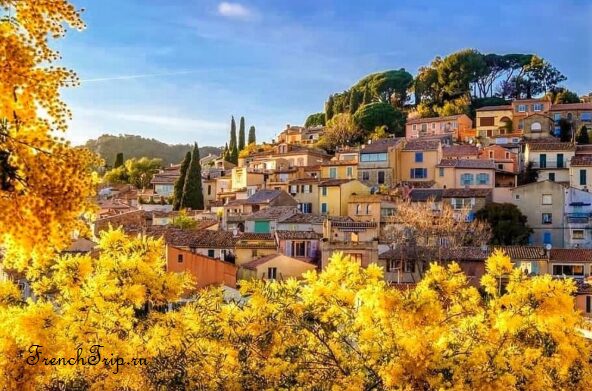
The name
The village was plain Bormes until 1968, when les Mimosas was added — partly to record how much grows here, partly to bring in visitors. The mimosa itself is an import: the trees that gave their name to the Route du Mimosa came to France with Napoleon III after the Mexican expedition of 1867. They flower in January and February, which is the one time of year the village looks yellow rather than green.
Where to start
Bormes has a larger modern town lower down that is of no particular interest. What you want is the medieval village further up the hill. There are two large free car parks just east of the centre, by the Gonzalez park — the Saint-François car park — and that is the right place to begin.
From the car park the path passes the chapel of Saint-François-de-Paule, built in 1560 in the Provençal Romanesque style and the oldest chapel dedicated to him anywhere. It honours the hermit Francesco Martolilla, who was credited with ridding the village of plague in 1481 on his way to the deathbed of Louis XI in Paris; he founded the order of the Minims and was canonised in 1519. In 1653 the Confraternity of the White Penitents took the chapel over as their burial place; in 1791 it was sold as national property to Maurice Courmes, who refused to turn it into a windmill and restored it to worship in 1827. The old cemetery and the remains of the mills are beside it.
On Place Saint-François, in front of the chapel, a statue of Saint-François-de-Paule was put up in 1791 by the Penitents, with help from local people. The painter and sculptor Jean-Charles Cazin is buried in the chapel’s old cemetery.
Just past the chapel, on Place Gambetta, the tourist office has a map of the village — worth taking, because the lanes are easy to lose yourself in.
What to see
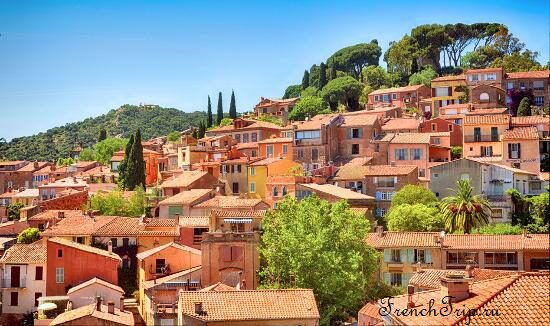
Église Saint-Trophyme is the first of the two important monuments uphill from the chapel. It was built in the 18th century but in the Romanesque manner, which makes it read as far older. French presidents staying nearby have a habit of attending it.
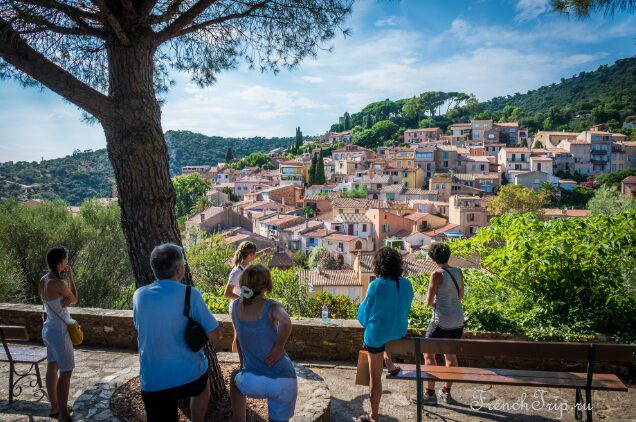
Château des Seigneurs de Fos, a 12th-century ruin, stands at the top of the village. It is closed to the public, but the path up to it is one of the best walks here, lined with plants and opening onto views across the Mediterranean to the Île d’Hyères.
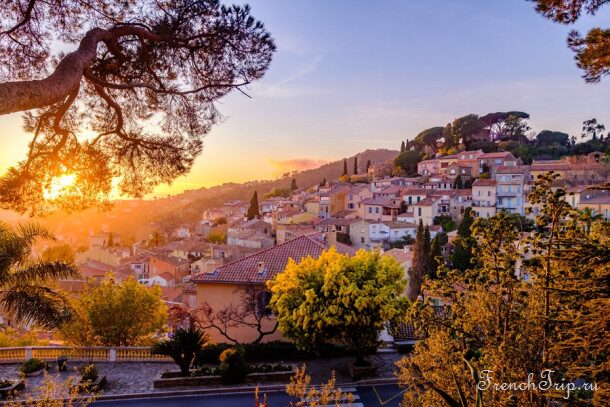
Chapelle Notre-Dame-de-Constance is the walk to make if you have the time: a path continues past the castle along the ridge and reaches the 13th-century chapel in about forty minutes, passing several oratories on the way. It stands on a rocky outcrop with a panorama over the whole coast, and it is the single best thing to do in Bormes.
Also here: the Musée Arts et Histoire, the arboretums of Gratteloup and Ruscas outside the village, and, down on the coast, the fort de Brégançon on its islet — the summer residence of French presidents, open to visitors when they are not in it.
Below the village, the Favière district has a marina, and the coast beyond it runs past the beaches of Favière, Cabasson, l’Estagnol and Pellegrin. Further along the same stretch of coast stands the Cap Bénat lighthouse, also known as the Cap Blanc lighthouse.
Five monuments in the commune are listed: the fort de Brégançon with its islet, the church of Saint-Trophyme, the chapel of Notre-Dame-de-Constance, the remains of the château des Seigneurs de Fos, and the chapel of Saint-François-de-Paule.
The old streets
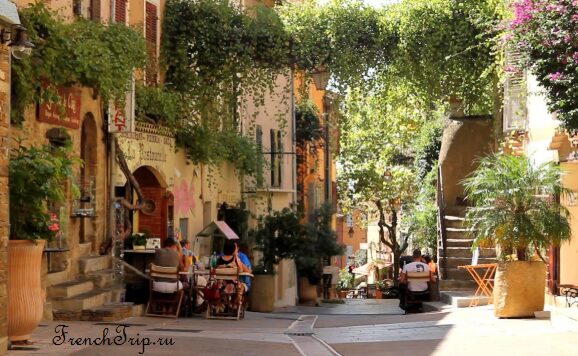
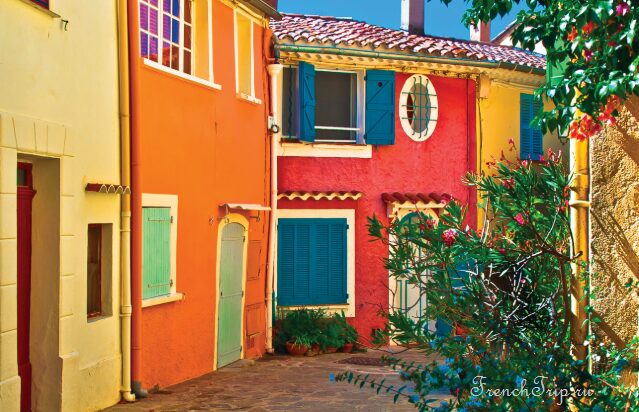
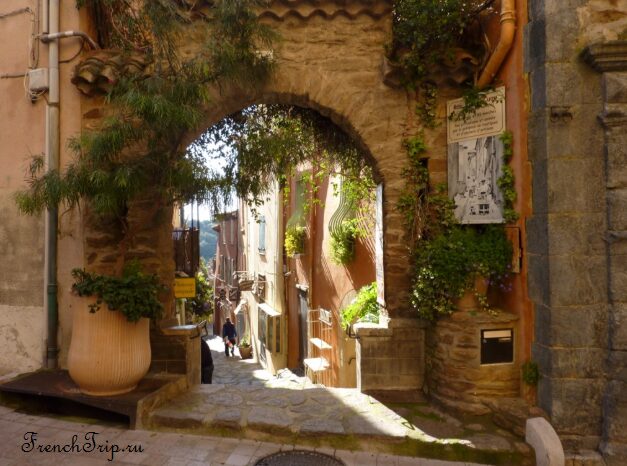
Rue des Bougainvilliers, between the church of Saint-Trophyme and Place Yann Piat, is a good place to start a walk through the old town. The village has at least a dozen fountains, and two small gardens, the Jardin Botanique and the Jardin Lou Pitchounet, sit among the lanes. Rue Carnot, through the centre, is wider than the rest, lined with taller houses in Provençal pastel colours and with most of the village’s shops and restaurants; the arts and history museum, at its western end, holds a collection built mainly around artists who worked in the region during the 19th and 20th centuries.
A signed walking tour threads about twenty points through the old streets and up past the château; it is mapped in full on the walking tour of Bormes-les-Mimosas.
The parks
Southeast of the old village, two parks run into each other across a road: the Parc Municipal du Cigalou, continuing over the hill into the Parc Gonzalez. Paths through tended gardens planted with a wide range of species lead back down towards the car parks, with views over the rooftops on the way.
Getting there
There is no railway station. The nearest is Hyères, 20 km away, and Toulon is the nearest large town. From either, the regional ZOU buses serve the village on lines 7801, 7802, 7803 and 8816 — about 3€ one way and 5€ return; see Provence by bus.
By car, the village is an easy detour from the coast road, and the free car parks make it painless outside July and August. Saint-Tropez is about 40 km east along the same road.
When to come
February, if you want the mimosa: the trees flower from January, and the Route du Mimosa links eight towns along this coast through the season. Otherwise spring and autumn, when the lanes are empty and the light is best. July and August fill the village and the car parks both.
The route runs about 115 km, northeast along the coast through Le Rayol-Canadel and Sainte-Maxime to Saint-Raphaël, then through Mandelieu-la-Napoule and inland via Tanneron and Pégomas to Grasse.
Around Bormes
Le Lavandou, a few kilometres southeast, is a former fishing village turned resort with a harbour, a beach, and a run of further beaches along the coast beyond it.
Inland, Collobrières sits in the heart of the Massif des Maures and calls itself the chestnut capital, with a chestnut festival each October. Paths from the village lead to the Chartreuse de la Verne, the chapel of Notre-Dame-des-Anges, and the menhirs of the Lambert plateau.
East along the coast: Ramatuelle, a medieval village near Pampelonne beach; Cogolin, known for its reed and pipe workshops; Grimaud, a medieval hill town with a feudal castle; Port-Grimaud, a lakeside town built in the style of Venice in the Gulf of Saint-Tropez; and Saint-Tropez itself, with its port, old lanes, the Citadel, the Musée de l’Annonciade and a butterfly museum.
West and inland: old Hyères, with the Villa Noailles, the Olbius-Riquier garden and the Roman site of Olbia; the Presqu’île de Giens, with a 17 km coastal path along a double tombolo; Carnoules, home to a tortoise sanctuary, the Village des Tortues; and Toulon, with its old town and harbour, boat tours of the port, and a cable car up Mont Faron (542 m). Boat trips out to the Îles d’Hyères can also be arranged along this stretch of coast.
Fréjus, further along the same coast, has Roman remains — an amphitheatre, an aqueduct and a theatre — and a chapel decorated by Jean Cocteau.
See also the Provence-Alpes-Côte d’Azur region page, the best beaches in Provence just below the village, and the cuisine of Provence.
Nearby
Other places on this site within easy reach, as the crow flies:
- Le Lavandou — 3 km
- Île de Port-Cros — 17 km
- Île de Porquerolles — 20 km
- Gassin — 22 km
- Sainte-Maxime — 30 km
- Roquebrune-sur-Argens — 40 km
This page in Russian: Bormes-les-Mimosas (Борм-ле-Мимоза)
Updated: