Hyères
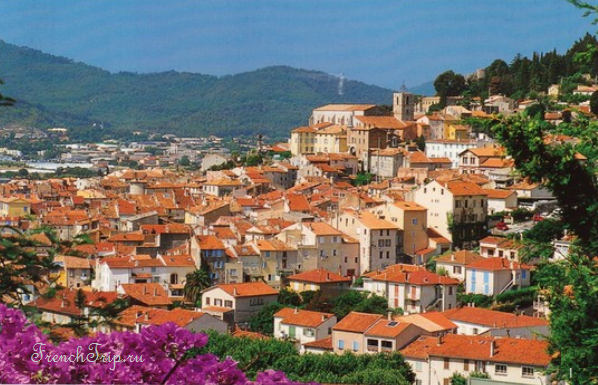
Hyères is a town of 57,000 on the Var coast, between Toulon and Le Lavandou. Its full name is Hyères-les-Palmiers, and it earns it: some 7,000 palms grow in the town, and it has been the centre of French palm cultivation since the nineteenth century.
It was also the first winter resort on the Riviera — before Nice, before Cannes. The English came from the 1760s, Queen Victoria stayed in 1892, and Robert Louis Stevenson wrote that he had only been happy once, and that was at Hyères.
History
Hyères began as Olbia, a trading post founded by Greek sailors around 400 BC near where the Giens tombolo meets the mainland, drawn by the salt pans nearby. Their successors judged the shore too exposed and moved the settlement onto the hill where the medieval town still stands; the remains of the Greek port are being excavated near the salt pans today. Hyères then belonged to the County of Provence until 1481, and its standing as a harbour was such that Louis IX put in here in 1254, on his way home from crusade.
The town played a part in the Allied landings in the south of France in August 1944. Its belle époque quarter has changed little enough that French directors have used it as a period set: Jean-Luc Godard shot scenes of Pierrot le Fou here, and François Truffaut made his last film, Vivement Dimanche, in the town. Visitors over the centuries are said to have included Napoleon; among the Russians who came was Nikolai Tolstoy, brother of the novelist, who died here in 1860, and the émigré poet Georgy Ivanov, who spent his final years in Hyères and died in 1958. The town carries the official designation Ville d’art et d’histoire.
Flowers and horticulture
Palm growing is only part of it: Hyères has been the south-east’s main horticultural centre since the 1980s. The wholesale flower market on the west side of town handles a large share of France’s cut flowers — roses, irises, carnations, gladioli, chrysanthemums, tulips and lilies among them — and the Var department as a whole accounts for around half of the region’s cut-flower production and over a quarter of the national total. Some of the town’s palm nurseries export as far as the Middle East.
Hyères holds the top rank, four flowers, in the national Villes et Villages Fleuris competition, and took a gold medal at the European flower-towns contest in 2003.
The old town
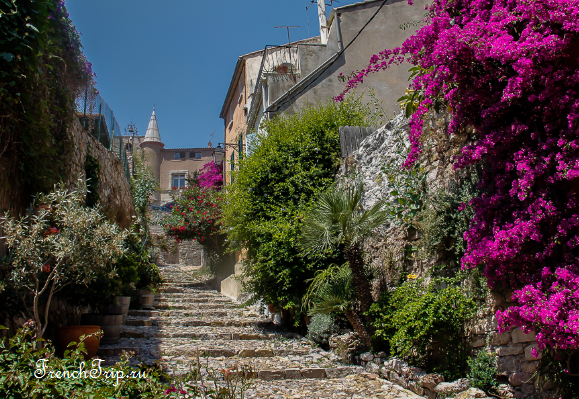
Medieval Hyères is up the hill, two kilometres back from the sea, and is a proper hill town of stepped lanes and vaulted passages that most people on the coast never see.
- Tour des Templiers — the twelfth-century Templar commandery tower on the Place Massillon, now an exhibition space
- Porte Massillon and Porte des Princes — the surviving gates
- Collégiale Saint-Paul — twelfth-century, with a collection of several hundred ex-votos
- Parc Saint-Bernard — terraced gardens climbing to the castle, planted with everything that will grow in this climate, which is almost everything
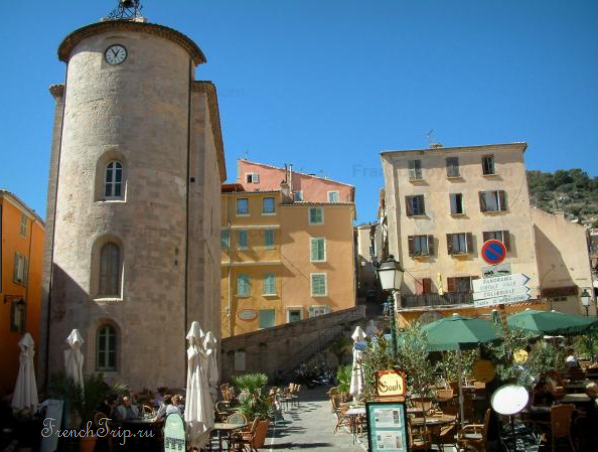
The weekly market fills the Place Massillon early in the morning, best seen before the day trippers arrive. Two signed walking routes start from the tourist office: one through the medieval lanes of the old town, the other through the 19th-century quarter below, past the grand hotels and villas built for the English winter colony.
Villa Noailles
Above the town, and the reason architects come to Hyères. Built from 1923 by Robert Mallet-Stevens for the patrons Charles and Marie-Laure de Noailles, it is one of the first modernist houses in France — a white cubist assembly of terraces, with a cubist garden by Gabriel Guevrekian.
Man Ray filmed Les Mystères du Château de Dé in it in 1929; Buñuel, Cocteau, Giacometti and Dalí all passed through. It is now an art and design centre, open free, and hosts an international fashion and photography festival each spring.
Festivals
Besides the fashion and photography festival, Hyères has a jazz festival and a festival of French chanson, both later in the year. The Journées européennes du patrimoine, the third weekend of September, opens sites normally closed to the public: the Anglican church built for the English winter colony, the Olbia excavations, and the forts on the islands.
The castle
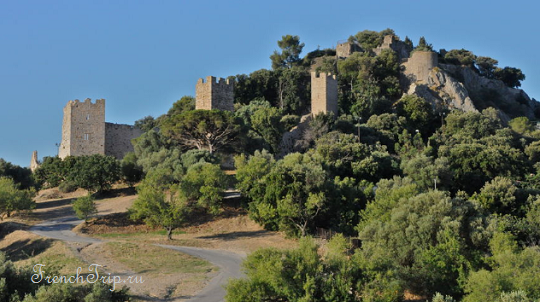
The ruins of the Fos family’s fortress crown the hill at 200 m. Twenty minutes up through the Parc Saint-Bernard, and the view takes in the salt pans, the peninsula and all three islands.
A lower alternative is Costebelle, a pine-covered hill between the old town and the sea with its own view over the Giens peninsula, without the climb to the castle.
Parks and gardens
The town has several other public gardens besides Parc Saint-Bernard. Parc Olbius Riquier, the main municipal park, holds an extensive palm collection. Parc Saint-Clair is another of the gardens recognised as a jardin remarquable, the French label for parks of particular note. The Jardin du Roi, by the Park Hôtel, is the oldest in town, laid out in 1882.
The peninsula and the salt pans
Hyères is the southernmost town in Provence, its commune stretched along some 39 km of coastline that alternates between sand and rocky cliffs.
South of the town the presqu’île de Giens runs out to sea on a double sand bar — a tombolo, one of only a handful in the world and the only one in Europe of this scale. Between the two arms lie the Salins des Pesquiers, former salt works now a protected wetland with flamingos, and beside them the Almanarre beach, which is one of the best windsurfing waters in France.
The salt pans have been worked for more than two thousand years, on an industrial scale since the Middle Ages, and production continued until it stopped only in 1995. Water levels across the site are now managed to suit the flamingos and other birds that feed there.
The islands
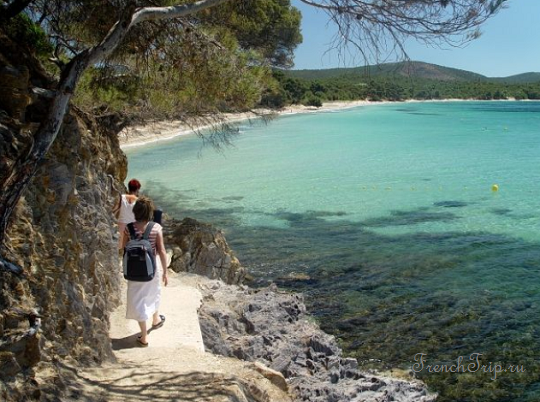
The Îles d’Hyères — the golden isles — are the real attraction:
The nickname is said to date from the Renaissance, when sailors saw the offshore rocks catch a golden light.
- Porquerolles — the largest, car-free, with white sand beaches; ferries from La Tour Fondue on the Giens peninsula, 15 minutes
- Port-Cros — a national park on land and sea, with an underwater snorkelling trail
- Île du Levant — nine-tenths military, one-tenth the naturist village of Héliopolis, founded in 1931
Local food and wine
Being on the coast, Hyères is known for fish and seafood, including bouillabaisse — a proper version takes hours to prepare, so it is usually ordered in advance. A local sweet speciality is Princesses d’Îles d’Or, dark-chocolate truffles studded with candied orange.
The vineyards around Hyères fall within the Côtes de Provence appellation, in the La Londe cru shared with neighbouring communes. Most of the wine is rosé, with smaller amounts of red and white, from grape varieties that include Cinsault, Grenache, Cabernet Sauvignon, Tibouren and Syrah. The commune has sixteen wine estates, two of them ranked Cru Classé — one of only eighteen such estates in the whole Côtes de Provence appellation. See Provençal wines.
Getting to Hyères
- By train — a branch from Toulon, about 20 minutes; TGV from Paris to Toulon then on.
- By air — Toulon-Hyères airport is in the town, with Paris and seasonal flights.
- By car — the A57 from Toulon. In August the road down the Giens peninsula is very slow. See parking in France.
Around
- The islands — from La Tour Fondue and the Port d’Hyères
- Le Lavandou — 25 km east, twelve beaches
- Toulon — 20 km west, with the harbour and the cable car up Mont Faron
- Massif des Maures — inland, cork oak and chestnut
- Bormes-les-Mimosas — 20 minutes, and February for the mimosa
When to go
April to June and September to October. Hyères has the mildest winter on this coast and stays green all year, and the old town works even in January — which cannot be said of most of the Var.
See Provence and when to visit.
Weather in Hyères
| Month | Day | Night | Rainfall |
|---|---|---|---|
| January | +13° | +5° | 74 mm |
| February | +14° | +4° | 51 mm |
| March | +16° | +6° | 44 mm |
| April | +18° | +9° | 55 mm |
| May | +22° | +12° | 40 mm |
| June | +26° | +15° | 37 mm |
| July | +29° | +18° | 8 mm |
| August | +29° | +18° | 14 mm |
| September | +25° | +15° | 58 mm |
| October | +21° | +13° | 105 mm |
| November | +17° | +9° | 109 mm |
| December | +14° | +6° | 75 mm |
Updated: