Guebwiller
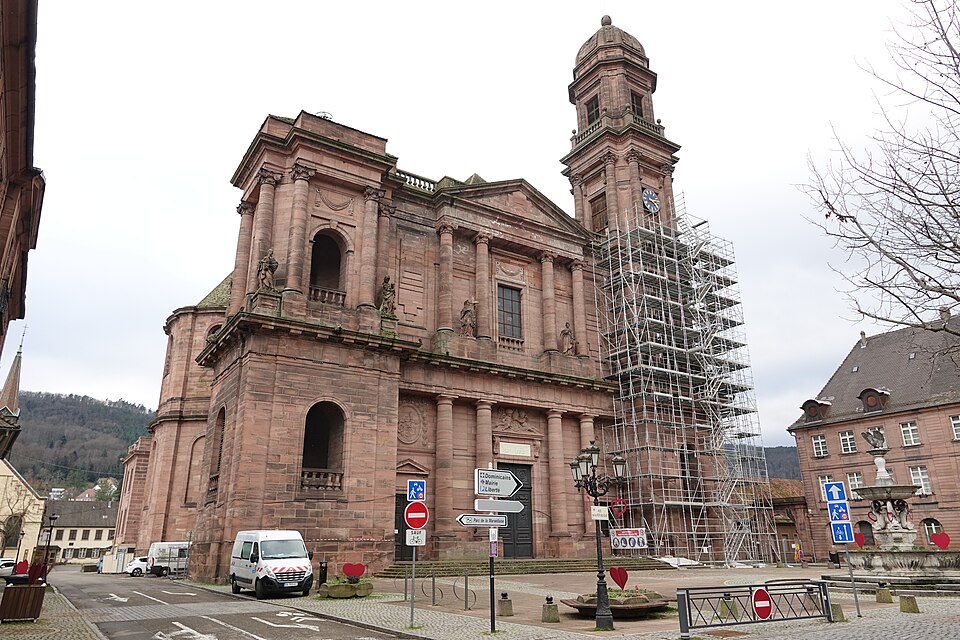
Guebwiller is a town of 11,000 at the mouth of the Florival valley in southern Alsace, 23 km north-west of Mulhouse and 25 km south of Colmar.
It has a distinction no other Alsatian town can claim: four grands crus within its commune — Kitterlé, Kessler, Saering and Spiegel. For anyone following the wine, that alone justifies the stop.
For everyone else it is a solid provincial town rather than a picture-book village: three churches spanning Romanesque, Gothic and neoclassical, a former Dominican monastery, and streets of nineteenth-century industrial villas. Half a day is about right.
History
Guebwiller grew up around the Romanesque church of Saint-Léger and the château du Burgsthal, under the abbey at Murbach. The town was walled between 1270 and 1287 and served as the administrative capital of the prince-abbey’s territory.
The Revolution ended that arrangement: the abbey’s assets were sold to industrial developers, and Guebwiller grew quickly into Alsace’s second industrial centre after Mulhouse. Factories, villas — some of them Art Nouveau — and housing estates went up beyond the old walls, and much of that townscape is still there.
The three churches
Guebwiller’s oddity is that its three principal churches are each from a different age and each of them good.
- Église Saint-Léger — late Romanesque, twelfth–thirteenth century, and one of the finest of its kind in Alsace. It is on the Route Romane d’Alsace, the region’s Romanesque trail. The west front with its three towers and porch is the part to look at.
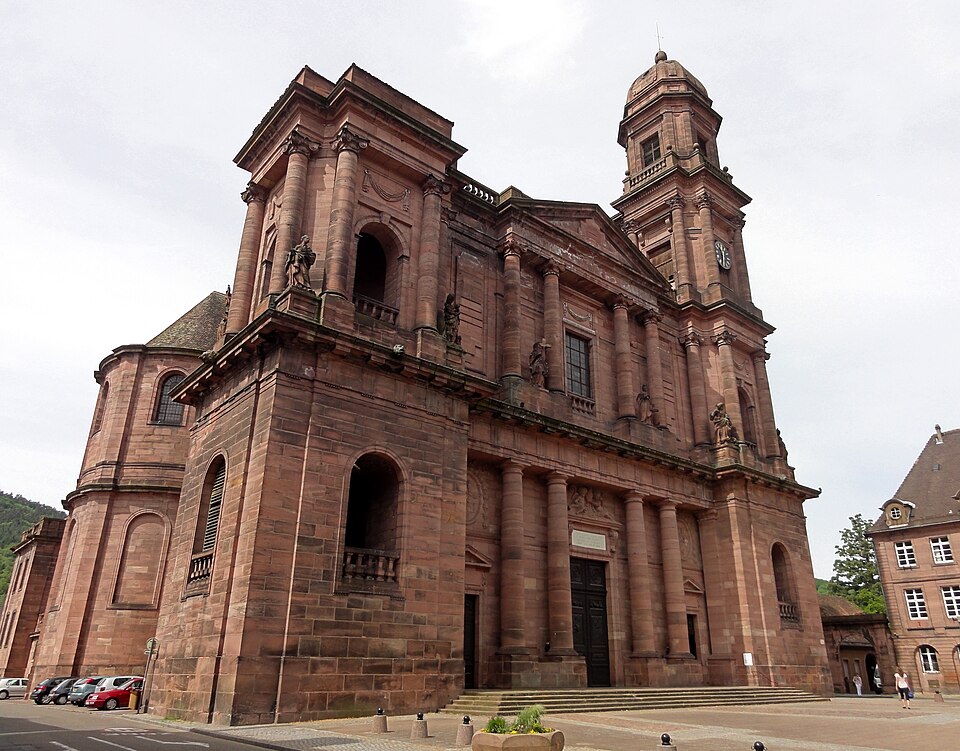
- Église Notre-Dame — neoclassical, built 1760–85 for the last prince-abbots of Murbach, with a baroque interior and a huge carved Assumption behind the altar. An unexpectedly grand church for a small town, and the reason is money: the abbey had it.
- Les Dominicains — the fourteenth-century Dominican church and cloister, deconsecrated and now a concert hall with remarkable acoustics, used for early and sacred music. The medieval wall paintings survive.
Saint-Léger is built of pink Vosges sandstone; the present church, put up between 1182 and 1235 under the abbot of Murbach, replaced an earlier chapel on the same site.
Inside Les Dominicains, the nave’s wall paintings date from the fourteenth to the seventeenth century. The building now houses a cultural centre for the Dominicans of Upper Alsace, with concerts and exhibitions through the year.
The abbey itself transferred from Murbach to Guebwiller in 1759, and building of Notre-Dame began in 1763. The church is ringed by the houses of its canons; one of them holds the Théodore Deck and Florival museum.
Murbach
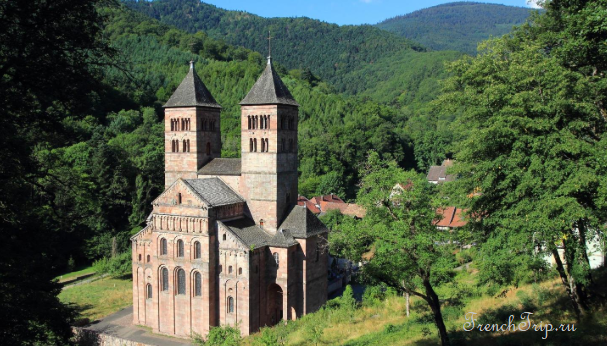
Six kilometres up the valley stands Murbach abbey, and it is the reason Guebwiller exists. Founded in 727, it became one of the most powerful monasteries in the Holy Roman Empire — its abbot was a prince, and at its height the abbey held authority over some three hundred villages.
What survives is the choir and transept of the twelfth-century Romanesque church, the nave having been demolished in the eighteenth century. Standing alone at the head of a wooded valley, with its two square towers and its band of blind arcading, it is one of the most striking Romanesque buildings in eastern France.
The church is built of red sandstone, and its arches are sometimes said to be the oldest pointed arches in Alsace. The carving on the facades is still somewhat crude but expressive. The village also has a garden laid out in medieval style and the late-seventeenth-century chapel of Notre-Dame-de-Lorette.
See Murbach.
The wine
The four grands crus sit on the slopes immediately above the town, on soils that differ sharply from one another — sandstone at Kitterlé, marl and limestone at Kessler and Saering. Riesling and Gewurztraminer dominate. Several of the growers here are among the best known in Alsace.
Guebwiller is on the southern stretch of the wine route; see also the wines of Alsace.
Getting to Guebwiller
- By train — the line was closed to passengers; the nearest station is Bollwiller, on the Strasbourg–Mulhouse line, 6 km away, with a bus connection.
- By car — 25 minutes from Mulhouse, 30 from Colmar. See parking in France.
- By bus — regional services from Mulhouse and Colmar.
Around Guebwiller
- Murbach — 6 km up the valley
- Grand Ballon — the highest point of the Vosges at 1,424 m, 8 km west as the crow flies and about 40 minutes by road
- Thann — 18 km south-west, with the finest Gothic spire in Alsace
- Écomusée d’Alsace — 20 minutes at Ungersheim, the largest open-air museum in France
- Mulhouse — 23 km, with the car and railway museums
- Thierenbach — a Baroque pilgrimage basilica at the foot of the Grand Ballon, on a site of pilgrimage said to go back to the eighth century; the present building is an eighteenth-century rebuild, with a striking interior and numerous ex-votos.
- Lautenbach — a Romanesque collegiate church with a twelfth-century nave and a thirteenth-century altar; the west porch, heavily carved, is reckoned one of the most impressive in Alsace.
- Hartmannswillerkopf — a First World War battlefield and national memorial on a 956 m summit of the Vosges, where some 30,000 men died, mostly in 1915 and 1916. The site has been preserved and waymarked since it became a historic monument in 1921.
- Soultz-Haut-Rhin — an old town with a Gothic church built between 1260 and 1489 and Renaissance-era winegrowers’ houses recognisable by their oriel windows and stair towers.
When to go
May to October. The Florival valley behind the town is good walking country and the Grand Ballon road is one of the better drives in the Vosges. Guebwiller sees a fraction of the crowds of the northern wine-route villages.
See Alsace.
Photo credits
Some photographs on this page come from Wikimedia Commons under free licences:
- Notre-Dame — Gzen92, CC BY-SA 4.0, via Wikimedia Commons
- The interior — Ralph Hammann, CC BY-SA 4.0, via Wikimedia Commons


Nearby
Other places on this site within easy reach, as the crow flies:
Weather in Guebwiller
| Month | Day | Night | Rainfall |
|---|---|---|---|
| January | +5° | -1° | 93 mm |
| February | +7° | 0° | 76 mm |
| March | +12° | +2° | 72 mm |
| April | +16° | +6° | 60 mm |
| May | +20° | +10° | 81 mm |
| June | +24° | +13° | 74 mm |
| July | +26° | +15° | 66 mm |
| August | +26° | +14° | 71 mm |
| September | +21° | +11° | 60 mm |
| October | +16° | +7° | 81 mm |
| November | +9° | +3° | 76 mm |
| December | +6° | 0° | 111 mm |
This page in Russian: Guebwiller (Гебвиллер)
Updated: