Rouffach
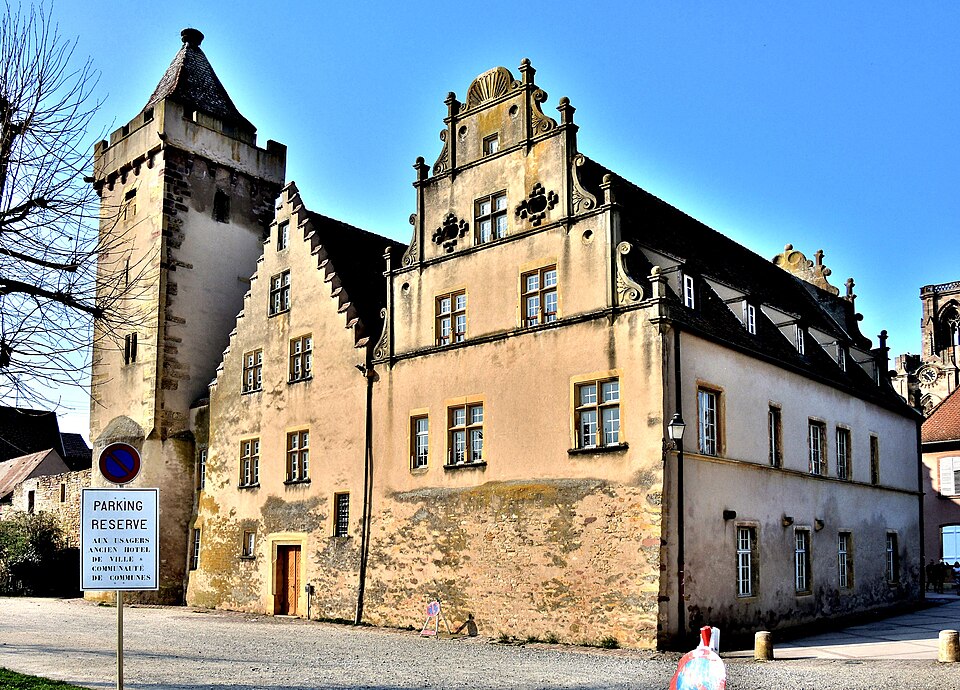
Rouffach is a small town on the Alsace wine route, 15 km south of Colmar and 28 km north of Mulhouse. It is next door to Eguisheim and it loses the beauty contest to it — but Rouffach has more surviving historic building than almost any town of its size in Alsace, and hardly anyone stops. If you are driving the wine route, it is worth the detour.
It also sits in the driest spot in France: the Vosges take the rain out of the westerlies before they reach here, which is exactly why the vineyards are where they are.
History
Rouffach was probably founded in the Celtic period; in Latin it was Rubeacum. Excavations in the centre have turned up a Roman settlement, and the Merovingians built a residence here — Isenbourg.
In the seventh century the town passed to the bishops of Strasbourg, and stayed theirs until the Revolution. The legend has King Dagobert II giving it to Bishop Arbogast in thanks for miraculously reviving his son. The bishops turned Rouffach into a fortress with a double wall running up to the castle of Isenbourg, which still stands above the town.
It became the capital of the Haut Mundat, the bishops’ territory in the Upper Rhine, comprising the bailiwicks of Rouffach, Soultz and Eguisheim. Nobles, religious houses and guilds all built here, and the Renaissance was the town’s golden age. Until the end of the Thirty Years’ War, this was Holy Roman Empire, not France.
Place de la République
Almost everything worth seeing stands on or just off the central square.
Église Notre-Dame-de-l’Assomption
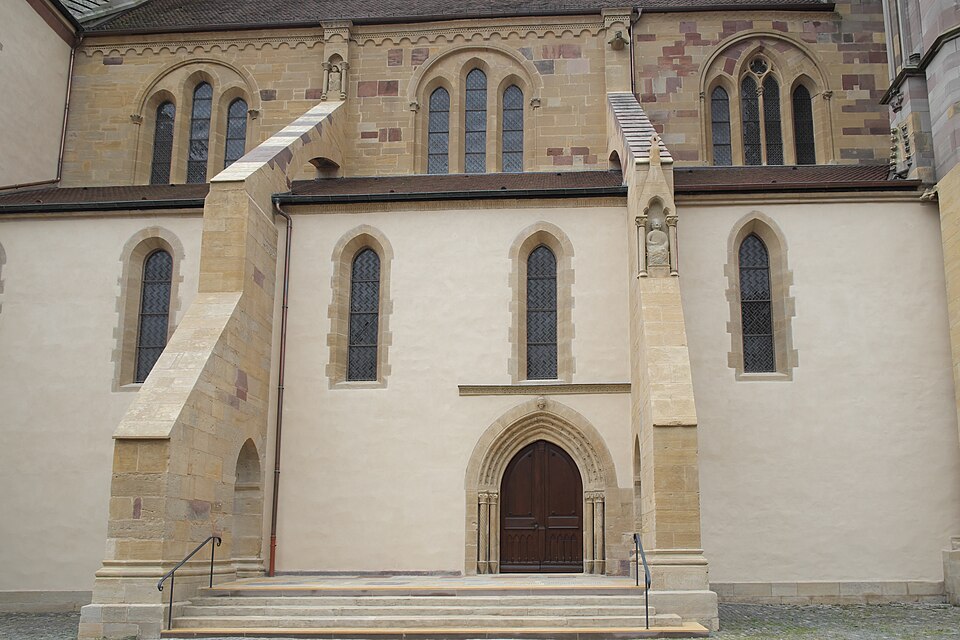
The reason to stop. Rouffach was the bishop of Strasbourg’s Alsatian capital, so it was obliged to have a church that showed it — and this one was built on the model of Strasbourg cathedral, in the same yellow sandstone from the Strangenberg quarries a few kilometres away, which catches the light in the same way.
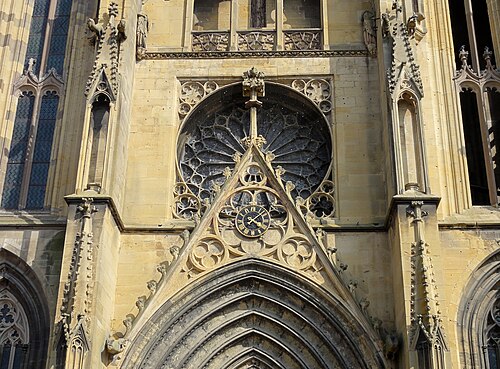
It runs from Romanesque through to the nineteenth century in one building. The north tower was finished in 1875; the south tower never was, and the asymmetry is the town’s silhouette. An octagonal spire — the old belfry, known as the “finger of the town” — rises from the crossing, and the rose window is a deliberate echo of Notre-Dame in Paris.
The portal sculpture was smashed at the Revolution. Inside, the fifteenth-century altar of the Virgin survives, the polygonal choir is thirteenth-century, and by the door are two pieces from the old treasury: a Paschal Lamb, and the pair of small figures known as the Smile of Rouffach.
Tour des Sorcières
The Witches’ Tower, the last of the town’s fortified towers. The round base is thirteenth-century, the square upper storeys fourteenth and fifteenth. It held the town prison for several hundred years, and during the Inquisition it was where accused witches were locked up — hence the name. A stork nests on top.
Halle au Blé
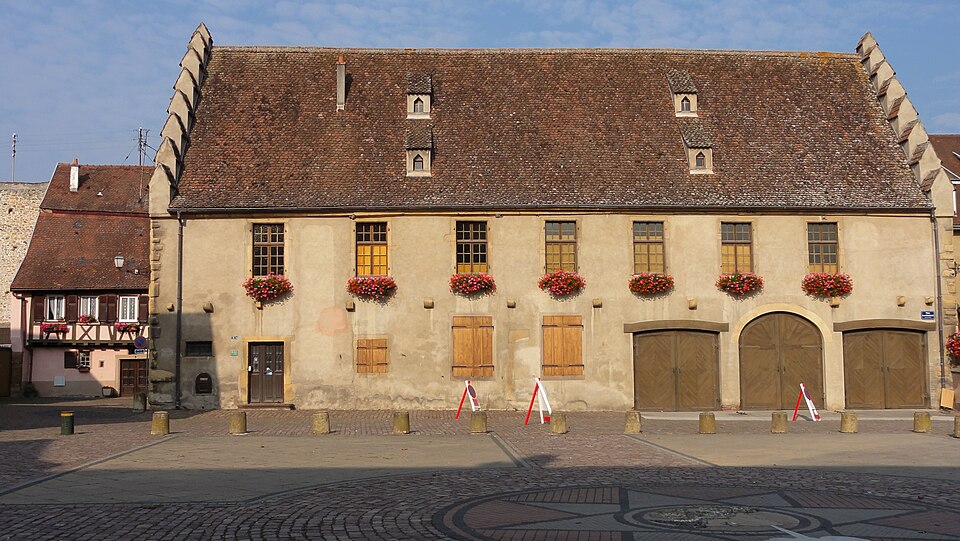
The sixteenth-century corn exchange with a stepped gable, used for storing and trading grain, then a boys’ school from 1819 to 1960. The upper floor now holds the town museum, covering Rouffach’s history and Marshal Lefebvre, who was born here.
The rest of the square
- Maison de l’Œuvre Notre-Dame — the masons’ lodge for the church, with the town’s shield of 1490 between the arches. Witch trials were held in its courtyard.
- The former town hall — right wing fifteenth-century, remodelled 1721; left wing built in 1581 by the local mason Franz Bauer
- The presbytery of 1778 on Rue des Prêtres
- The current town hall of 1831, with a bust of Marshal Lefebvre in front — one of Napoleon’s marshals, born in the house to its right
- The bishop’s old courtyard, whose arms over the portico were chiselled off at the Revolution
The walking route
The tourist office marks a numbered circuit through the old town, starting at Place de la République. What it takes in, besides the above:
- Place de la Fontaine (Place Foch) — the fountain of 1534, carrying a figure of Bishop Guillaume de Honstein below a Virgin with an old inscription
- The synagogue on Rue Ullin, with elements surviving from the thirteenth century — what remains of a long-established Jewish community
- Maison des Trois Dames — a sixteenth-century house on Rue du Maréchal-Lefebvre, named for the three oak columns holding up its upper storey
- The Beguine house at the end of the same street, with a butcher’s sign — home to a lay sisterhood who taught girls and nursed the sick
- Metzig — the slaughterhouse of 1544, in use until the end of the Second World War
- Hôtel de Schoenau and Hôtel Rettig — noble houses with fourteenth-century gables and blocked-up windows
- Maison au Cygne Blanc — the White Swan, 1666
- The old tannery and the public baths along the Ohmbach, the stream that ran round the old town; the pits in front of the tannery were in use into the twentieth century
- Hôpital du Saint-Esprit — founded in 1270 by Jacques de Ratsamhausen for the poor and for orphans
- Stockbrunnen — a well of 1578 from the Knechtlin estate
- The statue of St John of Nepomuk (1796), patron of bridges, left over from a vanished gate
- Place de la Liberté — the lime trees were planted in 1919 to mark the return to France
How the houses are built
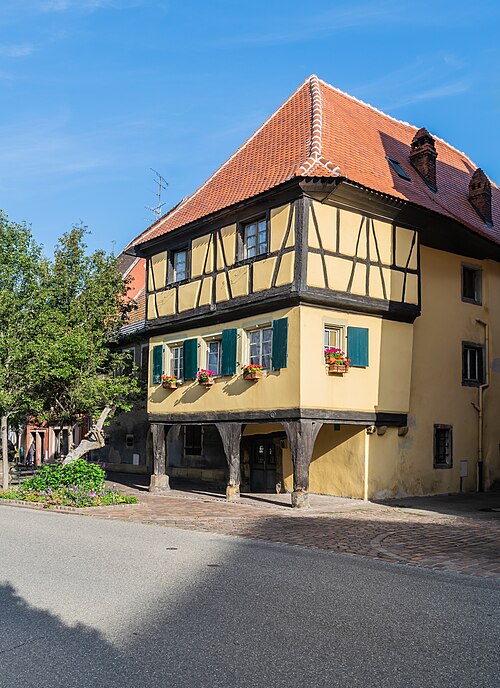
Worth knowing before you walk it. Since Roman times the building stone here has been the yellow Strangenberg sandstone, used across the region — Colmar, Thann, Ensisheim. Rouffach’s houses follow one pattern: cellars at street level, to keep the wine above flood water, with the living rooms on the first floor. There are also many cours communes, where several houses share one courtyard — the way a walled town uses its space efficiently. Look for the oriel windows on the noble houses and the porticoes on the winegrowers’.
Château d’Isenbourg
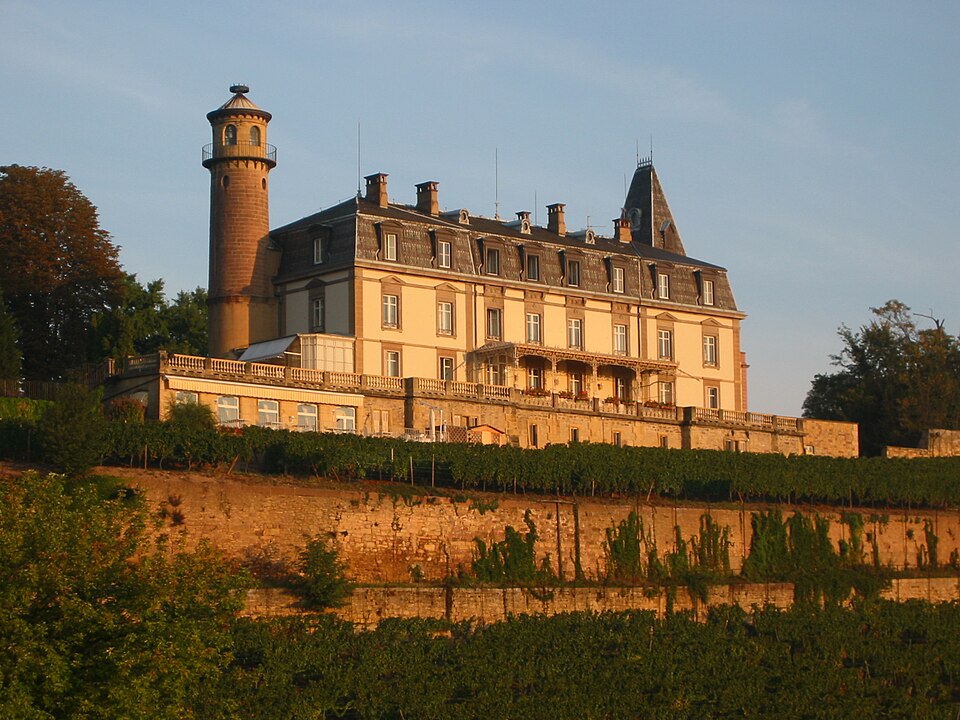
The bishops’ castle on the hill above, rebuilt several times and now a hotel. Even if you are not staying, the terrace and the view over the vineyards to the Black Forest are the reason people come up.
The vineyards
Rouffach’s grand cru is the Vorbourg, on the slope above the town, and there is a signposted circuit of about 3.8 km through it starting from Place de la Mairie — a two-hour walk, 98 m of climb, with a balcony viewpoint over the town and, on a clear day, the Black Forest and the Alps.
See the Alsace wine route and French wines.
Festivals
- Musicalta — a classical music festival and academy, mid-July to mid-August
- The Witches’ Festival — a medieval festival in mid-July, playing on the tower’s history
- Rouffach en Fête — early August
- Christmas market — early December
Getting to Rouffach
- By train — the station is 1 km from the centre, with direct regional trains from Colmar (about 10 minutes) and Mulhouse (about 26 minutes), roughly every hour or two.
- By bus — line 440 runs Colmar – Eguisheim – Hattstatt – Gueberschwihr – Rouffach – Soultzmatt – Guebwiller, which is a wine-route itinerary in itself.
- By car — on the N83 and the wine route; the easiest way, and the way most people arrive. See parking in France.
What to eat
Alsatian: tarte flambée, baeckeoffe, choucroute, and the Vorbourg wines with them. See the cooking of Alsace.
Around Rouffach
- Eguisheim — 8 km north, one of the most beautiful villages in France and the reason most people drive past Rouffach
- Colmar — 15 km north
- Guebwiller and the Florival valley — south-west, into the Vosges
- Grand Ballon — the highest point of the Vosges, half an hour west
- Wissembourg — the far end of the wine route, two hours north
When to go
May to October, and September–October for the harvest, when the vineyards turn and the villages are working. December for the Christmas market.
See Alsace and the most beautiful villages in France.
Photo credits
Photographs on this page come from Wikimedia Commons under free licences:
- Notre-Dame-de-l'Assomption — GFreihalter, CC BY-SA 4.0, via Wikimedia Commons
- The west portal and rose window — Ralph Hammann, CC BY-SA 4.0, via Wikimedia Commons
- The Witches' Tower and the old town hall — Espirat, CC BY-SA 4.0, via Wikimedia Commons
- The Halle au Blé — Ralph Hammann, CC BY-SA 4.0, via Wikimedia Commons
- Maison des Trois Dames — Krzysztof Golik, CC BY-SA 4.0, via Wikimedia Commons
- Château d'Isenbourg above the vineyards — Rollopack, CC BY-SA 3.0, via Wikimedia Commons
_%C3%89glise_Notre-Dame_de_l%E2%80%99Assomption_952.jpg)


.jpg)

Where to park in Rouffach
| Car park | Spaces | Fee | From centre |
|---|---|---|---|
| Place de la République | — | free | 90 m |
| Car park | 200 | free | 420 m |
| Gare de Rouffach | 22 | free | 1.0 km |
| Open car park | 49 | free | 1.1 km |
Weather in Rouffach
| Month | Day | Night | Rainfall |
|---|---|---|---|
| January | +6° | 0° | 40 mm |
| February | +8° | +1° | 33 mm |
| March | +12° | +4° | 35 mm |
| April | +17° | +7° | 43 mm |
| May | +21° | +11° | 73 mm |
| June | +25° | +14° | 67 mm |
| July | +27° | +16° | 66 mm |
| August | +26° | +15° | 64 mm |
| September | +22° | +12° | 50 mm |
| October | +16° | +8° | 58 mm |
| November | +10° | +4° | 44 mm |
| December | +7° | +1° | 48 mm |
Updated: