Thann
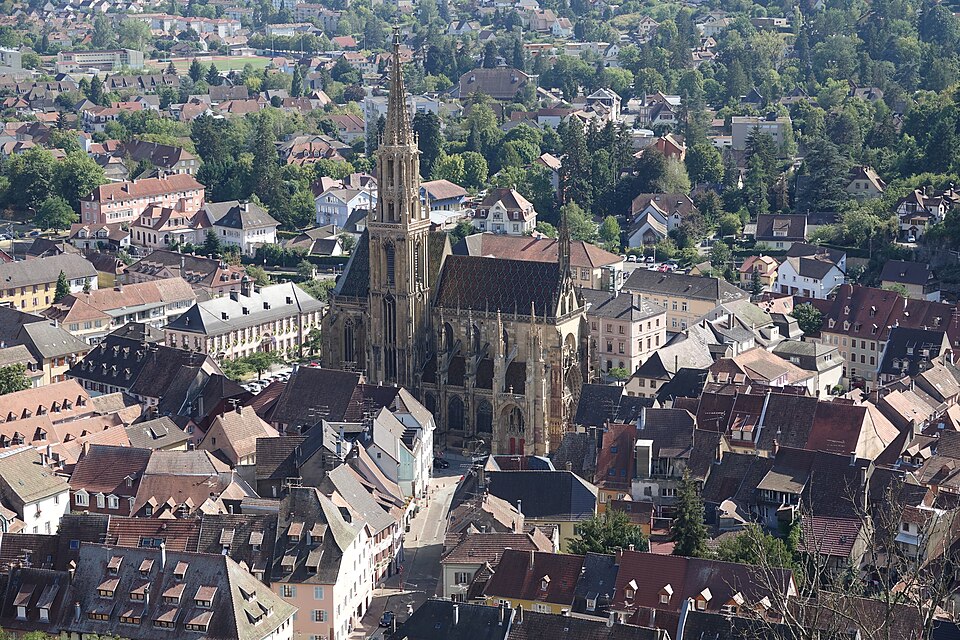
Thann is the southern end of the Alsace wine route, a town of about 8,000 where the Thur valley comes out of the Vosges, 20 km from Mulhouse.
It has two things: a Gothic collegiate church that an old Alsatian saying rates against the cathedrals of Strasbourg and Freiburg, and the steepest vineyard in Alsace directly above it.
History
Thann is first recorded in 1290, and received its town charter seventy years later, in 1360. Before the Thirty Years’ War it belonged to the House of Habsburg; in 1659 Louis XIV granted it to Cardinal Mazarin.
Like the rest of Alsace, the town was annexed by Germany after the Franco-Prussian War, returned to France after the First World War, annexed again from 1940 to 1945, and returned once more after the Second World War.
The title of Count of Thann and Rosemont is said to still be held by the head of the princely house of Monaco.
A textile industry grew up in Thann from the nineteenth century and lasted into the 1960s. The chemical works that grew out of it, originally tied to dyeing cloth, is said to be the oldest of its kind still operating in Europe.
Collégiale Saint-Thiébaut
Built between 1332 and 1516, and the saying goes: Strasbourg’s tower is the tallest, Freiburg’s the most beautiful, Thann’s the finest. That is a local boast, but the openwork spire — 78 m of stone lace — justifies it.
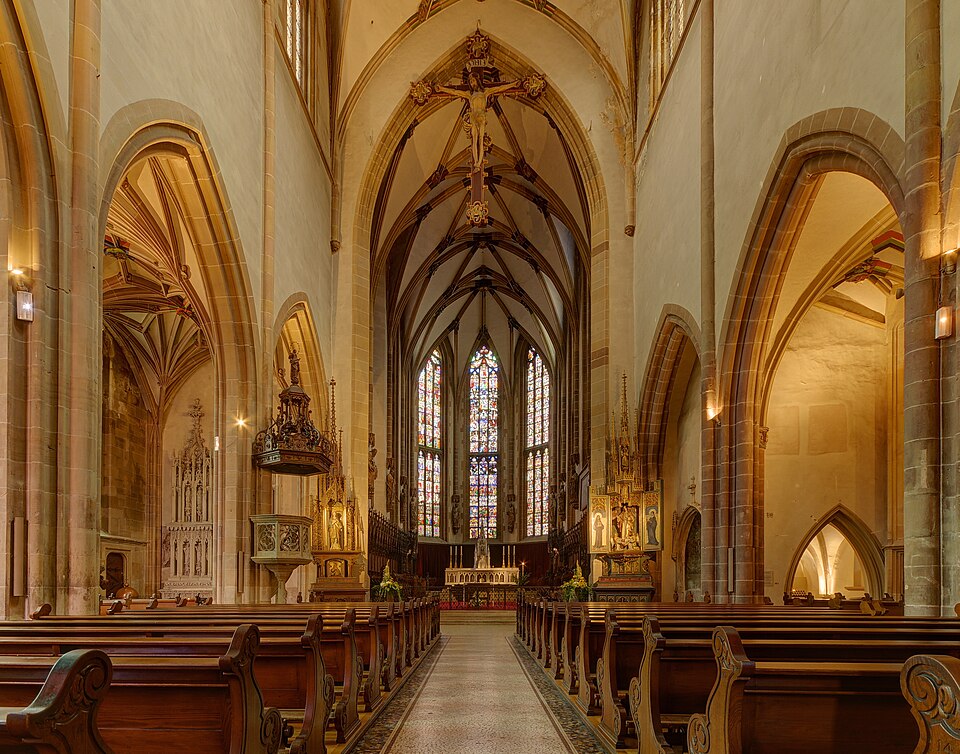
The west portal carries around 500 carved figures across its tympanums and jambs — one of the most densely sculpted doorways in France — and the choir keeps its fifteenth-century stalls and glass.
The name collégiale comes from the college of canons attached to the church, who moved to Thann from the neighbouring town of Saint-Amarin in 1442. It has been listed as a historic monument since 1841.
The legend
The church exists because of a story. A servant of Saint Theobald of Gubbio, carrying the bishop’s thumb ring as a relic, fell asleep under a fir tree here; when he woke, his staff was stuck fast and would not move, and three lights appeared over the trees. The lord of Thann took it as a sign and built a chapel.
The town still marks it: on 30 June the Crémation des Trois Sapins burns three fir trees in front of the church, and has done for centuries.
The Rangen
The vineyard above the town is the Rangen, and it is unlike anything else in Alsace: volcanic rock, terraced, and up to a 68% gradient — the steepest slope in the region, worked entirely by hand. It is also the southernmost grand cru.
The wines, mostly Riesling and Pinot Gris, are smoky and mineral in a way that comes straight from the volcanic soil. A marked path climbs through the terraces from the town.
See the wines of Alsace.
The rest of the town
The old town, included among the Plus Beaux Détours de France, spreads around the collegiate church: narrow streets of sixteenth-century houses, fountains, oriel windows, and stretches of fourteenth- and fifteenth-century fortifications.
- Tour des Sorcières — the Witches’ Tower, the surviving fortified tower of the medieval walls, with a stork nest on top
- Château de l’Engelbourg — the ruined castle above the town, blown up on Louis XIV’s orders in 1673. One section of the keep fell intact and landed on its side, and the ring of masonry with its hole through the middle is known as the Œil de la Sorcière — the Witch’s Eye. It is the emblem of Thann and visible from the valley.
- Musée des Amis de Thann — local history in a former Franciscan convent
- Ancien Château de Marsilly — a sixteenth- to seventeenth-century castle
- Hôtel de Ville — the town hall, designed in 1787 by Jean-Baptiste Kléber, later a general of the Revolutionary Wars. Building began in 1788 as a hospital meant to replace the town’s outdated Saint-Erhard hospital, but the plan changed to a town hall before it was finished, and the work was completed in 1793.
The Witches’ Tower was built in 1441 as part of the town walls; its onion dome dates from 1628, and it now houses a small museum devoted to winemaking. The Château de l’Engelbourg dates from the thirteenth century, built by the Counts of Ferrette to control the valley and collect tolls from traffic crossing the Vosges by the Thur valley road and the Col de Bussang. The ruins look out over the vineyards and the valley.
Getting to Thann
- By train — on the line from Mulhouse up the Thur valley, about 25 minutes, with a tram-train running into Mulhouse city centre. Easy without a car, which is rare on this route.
- By car — 20 minutes from Mulhouse, 45 from Colmar. See parking in France.
Trains run roughly hourly.
Around Thann
- Guebwiller — 20 km north on the wine route
- Grand Ballon — the highest summit of the Vosges at 1,424 m, 40 minutes up
- Vieil-Armand / Hartmannswillerkopf — a First World War battlefield and national monument on the ridge, where some 30,000 men died over four years of fighting for a hill
- Mulhouse — 20 km, with the car museum
- Écomusée d’Alsace — 25 minutes, the open-air museum at Ungersheim
When to go
May to October, and September–October for the harvest on the Rangen. 30 June for the fir-tree burning if you want the oddest festival in Alsace. Thann is at the quiet end of the wine route and gets a fraction of the visitors of the northern villages.
See Alsace.
Photo credits
Photographs on this page come from Wikimedia Commons under free licences:
- The town and spire — Gzen92, CC BY-SA 4.0, via Wikimedia Commons
- The interior — Thomas Bresson, CC BY 3.0, via Wikimedia Commons


Nearby
Other places on this site within easy reach, as the crow flies:
- Cernay — 6 km
- Soultz-Haut-Rhin — 13 km
- Murbach — 13 km
- Rouffach — 22 km
- Munster — 26 km
- Eguisheim — 30 km
Weather in Thann
| Month | Day | Night | Rainfall |
|---|---|---|---|
| January | +5° | -1° | 150 mm |
| February | +7° | -1° | 121 mm |
| March | +12° | +1° | 111 mm |
| April | +16° | +4° | 78 mm |
| May | +20° | +8° | 98 mm |
| June | +24° | +11° | 91 mm |
| July | +26° | +12° | 89 mm |
| August | +26° | +12° | 89 mm |
| September | +21° | +9° | 82 mm |
| October | +16° | +6° | 115 mm |
| November | +9° | +2° | 113 mm |
| December | +6° | 0° | 171 mm |
This page in Russian: Thann (Танн)
Updated: