Colmar main sights
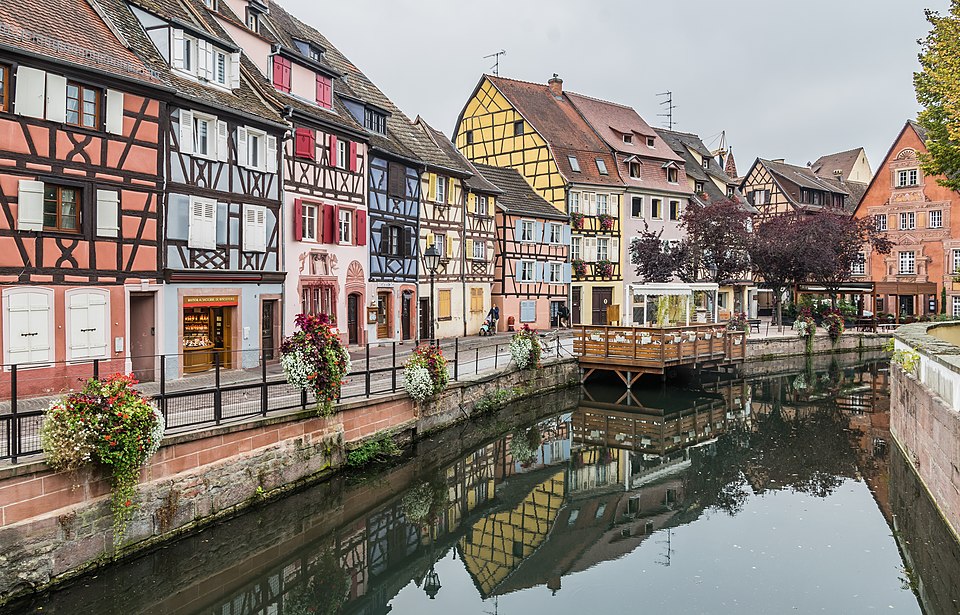
The historic centre of Colmar is small. Walk it briskly and you can see everything in two hours; stop to look and photograph and it takes four or five. Either way you have the rest of the day for the villages around, which is exactly what most people should do.
This page is what to see, in the order it makes sense to walk it.
Petite Venise
The former quarter of fishermen and market gardeners along the Lauch, and the picture everyone has seen: timber-framed houses in ochre, pink and blue standing directly over the water, with flat-bottomed boats working the canal in summer.
It runs from behind the Koïfhus down past the covered market to the Pont Saint-Pierre, which is the classic viewpoint. Go early — by ten in season the bridge is three deep.
The fishermen’s quarter
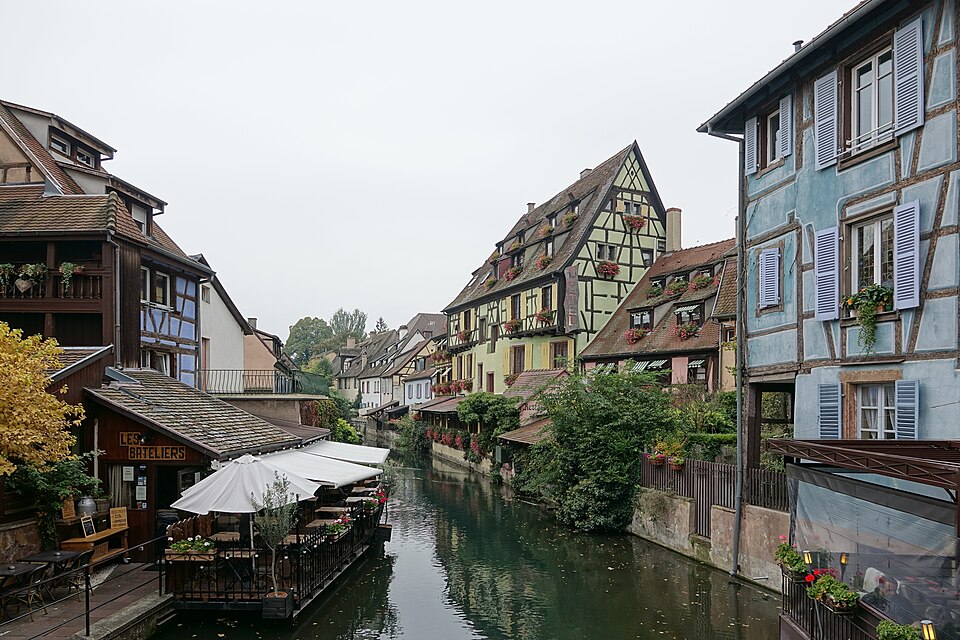
Quai de la Poissonnerie — the fish quay — is where the professional fishermen and boatmen lived, and they were organised enough to form one of the more powerful corporations in the town. The catch was kept in a pond here and sold on the spot.
A fire in 1706 destroyed more than forty houses in the quarter. What you see is partly the rebuilding, and partly the serious restoration campaign of 1978–1981 that saved the timber frames between the tanners’ district and Petite Venise.
The tanners’ district
The Quartier des Tanneurs, restored in the same period, has the tallest houses in Colmar — narrow, four and five storeys, with open top floors where the hides were hung to dry. The trade needed water and needed height, and the buildings show both.
The centre
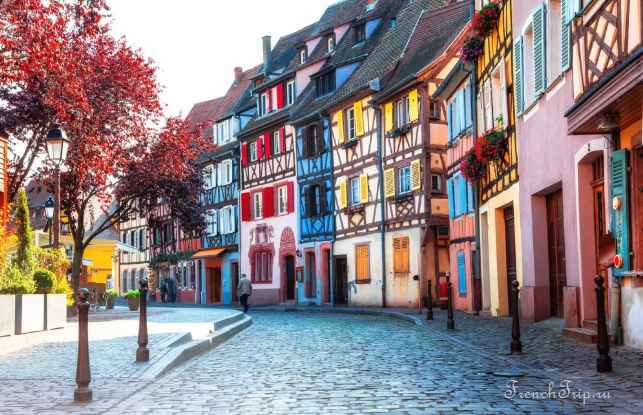
- Koïfhus (Ancienne Douane) — the old customs house of 1480, the economic and political centre of the town and of the Décapole league; the arcaded ground floor handled the goods, the hall above the meetings
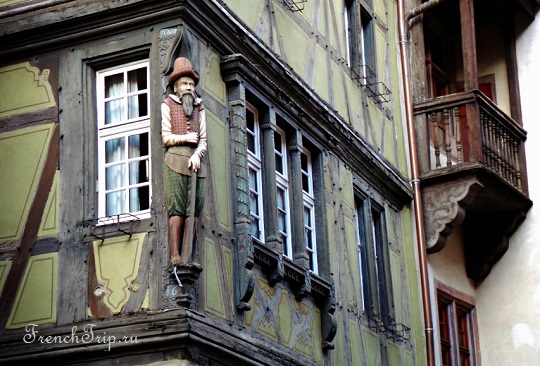
- Maison Pfister — 1537, the most photographed house in Colmar: a corner oriel, a wooden gallery and painted panels of emperors and evangelists. Built for a hatter, which tells you how much money there was in this town
- Maison des Têtes — 1609, with 106 grotesque heads on the façade; now a hotel
- Collégiale Saint-Martin — thirteenth–fourteenth century, the great church of the town, with a south portal of the Judgement
- Église des Dominicains — for Schongauer’s Virgin in the Rose Bower of 1473
- Maison Adolph — the oldest house in Colmar, about 1350
- Ancien Corps de Garde — the Renaissance guardhouse of 1575 on the Place de la Cathédrale
Musée Unterlinden
The reason to give Colmar a whole day rather than half of one. In a thirteenth-century Dominican convent, extended by Herzog & de Meuron in 2015, and it holds the Isenheim altarpiece — Grünewald’s polyptych of about 1515, painted for a hospital of plague and ergotism sufferers, and one of the most extreme works of art in Europe.
The rest of the collection runs from medieval Rhenish sculpture to Monet, Picasso and Dubuffet. Allow two hours.
Bartholdi
Colmar produced Auguste Bartholdi, who made the Statue of Liberty. The Musée Bartholdi is in his birthplace, and a full-size replica of the statue — twelve metres — stands at the northern entrance to the town, put up in 2004 for the centenary of his death.
Practical
- The centre is pedestrian; park in one of the garages on the ring and walk in. See parking in France.
- Boat trips on the Lauch run from the Petite Venise landing, about half an hour, April to October.
- Most museums close on Tuesday.
- The Christmas markets — six of them across the old town — run from late November to the end of December and change the whole experience of the place, for better and worse.
Then leave
Colmar’s real advantage is what is within twenty minutes of it: Riquewihr, Eguisheim, Kaysersberg, Turckheim, and the wine route running both ways from the town. Do the centre in the morning and be in the vineyards by lunch.
See Alsace.
Photo credits
Some photographs on this page come from Wikimedia Commons under free licences:
- Petite Venise — Krzysztof Golik, CC BY-SA 4.0, via Wikimedia Commons
- The canal — Gzen92, CC BY-SA 4.0, via Wikimedia Commons


Nearby
Other places on this site within easy reach, as the crow flies:
- Katzenthal — 6 km
- Hunawihr — 12 km
- Ribeauvillé — 13 km
- Rouffach — 14 km
- Bergheim — 14 km
- Neuf-Brisach — 14 km
Weather in Colmar
| Month | Day | Night | Rainfall |
|---|---|---|---|
| January | +6° | -1° | 33 mm |
| February | +8° | 0° | 29 mm |
| March | +12° | +2° | 32 mm |
| April | +17° | +6° | 37 mm |
| May | +21° | +10° | 64 mm |
| June | +25° | +13° | 61 mm |
| July | +27° | +14° | 60 mm |
| August | +26° | +14° | 57 mm |
| September | +22° | +10° | 46 mm |
| October | +16° | +6° | 55 mm |
| November | +10° | +3° | 42 mm |
| December | +6° | 0° | 42 mm |
Updated: