Munster
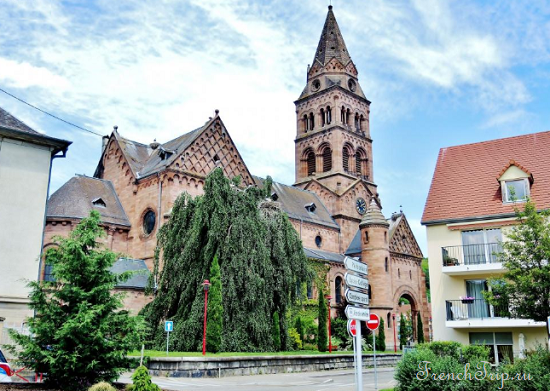
Munster is a town of about 4,500 in a valley of the Vosges, 20 km west of Colmar, and it gave its name to one of the most pungent cheeses in France.
Both the town and the cheese come from the same source: Benedictine monks founded an abbey here in the seventh century — monasterium, hence Munster — and made cheese from the milk of the high pastures above.
History
Munster lies in the Haut-Rhin département, inside the Parc naturel régional des Ballons des Vosges. The town grew up around the abbey, founded around 660 at the confluence of the valley’s two Fecht streams and dedicated to Saint Gregory, which gave the valley its old name, Val Saint-Grégoire.
In 1235 the abbot ceded two-thirds of his jurisdiction over the town to the emperor Frederick II, who passed it on to the townspeople. In 1287 Munster joined nine other villages of the valley to form the Community of the Valley and Town of Munster, a self-governing union that lasted until 1847. The town was walled in 1308, and in 1354 it joined the Décapole, the league of ten free Alsatian towns. Between 1543 and 1559 three-quarters of the population turned Protestant, and the 1575 Treaty of Kienzheim settled the dispute with the abbey by guaranteeing the townspeople freedom of worship in exchange for a payment to their pastor.
The Thirty Years’ War (1618–48) was the valley’s worst period: soldiers, famine, epidemics and hard winters cut the population sharply, and the abbey itself was not rebuilt until 1682–86, its palace not until the 1780s. Resistance to royal authority ran through the 18th century, and in July 1789 the townspeople stormed the town hall.
The 19th century brought the road over the Col de la Schlucht, in 1860, and a railway to Colmar, in 1868, later extended up the valley to Metzeral. By 1914 Munster had grown to around 6,000 people on the back of industry and tourism, and had also become a customs post, since the Franco-German border had run along the Vosges ridge above the town since 1871. The First World War reversed all of it: the front line sat on the ridge for four years, the town was shelled daily and evacuated in 1915, and around 85% of it was destroyed. Reconstruction began the day after the 1918 armistice. Munster was occupied again in 1940 and liberated in February 1945.
The cheese
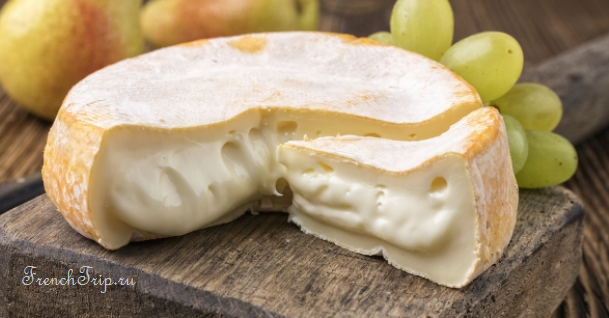
Munster — full name Munster-Géromé, AOP since 1969 — is a soft cow’s-milk cheese with an orange washed rind, made on both sides of the Vosges ridge. Washing the rind in brine during ageing is what produces both the colour and the smell.
Two things worth knowing:
- The smell is far stronger than the taste. People who cannot get past the aroma are usually surprised by how mild it is.
- Eat it with cumin. The caraway or cumin seeds served alongside are not decoration — it is the traditional pairing, along with a glass of Gewurztraminer or a boiled potato.
- Pack it well if you’re taking one home. Munster is pungent enough to fill a car if left loose in the boot.
Farm-made munster fermier comes from the marcaireries, the summer mountain farms on the pastures above the valley, several of which sell at the door and serve meals.
See French cheeses and the wines of Alsace.
In Gunsbach, down the valley, the Maison du Fromage is a farm-tourism exhibit built around the valley’s cheesemaking and its pastoral traditions.
The town
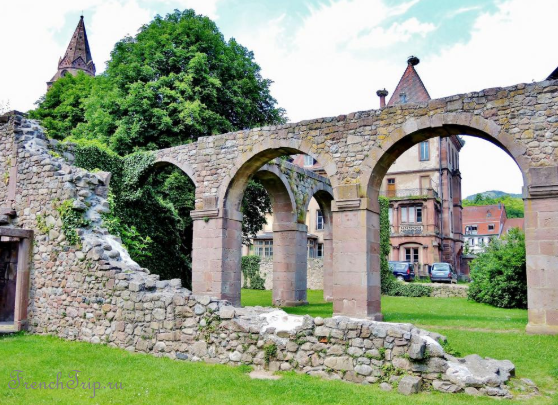
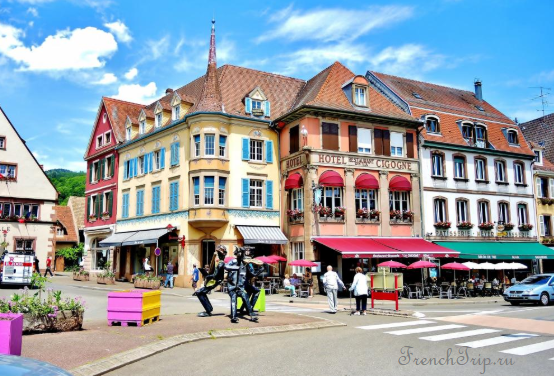
Munster was badly damaged in the First World War — the front ran along the ridge above it for four years — so much of what stands is 1920s reconstruction. What survives:
- The abbey ruins in the park at the centre, with the arcades left standing
- The Protestant church and the Catholic one facing each other, in the usual Alsatian arrangement
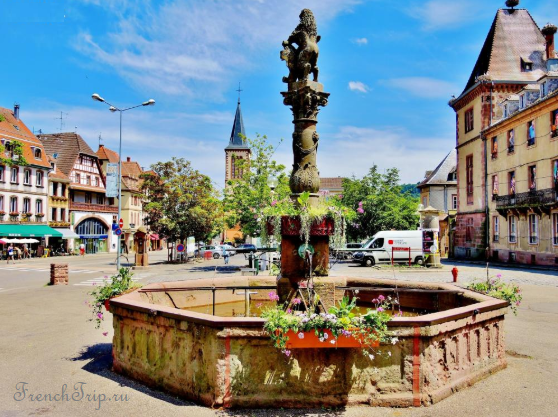
- Place du Marché with its fountain and Saturday market
- The storks — Munster has a reintroduction enclosure and nests on several roofs
- The town hall, dating from 1550 and rebuilt after the First World War, with a Renaissance facade and, inside, an eclectic collection of columns, tombstones, statues and stained glass gathered from around the town
- Saint-Léger, the Catholic church, has an astronomical clock on four dials showing the date and the phases of the moon
- The Laub, a building of 1867–69 that took over the functions of an older hall where the valley and town council used to meet and hold its market
More of the abbey survives nearby: the abbot’s palace, the prelate’s building and an old mill that served the monastery.
The fountain on Place du Marché is topped with a lion. It was put up in 1576 to mark the previous year’s Treaty of Kienzheim, damaged and taken down during the Revolution, and reinstated a century later a short distance from its original site near the town hall.
The valley
The Vallée de Munster runs west into the mountains and is the real attraction: high pasture, beech forest, lakes and the chaumes — the open grassland on the tops where the cows spend the summer.
- Route des Crêtes — the ridge road along the summits, built as a military supply route in 1914–18, with the whole Rhine plain on one side and Lorraine on the other. On a clear day the Alps are visible.
- Lac Blanc and Lac Noir — glacial lakes at the head of the valley
- Le Hohneck — 1,363 m, one of the highest points of the Vosges, drivable
- Le Linge — a preserved First World War battlefield with trenches and bunkers left in place, and a small museum. Sobering and worth the detour.
- Gunsbach — Albert Schweitzer’s house, in the valley below
- Château de Schwartzenbourg — ruins of a castle at 522 m in the forest above the valley, on the boundary between Munster and Griesbach-au-Val
What to eat
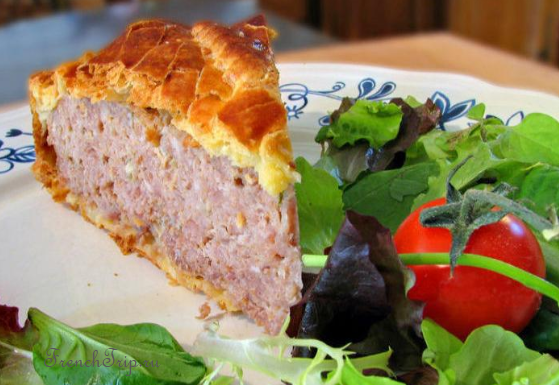
Besides the cheese: tourte de la vallée de Munster, a raised pie of minced pork and veal marinated in Riesling, which is the valley’s own dish, and roïgabrageldi, potatoes slow-cooked with bacon and onion. The mountain farms serve both.
The tourte also has a place on the traditional shepherds’ menu of the Vosges mountain farms; it is usually served with a green salad and a glass of Alsace Pinot Noir or Pinot Blanc.
Getting to Munster
- By train — the branch line from Colmar takes about 25 minutes and continues up the valley to Metzeral. This is unusual out here and makes a car-free visit possible.
- By car — 20 minutes from Colmar on the D417, which continues over the Col de la Schlucht into Lorraine. See parking in France.
- By bus — there is also a bus route from Colmar, for travellers without a car who would rather not wait for the train
Around
- Turckheim — 10 km, at the mouth of the valley on the wine route
- Colmar — 20 km
- Col de la Schlucht — the pass at the head of the valley, and the Route des Crêtes from there
When to go
May to October. The high pastures are in use from late May to September and the mountain farms only serve then. Autumn on the ridge is the best of it; winter brings small ski stations and the road over the pass can close.
See Alsace.
Weather in Munster
| Month | Day | Night | Rainfall |
|---|---|---|---|
| January | +6° | -1° | 121 mm |
| February | +7° | -1° | 92 mm |
| March | +11° | +2° | 81 mm |
| April | +16° | +5° | 64 mm |
| May | +20° | +8° | 86 mm |
| June | +24° | +12° | 82 mm |
| July | +26° | +14° | 76 mm |
| August | +25° | +13° | 80 mm |
| September | +21° | +10° | 64 mm |
| October | +16° | +7° | 98 mm |
| November | +10° | +3° | 85 mm |
| December | +6° | 0° | 125 mm |
Updated: