Wines of Alsace
Alsace is the odd one out among French wine regions, and in a way that makes it easier for a visitor: the label tells you the grape. Everywhere else in France you are expected to know that Chablis means Chardonnay and Gigondas means Grenache. Here it says Riesling on the bottle.
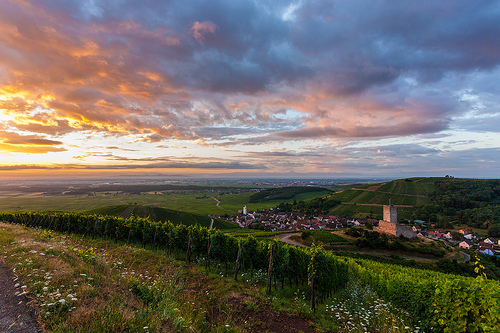
The reason is German. Alsace spent long stretches under German rule, and German labelling by variety stuck.
The grapes
About 90% of production is white.
- Riesling — dry, taut, mineral, and the region’s serious wine. Nothing like the sweeter German style; this is bone dry and ages for decades.
- Gewurztraminer — lychee, rose and spice, low acid, often off-dry. The one people either love or cannot drink. The name means “spiced Traminer”.
- Pinot Gris — fuller and rounder, sometimes with a touch of sweetness; good with white meat and with foie gras
- Muscat — grapey and dry, which surprises people; drunk as an aperitif
- Sylvaner — light and everyday, and mostly out of fashion, with one exception at Mittelbergheim
- Pinot Blanc — the reliable everyday white, and the base of most crémant
- Pinot Noir — the only red permitted, and increasingly good as the climate warms
The hierarchy
- AOC Alsace — the base appellation, about three quarters of production, from anywhere in the region
- AOC Alsace Grand Cru — 51 named hillsides, each a defined plot with its own soil and rules. Only the four “noble” grapes are normally allowed: Riesling, Gewurztraminer, Pinot Gris and Muscat.
- Crémant d’Alsace — the sparkling wine, made by the same method as champagne, and the largest-selling crémant in France
Two late-harvest categories sit above the dry wines:
- Vendanges Tardives — grapes left on the vine, concentrated, richly sweet
- Sélection de Grains Nobles — individually picked botrytised berries, rare and expensive
The Sylvaner exception
Worth knowing because it explains how the system works. When the grands crus were defined, Sylvaner was excluded as an ordinary grape. The growers of Mittelbergheim argued that on the marl-limestone of their Zotzenberg it had always made their best wine, and in 2005 they won: Zotzenberg is the only grand cru in Alsace permitted to produce Sylvaner.
The bottle and the glass
Alsace wine comes in a tall narrow bottle, the flûte d’Alsace, and by law it may only be bottled within the region — a rule dating from 1972. Serve it cool but not iced, around 8–10 °C; too cold and the aromatics disappear, which is the usual mistake.
What to drink with what
The regional cooking and the regional wine were built together:
- Choucroute — Riesling, and it is cooked in Riesling too
- Munster cheese — Gewurztraminer, which is one of the great pairings and works because the wine is aromatic enough to survive the cheese
- Foie gras — Pinot Gris or a Vendanges Tardives
- Tarte flambée — Sylvaner or Pinot Blanc, cold, with the smoke
- Coq au Riesling — the same wine you cooked it in
- Baeckeoffe — the marinade is Riesling; drink that
See the cooking of Alsace and French cheeses.
Tasting in Alsace
- Walk in. Signs saying dégustation or vente directe mean exactly that; most growers on the wine route need no appointment and charge nothing.
- Buying is the etiquette after a free tasting at a small domaine, and the prices at the door are a fraction of restaurant prices.
- Cooperatives — Turckheim, Ribeauvillé, Bennwihr and others — are a good way to compare a whole village in one room.
- Do not drive. France’s limit is low and in an accident any alcohol effectively decides fault. Nominate a driver who does not taste, or use the marked cycle route.
- Harvest is September–October, when the growers are working and have less time — either side of it is better for visits, and the villages are just as beautiful.
Where to go
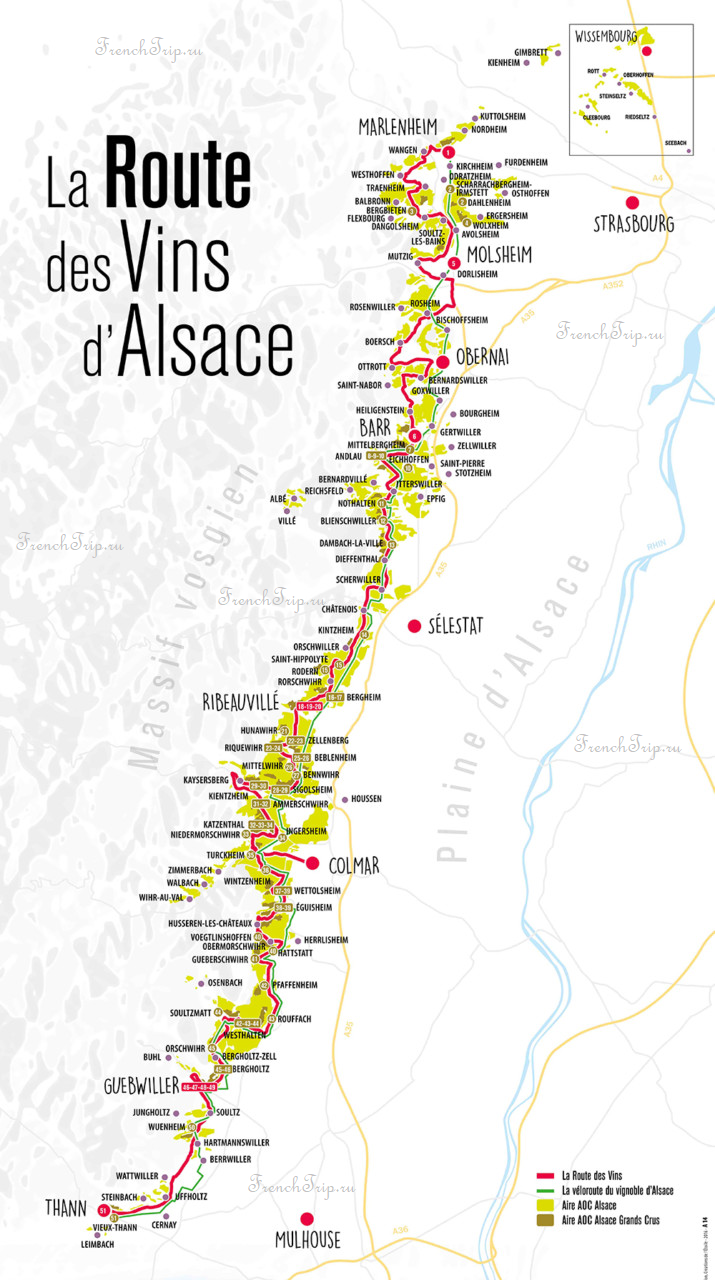
The Alsace wine route runs 170 km from Marlenheim to Thann and passes almost every producer in the region. Villages worth stopping at for the wine specifically:
- Riquewihr — Schoenenbourg and Sporen grands crus, and the historic houses of Hugel and Dopff
- Hunawihr — the Rosacker, source of the celebrated Clos Sainte-Hune
- Turckheim — the Brand, and a good cooperative
- Eguisheim — Eichberg and Pfersigberg, and where Alsatian viticulture is claimed to have begun
- Kaysersberg — the Schlossberg, the first Alsatian vineyard classified grand cru, in 1975
- Rouffach — the Vorbourg, with a marked walk through it and nobody on it
See French wines and wine routes in France.
Updated: