Murbach
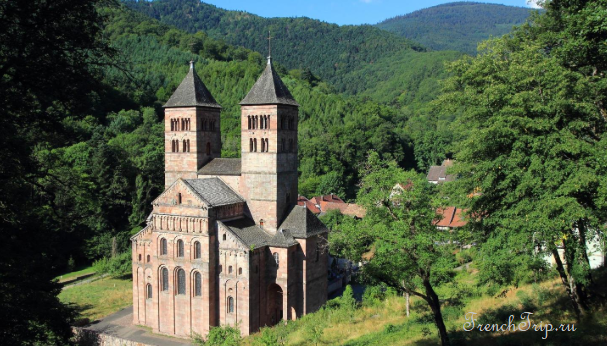
Murbach is a hamlet of about a hundred people at the head of a wooded valley in the southern Vosges, 6 km above Guebwiller. There is almost nothing there — and one of the finest Romanesque buildings in France.
The abbey
Founded in 727 by Count Eberhard of Alsace and the Irish monk Saint Pirmin, Murbach became one of the most powerful monasteries in the Holy Roman Empire. At its height the prince-abbot ruled some three hundred villages, minted coin, and answered to nobody but the Emperor. Its library was famous across Europe.
What you see is the choir and transept of the church rebuilt about 1140 — flat-ended, in pink Vosges sandstone, with two square towers and bands of blind arcading. The nave was pulled down in 1738 when the monks, by then thoroughly worldly, decided to move to Guebwiller and build something more comfortable. The Revolution finished the community off.
The result is a building cut in half, standing alone in a green cirque with wooded slopes closing round it. The proportions are extraordinary and the setting does the rest.
What to look for
- The east front — the flat chevet with three tiers of arcading, unusual in France and Rhenish in feeling
- The tympanum of the south portal, with two lions
- The tomb slabs of the abbots inside
- The chapel of Notre-Dame-de-Lorette, a twenty-minute climb up the slope behind, with the view down onto the church
The valley
The Vallée de Murbach is a dead end — the road stops at the abbey — which is why it is quiet. Walking paths run up from the church into the Vosges: to the Lorette chapel, to the Grand Ballon (1,424 m, the highest summit of the range) and along the ridge.
Getting there
- By car — the only way. From Guebwiller take the D429 up the Florival valley then the turning to Murbach, about 10 minutes. Colmar 35 minutes, Mulhouse 30. See parking in France.
- Parking — a small area by the church; it fills on summer Sundays.
- Access — the church is normally open and free.
Around Murbach
- Guebwiller — 6 km, the town the abbey built, with four grands crus
- Grand Ballon — 30 minutes by road, the roof of the Vosges
- Soultz-Haut-Rhin — 10 minutes, on the wine route
- Thann — 25 minutes south, with the Rangen vineyard
- Route des Crêtes — the ridge road built for the First World War front, running the length of the Vosges
When to go
April to October. Autumn is the best of it — the beeches on the slopes turn and the pink sandstone takes the low light. Concerts of early music are held in the church in summer, and the acoustics are what you would hope.
See Alsace.
Nearby
Other places on this site within easy reach, as the crow flies:
- Rouffach — 11 km
- Cernay — 13 km
- Munster — 13 km
- Eguisheim — 18 km
- Turckheim — 20 km
- Katzenthal — 23 km
Weather in Murbach
| Month | Day | Night | Rainfall |
|---|---|---|---|
| January | +4° | -1° | 148 mm |
| February | +5° | -1° | 118 mm |
| March | +11° | +2° | 112 mm |
| April | +16° | +5° | 80 mm |
| May | +19° | +8° | 106 mm |
| June | +23° | +12° | 88 mm |
| July | +25° | +14° | 90 mm |
| August | +25° | +13° | 88 mm |
| September | +20° | +10° | 85 mm |
| October | +14° | +7° | 119 mm |
| November | +9° | +3° | 119 mm |
| December | +6° | 0° | 167 mm |
Updated: