Carnivals in France
Carnival season in France runs from late January to early March, and it is the best reason to be here in the worst weather of the year. The biggest of them is in Nice; the strangest is in Dunkirk; the longest, anywhere in the world, is in a small town in the Languedoc called Limoux.
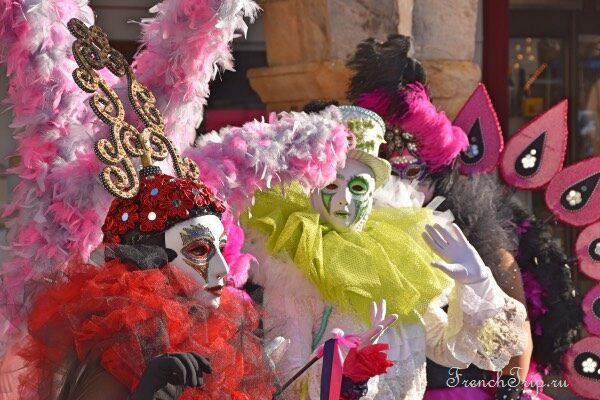
What Mardi Gras is
Mardi Gras, Fat Tuesday, falls the day before Ash Wednesday — 47 days before Easter, so the date moves every year. It has no liturgical event of its own. It is simply the last day before Lent, which in the Middle Ages meant a ban on celebrations, dancing, pleasure and decent food for six weeks. Faire gras means to eat meat; faire maigre means to fast. The word carnival comes from the Latin carne levare, to take away the flesh.
The form is older than Christianity. The Roman Saturnalia temporarily overturned the social order, letting slaves behave as they liked; the calends of March celebrated the coming spring with disguises and broken taboos. By the 11th century all of it had folded into a popular procession where anyone could dress up and walk through the streets. In the Middle Ages the reversal went further still, with the election of a «pope of fools» — the scene Victor Hugo gives to Quasimodo in the fifth chapter of Notre-Dame de Paris.
The food is part of it: crepes, waffles and beignets, all of them ways of using up fat, eggs and sugar before Lent. Today, in most of France, that survives mainly as sweets handed out in schools.
Nice
One of the largest carnivals in the world and the biggest winter event in Europe. The records go back to 1294, when Charles of Anjou, count of Provence, wrote of passing «the joyous days of carnival» in the town. The modern shape — parades, masquerades, satirical floats — dates from 1873.
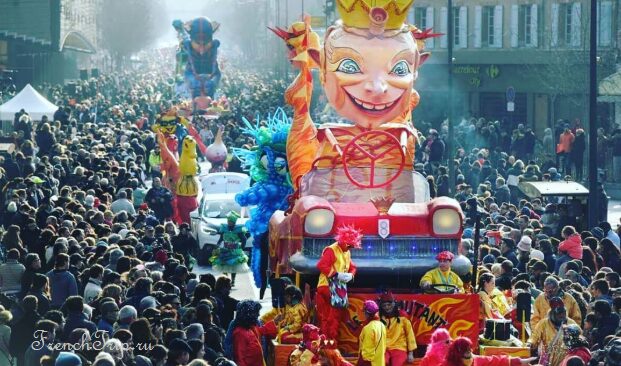
It runs for about two weeks and draws over a million spectators. Artists build around twenty papier-mâché floats and giant figures each year, and the parade runs along the Promenade des Anglais from Place Masséna in Nice. There are two kinds of procession: the corso carnavalesque with the floats, and the bataille de fleurs, in which costumed figures on flower-covered floats throw thousands of stems into the crowd. Seats in the stands are ticketed and sell out; the standing areas cost less and see nearly as much.
Book accommodation early — the whole Côte d’Azur fills up, not least because Menton holds its lemon festival in the same weeks, with citrus sculptures the size of houses, and most visitors do both.
Paris
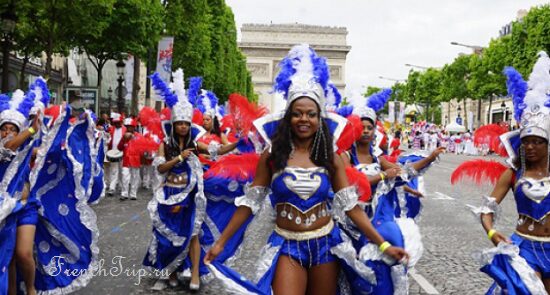
Paris has had a carnival since the 16th century at least, with a gap from 1952 to 1957. The parade draws more than fifty thousand people for music, street theatre, jugglers and acrobats.
Its centrepiece is the Promenade du Bœuf Gras, the fat ox parade, which keeps the medieval form: it sets off at about 13:00 from Place Gambetta in the 20th arrondissement, crosses the centre and ends at Place de la République, led by a live long-horned cow, with whistles, streamers and confetti doing what they can for a grey city. It is held on the Sunday before Mardi Gras.
A second parade, the carnival of the laundry queens, came back in 2009 and falls in mid-Lent, about a month later. The rule of the day is that women dress as queens and men dress as women.
Limoux
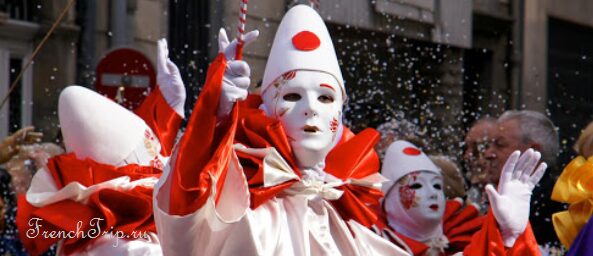
The longest carnival in the world, in a town of ten thousand people near the Spanish border. It runs from January to March, and on every Saturday and Sunday the bands — the fecos — come out three times: 11:00, 16:30 and 22:00. Each band has its day; musicians lead, and behind them come the goudils, masked figures who tease the crowd.
The masks are the difference. They are closer to Venice than to the papier-mâché giants of the north, and the whole thing is slower, odder and more local than a parade. The tradition is traced to the 14th century, when the millers were exempted from their dues to the priory of Prouille on Mardi Gras and celebrated by walking the streets with minstrels, throwing sugared almonds and flour.
Dunkirk
One of the loudest carnivals in Europe, and the one with the strangest roots. It goes back to the 17th century and the vischerbende: the fishermen went from café to café with their families before sailing for the Iceland cod grounds, a send-off for men who might not come back.
It runs from late January to early March, with the main parade on the Mardi Gras weekend and neighbouring communes holding their own on other days. Expect drums, oilskins, umbrellas, herrings thrown from the town hall balcony, and a crowd that sings rather than watches. See the cuisine of Hauts-de-France for what to eat afterwards.
Annecy
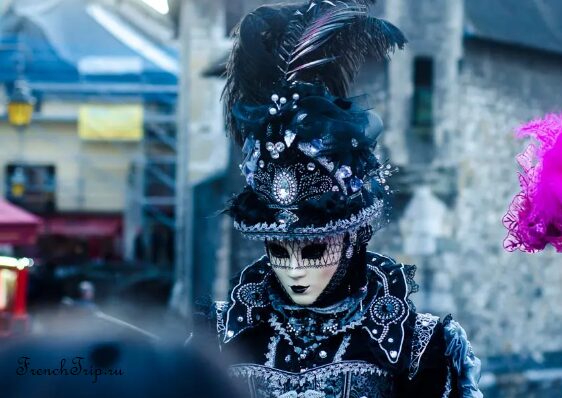
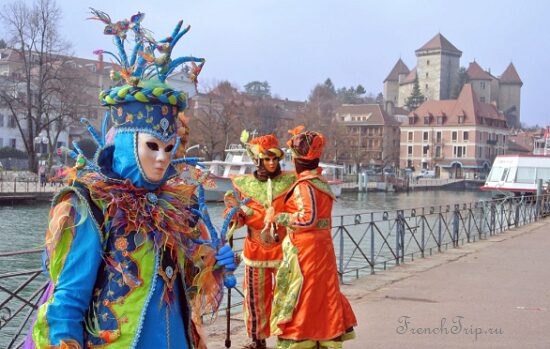
Annecy holds a Venetian carnival, and it works because the town looks the part: canals, arcades, painted houses. There is no parade. Costumed figures simply appear in the old town and pose, silently, for anyone with a camera, all weekend. It is the most photogenic of the French carnivals and the quietest.
Mulhouse and Albi
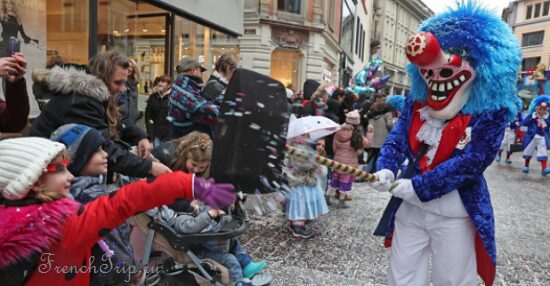
Mulhouse runs the largest carnival in Alsace, with a Sunday parade of bands and floats through the centre, and it is one of the four biggest in the country. Albi, in the south-west near Toulouse, holds a smaller and friendlier one in its red-brick streets.
Three more worth the detour
Granville, in Normandy, holds the biggest carnival in the west — four days, a hundred thousand visitors, and a tradition that grew out of the Newfoundland cod fleet, like Dunkirk’s. It was added to France’s inventory of intangible cultural heritage in 2016. The last night belongs to the intrigues: masked locals who corner friends and neighbours in the bars and tease them in disguised voices.
Cholet, in the Pays de la Loire, runs a night parade with illuminated floats. Bailleul, in Flanders, elects a giant called Gargantua and parades him — northern carnivals are full of géants, wicker figures several metres tall that belong to particular towns and come out only for this.
Practical notes
Carnivals are also spread across Provence, the Côte d’Azur, Alsace, the north near the Belgian border, around Lyon and in Aquitaine near Bordeaux. Wherever you go, check the local programme: where the season is long, the processions happen only on particular days, and in between you may find no more than a few costumed groups and a band in the street. The big parade is usually the last day.
Dress for cold and wet, bring small change for the food stalls, and expect to be hit by confetti, sweets and, in Dunkirk, fish.
What to eat while you are there. Carnival food is fried and sugared: beignets everywhere, bugnes around Lyon, oreillettes in Provence, merveilles in the south-west, waffles in the north, and crepes in Brittany — all of them ways of finishing the fat and eggs before Lent starts.
With children. Carnivals are the easiest winter outing in France: costumes are sold in every supermarket from January, children are expected to be in them, and the sweets thrown from the floats are aimed at the front row.
See also festivals in France, public holidays in France and, for the northern version of all this, the Hauts-de-France region page.
Updated: