Villefranche-sur-Mer
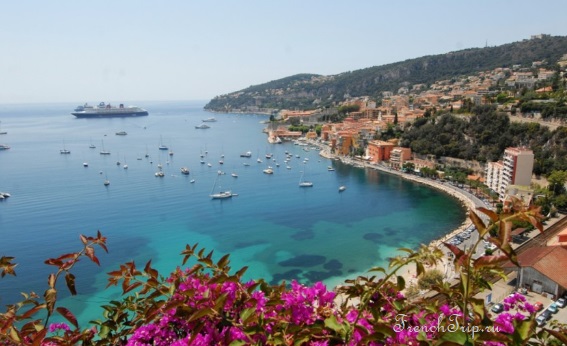
Villefranche-sur-Mer is a small resort town of about 6,000 people on the French Riviera, 6 km east of Nice and 10 km from Monaco. It sits on one of the deepest natural harbours in the Mediterranean.
The bay reaches 95 metres between the Cap de Nice and Cap Ferrat, and beyond it the seabed falls away into the Villefranche Canyon about a nautical mile offshore. That depth is why the large Mediterranean cruise ships anchor here rather than at Nice — several thousand passengers a day come ashore in season, most of them heading straight for Èze.
Why come here
The beach is sand. That sounds trivial, and it is the single practical reason many families choose Villefranche over Nice: the long town beach is one of the very few between Nice and the Italian border that is coarse sand rather than pebble. No beach shoes required, and it works with small children.
The town was a favourite of writers and artists — Aldous Huxley among them — and it has stayed expensive. Property on the steep slope above the bay is some of the dearest on the coast; Tina Turner and Bono both bought houses here.
The town climbs from the shore to 575 metres. Three corniche roads at different heights connect it to Nice and on towards Italy.
Getting there
Villefranche is one of the easiest places on the coast to reach without a car.
- By train — about 6 minutes from Nice-Ville on the coastal line, with trains every 15–30 minutes. The station is right by the beach.
- By bus — route 15 and the coastal services from Nice, slower but more scenic along the lower corniche.
- By car — the lower corniche runs through the town. Parking is very limited and largely paid; in season it is genuinely difficult. See parking in France.
Nice Côte d’Azur airport is about 20 minutes away. See regional trains in France.
What to see
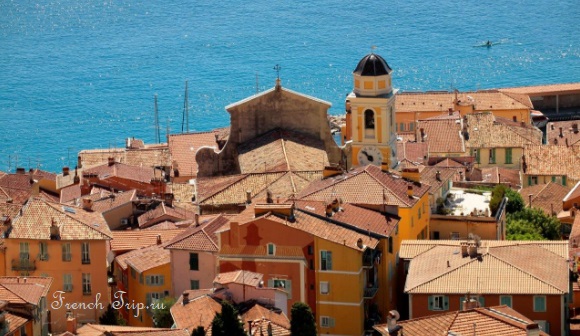
The old town is small and steep — a grid of stepped lanes in ochre and pink between the shore and the citadel, and it takes an hour to walk properly.
Chapelle Saint-Pierre
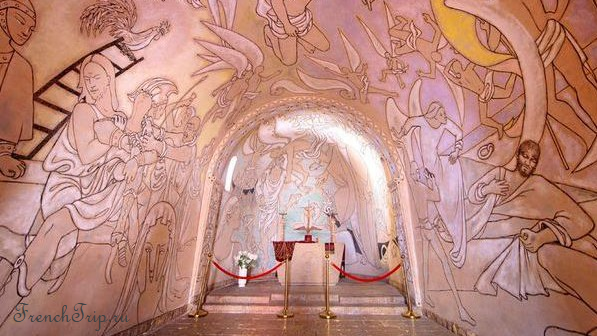
A fishermen’s chapel by the harbour, decorated inside and out by Jean Cocteau in 1957 — scenes from the life of Saint Peter and from the life of the town, in his unmistakable line. Small, cheap to enter, and the most memorable thing in Villefranche.
Rue Obscure
A covered medieval street running under the houses for about 130 metres — built in the thirteenth century as a defensive passage, and one of very few of its kind left in France. Cool in any weather, and slightly eerie.
Citadelle Saint-Elme
The sixteenth-century fortress on the point, built by the Duke of Savoy. It now holds the town hall and several small free museums — the Volti collection of sculpture is the best of them — and the ramparts give the view back over the bay.
Église Saint-Michel
The eighteenth-century baroque parish church, with a Christ carved from a fig tree by an anonymous galley slave.
Port de la Santé and the Royal Port
The old harbour front with its restaurant terraces, and the darker Port de la Darse beyond the citadel, built by the Savoy as a naval arsenal.
Walking route through the town
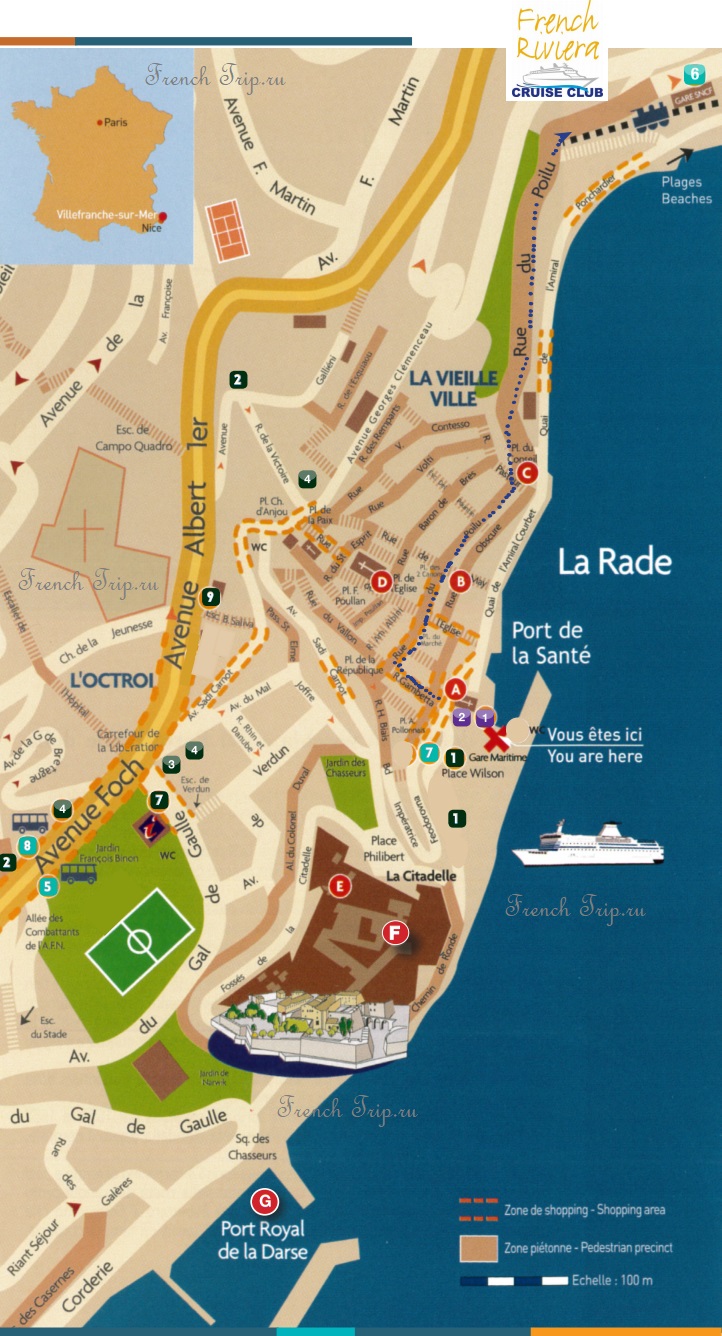
The town has a signed route linking the sights above, from the chapel by the harbour up through the Rue Obscure to the citadel and back along the front. It takes about an hour and a half at a walking pace, longer if you stop.
What to eat
Fish, mostly, on the terraces along the Port de la Santé — with the prices you would expect of a view like that. The cooking is niçoise rather than broadly Provençal: socca, pissaladière, salade niçoise. See Provençal cuisine.
Nearby
- Saint-Jean-Cap-Ferrat — the peninsula across the bay, with the Villa Ephrussi de Rothschild and a coastal footpath around the point
- Èze — the hilltop village, 10 minutes east
- Beaulieu-sur-Mer — next along the coast, with the Villa Kérylos
- Monaco — 15 minutes by train
- Nice — 6 minutes, and the reason Villefranche works as a quieter base
When to go
May, June and September are the best months. In July and August the beach is full and the cruise ships add several thousand day visitors to a town of six thousand — mornings are noticeably calmer than afternoons. Winter is quiet and mild, and the bay is just as good to look at.
Where to park in Villefranche-sur-Mer
| Car park | Spaces | Fee | From centre |
|---|---|---|---|
| Place Sainte-Élisabeth | — | free | 20 m |
| Place Wilson | — | paid | 270 m |
| Aire Demontzey | — | free | 1.2 km |
Nearby
Other places on this site within easy reach, as the crow flies:
- La Turbie — 9 km
- Aéroport de Nice — 9 km
- Roquebrune-Cap-Martin — 14 km
- Saint-Paul-de-Vence — 15 km
- Vence — 16 km
- Menton — 17 km
Weather in Villefranche-sur-Mer
| Month | Day | Night | Rainfall |
|---|---|---|---|
| January | +13° | +6° | 74 mm |
| February | +13° | +6° | 54 mm |
| March | +15° | +8° | 51 mm |
| April | +17° | +11° | 69 mm |
| May | +21° | +14° | 40 mm |
| June | +25° | +18° | 36 mm |
| July | +27° | +21° | 14 mm |
| August | +28° | +21° | 17 mm |
| September | +25° | +18° | 81 mm |
| October | +21° | +14° | 128 mm |
| November | +17° | +10° | 138 mm |
| December | +14° | +6° | 90 mm |
Updated: