French pancakes (Crêpes, Galettes)
French pancakes come under two names, and the difference is not size but flour. Sweet ones, made with wheat flour, are crêpes. Savoury ones, made with buckwheat, are galettes. Both are Breton in origin and both are now sold in every French town.
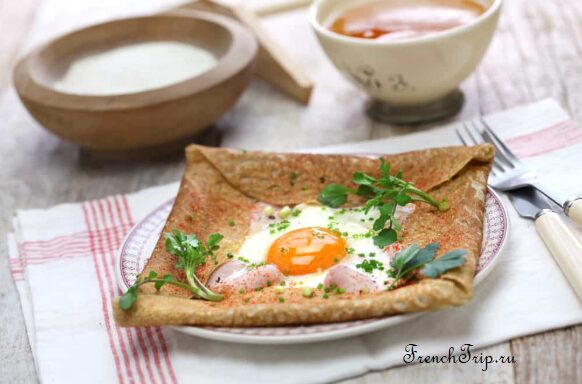
Galettes
Buckwheat — blé noir, black wheat — is recorded in Breton cooking in the 15th century, and buckwheat pancakes in the 16th. They were eaten by hand, or dipped into soup to thicken it. In 1838 Stendhal wrote in his traveller’s notes that Breton-speaking Brittany lived on buckwheat pancakes, and for a long time that was close to literal.
The name comes from galet, a pebble — though be careful with it, because the word means different things in different places: in Lower Brittany a galette is a sweet-butter shortbread, in Upper Brittany the savoury buckwheat pancake.
Normandy makes them too, and the border between the two traditions runs roughly where the cider does — see the cuisine of Normandy. A galette is large, very thin and noticeably darker than a crêpe, with the faint nutty taste of the buckwheat. It is served folded into a square, occasionally a triangle, around a savoury filling: cheese — often sheep’s cheese — pâté, sausage, ham, mushrooms, egg. The standard is the galette complète: cheese, ham and an egg, with the yolk left visible in the middle. Menus run much further, up to scallops in the coastal towns.
Crêpes
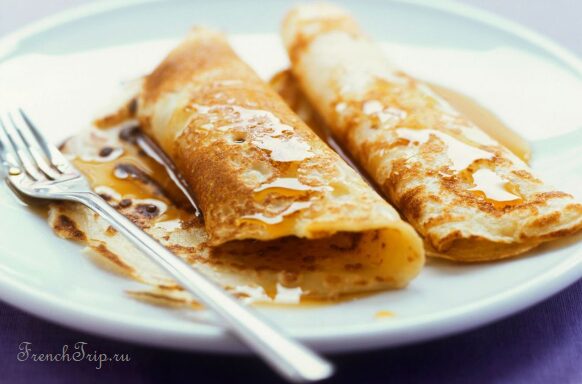
The sweet wheat-flour version is younger than it looks: it spread at the end of the 19th century, when wheat flour became cheap, and took hold around Montparnasse in Paris before travelling on from there.
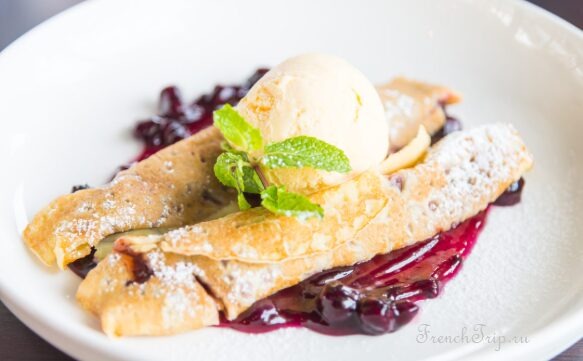
Fillings go from plain sugar and butter, through jam, honey and chestnut cream, to chocolate spread and salted butter caramel — the last being the Breton answer to everything.

Crêpes Suzette are the restaurant version: crêpes warmed in caramelised butter with orange juice and zest, then flambéed with Grand Marnier. Worth ordering once for the performance.
How they are made
Galette batter is nothing but buckwheat flour, salt and cold water — 330 g of flour and 10 g of salt to 750 ml of water feeds five people. Crêpe batter adds eggs, milk and butter. Both rest before use.
The pan is a flat cast-iron plate, a bilig in Breton — galetière or galettoire in Upper Brittany — and the batter is spread across it with a small wooden rake called a rozell, in one turn of the wrist. Watching this done well is half the reason to sit near the counter.
The two halves of Brittany even make different galettes. In Upper Brittany it is buckwheat flour, water and salt only — no eggs, sugar or milk — and the result is thicker, soft after frying and pitted with holes; that is the one wrapped round a sausage as a galette-saucisse. In Lower Brittany the batter is thinner, the surface smooth, and the pancake brittle as soon as it leaves the pan.
At home the Breton proportion is two cups of buckwheat flour to two cups of water and a teaspoon of salt, adjusted until it pours properly. Buckwheat needs a hotter pan than wheat and a good coat of butter; the first one always fails, after which the butter film starts doing its job. Buckwheat sticks more than wheat, and a spoonful of olive oil in the batter reduces that without changing the taste. Stacked warm, the galettes soften and become easy to fold round a filling.
In a crêperie
Do not expect white tablecloths. A crêperie is a small room with the tables pushed together, close enough that you catch your neighbour’s elbow — friendly, plain, and part of the point. They are everywhere in Brittany and Normandy, in every town and most villages, and common in the larger cities elsewhere; in Paris, one of the good old ones is La Crêperie de Josselin at 67 rue du Montparnasse, in the quarter where the sweet crêpe took hold in the first place.
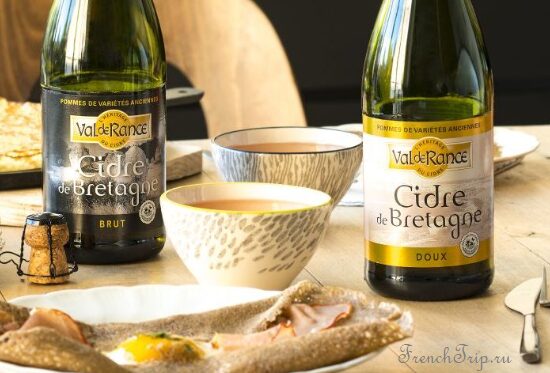
The usual order is one savoury galette, one sweet crêpe and a cup of cider, and most crêperies sell exactly that as a set menu: 9.5 to 15€ depending on the town and the fillings, around 10€ as a rule. Cider is served in a bowl rather than a glass; a cup costs about 2.5€, a 0.75 l bottle 8 to 16€ in a restaurant and 2 to 6€ in a shop.
Supermarkets sell packs of ready-made galettes and crêpes, about 2.5€ for five, which reheat in butter at home. Carry them flat: buckwheat galettes crack easily.
More on where they come from in the cuisine of Bretagne, on the rest of the country’s dishes in traditional dishes from France, and on regional cooking generally in French cuisine.
Updated: