Mont-Saint-Michel
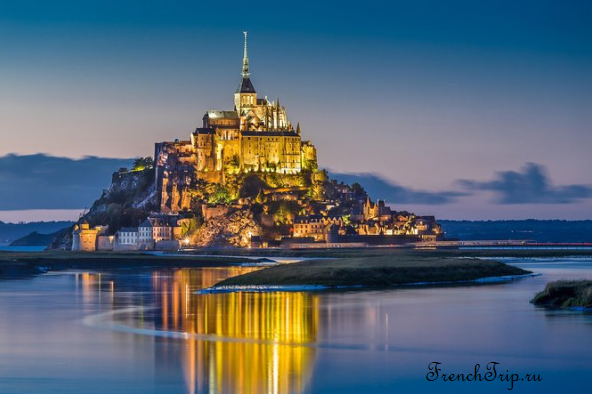
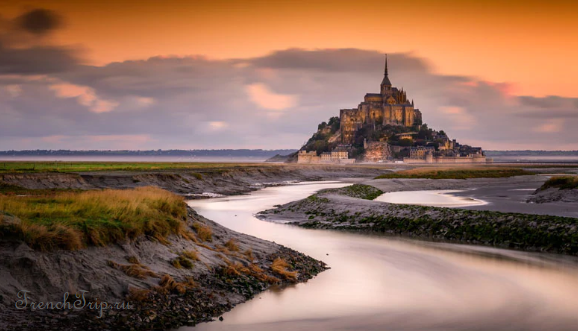
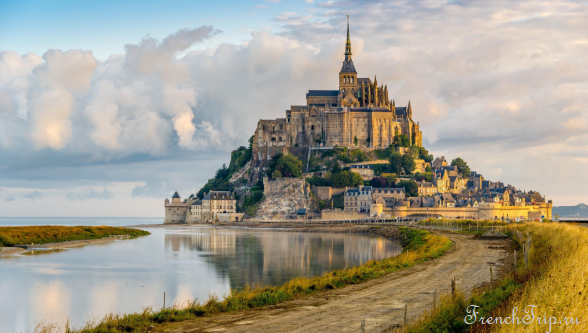
Mont-Saint-Michel is a rocky tidal island in the bay of the same name, on the border between Normandy and Brittany, crowned by a great medieval abbey and ringed by walls, with a tiny village clinging to its slopes. Rising from the sands and the sea, it is one of the most famous sights in France and one of the most visited, with millions of visitors a year. The Mont and its bay have been a UNESCO World Heritage Site since 1979. Only about thirty people still live on the island.
The best moments are early in the morning, in the evening when the day trippers have gone and the abbey is lit up, and at the high spring tides, when the sea surrounds the rock and it becomes an island again.
A short history
The rock, about 80 m high, was once called Mont Tombe. According to legend, in 708 the archangel Michael appeared three times to Aubert, bishop of nearby Avranches, ordering him to build a sanctuary on the rock; the third time, impatient, he touched the bishop’s head with his finger. The first church was consecrated in 709, and the Mont soon became one of the great places of pilgrimage of medieval Europe.
In 966 the Duke of Normandy, Richard I, brought Benedictine monks to the Mont, and over the following centuries they built the abbey that stands today: a Romanesque church on the summit from the 11th century, and in the 13th century the Merveille, the “Marvel”, a Gothic building of three storeys built against the steep north side of the rock. During the Hundred Years’ War the Mont was fortified and resisted every English attack: in 1434 its garrison of 119 knights drove off a final assault, and the English cannons they captured, the Michelettes, still stand by the entrance. The Mont became a symbol of French resistance.
After the Revolution the monks were expelled, and from 1793 to 1863 the abbey was a prison, ironically renamed Mont Libre, “Free Mount”. It was listed as a historic monument in 1874 and restored, and in 1897 the neo-Gothic spire was topped with the gilded statue of Saint Michael slaying the dragon, by the sculptor Emmanuel Frémiet. Monks returned in 1966 for the abbey’s thousandth anniversary, and a small religious community still lives and prays here.
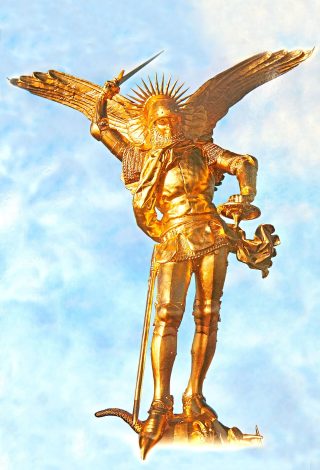
Statue of Saint Michael: photo by Dennis G. Jarvis, CC BY-SA 2.0, via Wikimedia Commons.
What to see
The village and the walls
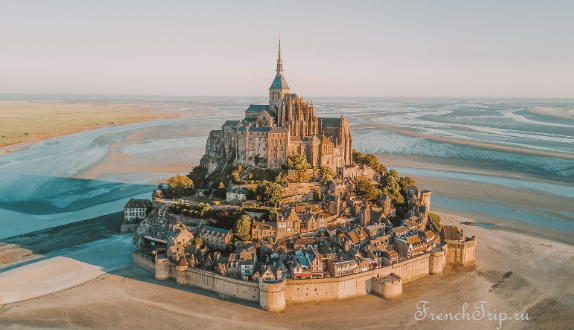
You enter through the fortified gates, past the Michelettes cannons, into the Grande Rue, the single narrow street that winds up the hill, lined with old houses, hotels, restaurants and souvenir shops, and very crowded in the middle of the day. Halfway up is the little parish church of Saint-Pierre. For a quieter way up, and the best views over the bay, walk along the ramparts instead. Everything is on foot and steep, with many steps: pushchairs and wheelchairs are not practical beyond the lower village.
The abbey
The visit to the abbey takes about an hour and a half. It is a maze of halls, crypts and staircases built on several levels around the rock:
- The West Terrace, in front of the church, with a great view over the bay, from Cancale in Brittany to the cliffs of Normandy and the islet of Tombelaine.
- The abbey church on the summit, with a Romanesque nave of the 11th century and a soaring Flamboyant Gothic choir rebuilt in the 15th century.
- The cloister of the Merveille, a garden in the sky surrounded by delicate double rows of staggered columns, with a bay opening onto the sea.
- The refectory, where the monks ate in silence, lit by narrow windows hidden from the entrance.
- The Knights’ Hall and the Guests’ Hall, among the finest Gothic halls in France, the crypts that support the church, and the great wooden wheel, turned by prisoners walking inside it to haul supplies up the rock in the days of the prison.
Mass is celebrated every day in the abbey church by the monastic community, and visitors are welcome to attend.
The tides
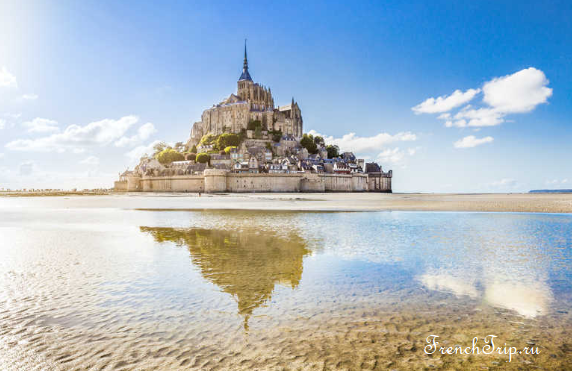
The bay of Mont-Saint-Michel has some of the highest tides in continental Europe, with a difference of up to about 14 m between low and high water at the spring tides. At low tide the Mont stands in a vast expanse of sand and mud; at high tide the water comes in fast and, at the biggest tides, surrounds the rock completely. The most spectacular tides come a day or two after the full and new moons, especially around the equinoxes in March and September. The tide tables are posted on the official site and at the tourist office.
A raised footbridge, opened in 2014 to replace the old causeway, lets the sea flow freely around the Mont again and keeps the access open at all but the highest tides.
Safety in the bay
- Never walk out onto the sands of the bay on your own. The tide comes in very fast over the flat sands, there are patches of quicksand and channels that fill quickly, and fog can come down suddenly. People are caught by the sea every year. Crossing the bay on foot is a wonderful experience, but only with a licensed guide, who knows the tides and the safe routes.
- On the days of the highest tides, stay on the footbridge and the paths, and follow the instructions of the staff.
- The streets and the abbey are steep, with many uneven steps, and the top of the Mont can be very windy and cold even on a sunny day.
What to eat
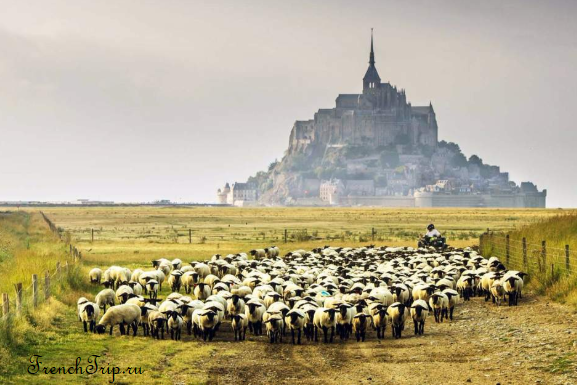
The Mont is famous for the omelette of La Mère Poulard, a fluffy omelette beaten in copper bowls and cooked over a wood fire, served since the late 19th century, and for pré-salé lamb, from sheep that graze on the salt meadows around the bay, which gives the meat its particular taste. The oysters of Cancale, across the bay, are a few minutes away.
Getting there
- By car: cars are not allowed on the Mont. Leave the car in the large car parks on the mainland, about 2.5 km away, and take the free shuttle bus, which stops near the footbridge at the foot of the Mont, or walk there in about 45 minutes, with the classic view of the Mont ahead of you all the way. Hotel guests on the mainland get access codes from their hotels.
- By train: from Paris, take the TGV to Rennes and the direct coach from Rennes station to the Mont, about an hour and ten minutes. There is also a train to Pontorson, the nearest station, with a bus from there.
- Coach tours run from Paris, but they make a very long day.
Around Mont-Saint-Michel
- Saint-Malo, the walled corsair city on the Brittany coast, and Cancale, famous for its oysters, each about an hour away.
- Dinan, a medieval town with streets of half-timbered houses.
- Avranches, where the manuscripts of the abbey are shown in the Scriptorial museum, and Granville, a seaside town with the Christian Dior museum.
See also the most beautiful places in Normandy and UNESCO sites in France.
Weather at Mont-Saint-Michel
| Month | Day | Night | Rainfall |
|---|---|---|---|
| January | +9° | +3° | 76 mm |
| February | +10° | +3° | 58 mm |
| March | +12° | +4° | 55 mm |
| April | +15° | +6° | 60 mm |
| May | +18° | +9° | 66 mm |
| June | +21° | +12° | 55 mm |
| July | +23° | +13° | 62 mm |
| August | +23° | +13° | 65 mm |
| September | +21° | +11° | 57 mm |
| October | +17° | +9° | 87 mm |
| November | +12° | +6° | 86 mm |
| December | +9° | +4° | 95 mm |
Nearby
Other places on this site within easy reach, as the crow flies:
This page in Russian: Mont Saint-Michel (аббатство Мон Сен-Мишель)
Updated: