Cancale
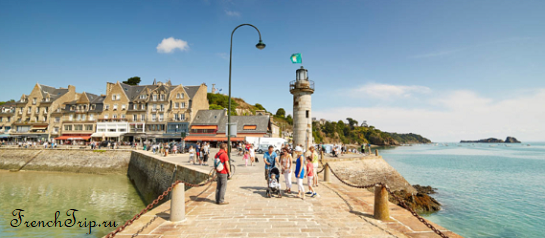
Cancale is an oyster port of 5,000 people on the eastern side of the bay of Mont-Saint-Michel, 14 km from Saint-Malo. It has supplied oysters to the tables of France since Roman times, and it is the single best place in the country to eat them.
The bay has the highest tides in Europe — up to fourteen metres between low and high water — which is exactly what an oyster bed needs, and what makes the place look completely different twice a day.
History
People have been present on this stretch of coast since the Palaeolithic. Local legend, recorded in an eleventh-century hagiography, credits a Welsh monk, Saint Méen, with landing in the bay around 545 to found Cancale and Christianise Armorica; a stone said to bear his footprints and a spring said to have healing powers survive near the site of the old church that carries his name.
Vikings raided Cancale and the surrounding Dol country in 996, and the church at Port-Pican was looted; building began soon after on a new church, Saint-Méen-de-Judicaël. The town’s name evolved from Konkaven to Cancaven — first recorded in a charter of Duke Alain III of Brittany in 1032 — and then to Cauncall.
Cancale’s sailors became known for the long cod-fishing voyages to Newfoundland; back from a season there, from October to March, they turned to coastal fishing, market gardening or oyster gathering. The town is said to have supplied oysters to the royal court from the reign of Francis I, who granted it the status of town in 1545 in recognition of their quality. English forces tried more than once to land near Cancale to attack Saint-Malo from the land side, notably in 1758 and 1779, and the military engineer Vauban built a fort on the Île des Rimains in response — said to have been one of the more powerful coastal fortresses of its day.
In 1612, ships fitted out at Cancale’s port — the Regent, Charlotte and Sainte Anne — sailed for Brazil under Daniel de La Touche, sieur de La Ravardière, a Huguenot naval captain who went on to found what became São Luís do Maranhão; he later settled at La Houle and died there. A bronze memorial to him was unveiled near the harbour lighthouse in 2012.
The oysters
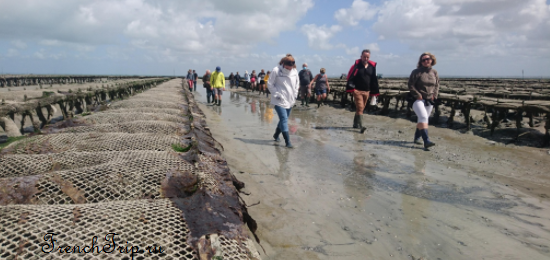
Some 25,000 tonnes a year come off the 7.3 km² of beds in the bay. Two kinds are grown:
- Huîtres plates — the flat native oyster, Ostrea edulis, the historic Cancale oyster: strong, mineral, expensive, and increasingly rare
- Huîtres creuses — the hollow Pacific oyster grown everywhere in France since the 1970s, fattened here on the plankton the bay produces
La Caravane
More than a hundred million flat oysters used to be taken from the bay each year in the wild fishery. Louis XVI regulated the harvest by decree in 1787 to stop the natural beds being exhausted: each spring, around Easter, the local sailing boats, bisquines, were allowed fifteen days of digging. When the watch gave the signal, a fleet of some two hundred bisquines put out together, a spectacle known as la Caravane. They came in on the tide to unload shells and oysters at the port, and at low water the women sorted the catch from each boat on the quay. The largest wild oysters, grown to an unusual size, were known as pieds de cheval — “horse’s hoof”.
Sailing boats made the run until the Second World War, after which motorised fishing boats took over, with the fishery supervised daily by the maritime authorities. A caravan that fell on Easter Sunday was the subject of a novel by the French writer Roger Vercel. Today’s oyster boats are large flat-bottomed aluminium barges.
At the Marché aux Huîtres on the Pointe des Crolles, the growers sell straight from trestle tables by the dozen, opened and on a paper plate with a lemon, for a few euros. You eat them sitting on the sea wall and throw the shells onto the beach below, as everyone has done for two hundred years — the shell bank under the wall is the result.
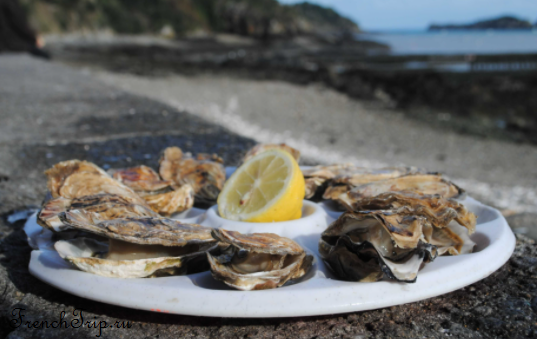
This is not a tourist ritual invented for visitors; it is how the town sells its seconds. The restaurants along the Port de la Houle do the same thing at table, with muscadet.
The oyster gatherers of Cancale have attracted painters for well over a century. Eugène Feyen painted the town and its oyster pickers over several decades from around 1865, and John Singer Sargent‘s Oyster Gatherers of Cancale (1878) shows the same trade.
The town
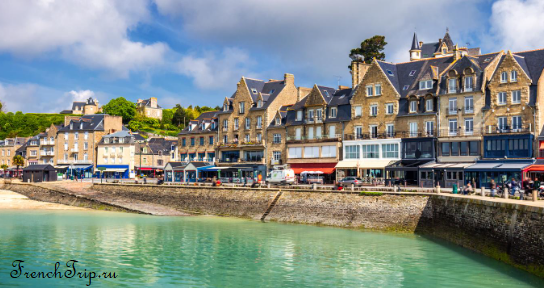
Cancale is really two places: La Houle, the harbour along the shore, and the town on the cliff above it, joined by steep streets.
- Église Saint-Méen — with a tower you can climb for the view over the bay to Mont-Saint-Michel
- Musée des Arts et Traditions populaires — in the deconsecrated old church, on the oyster trade and the deep-sea fishery Cancale also ran, to Newfoundland
- La Ferme Marine — a working oyster farm open for guided visits, with a collection of several thousand shells
- Musée des bois sculptés — around three hundred figures carved in high relief by a Cancale-born abbot (1879–1955), on themes running from the apple harvest to national commemoration
- Corps de garde des Daules — a seventeenth-century guardhouse by the old orchard cove, a listed monument and said to be the last of its kind built under Vauban in France
- Quai de l’Épi — a stone jetty below the old fort, also listed, built in the early nineteenth century to replace an older dike
- Château de la Vallée — a former malouinière of the eighteenth century that once belonged to the Dubois de la Cotardière family; malouinières, the large houses built by Saint-Malo’s merchant shipowners in the seventeenth and eighteenth centuries, are occasionally open to visitors, particularly during the September Journées du Patrimoine
- La Cancalaise — a sailing replica, launched in 1987, of the bisquine La Perle (1905), the traditional working boat of the bay
The church itself, Saint-Méen, was built between 1715 and 1727 by the architect Siméon Garangeau on the site of a medieval predecessor and extended in the 1830s; it is a listed historic monument. On the square in front of it stands a fountain with a bronze by the sculptor Jean Fréour, two oysters representing the work of the cancalaises, the women who worked the oyster trade before it was mechanised.
Walking
The GR34 — the old customs officers’ path — runs north from the port round the Pointe du Grouin, and this is the finest stretch of coast in Ille-et-Vilaine: cliffs, the Île des Landes bird reserve offshore, and on a clear day Mont-Saint-Michel across the bay and the Chausey islands out to sea.
Port-Mer to the Pointe du Grouin and back is about two hours.
Beaches
The beaches lie along the coast north of the harbour — Port-Briac, Port-Mer, Port-Pican and a beach by the old orchard — with swimming, a promenade and water sports. The northernmost, below the Pointe du Grouin, looks out to Cap Fréhel and Granville as well as the Chausey Islands.
Getting to Cancale
- By car — 20 minutes from Saint-Malo, 45 minutes from Mont-Saint-Michel, an hour from Rennes. Parking on the port fills by midday in summer; there is more above the town. See parking in France.
- From the east, the road leaves the N176 at the Châteauneuf-d’Ille-et-Vilaine interchange and follows the D76 into Cancale.
- By train — no station. Saint-Malo and Dol-de-Bretagne are the nearest, with buses on.
- By bus — regular services from Saint-Malo, about 40 minutes.
Around
- Saint-Malo — 14 km, the walled city
- Mont-Saint-Michel — 45 minutes across the bay
- Pointe du Grouin — 5 km north
- Dinan — 45 minutes inland
- Dol-de-Bretagne — 20 minutes, with its cathedral and the Menhir du Champ-Dolent
- Saint-Suliac — a small fishing village on the river Rance, often named among France’s most beautiful villages, with narrow streets of old stone houses
- Combourg — a town on a lake below a feudal castle, associated with the writer Chateaubriand, who lived there
Dol-de-Bretagne, the historic seat of the bishops of Brittany, stands on a cliff that was on the coastline until the eleventh century; from the top there is a view over the whole area from Cancale to Mont-Saint-Michel. Its Gothic cathedral of Saint-Samson has thirteenth-century stained glass, and the streets around it keep a number of timber-framed houses. Nearby, the Menhir du Champ-Dolent, at 9.3 metres, is one of the tallest standing stones in Brittany.
Food
Besides oysters, Cancale has plenty of restaurants serving Breton cooking, and most also offer meat for anyone who has had enough seafood. A crêperie is the cheapest way to eat, with a savoury galette and a cup of cider. Local mussels are in season from June to the end of August; they are best avoided outside that window.
When to go
Oysters are at their best from September to April — the old rule about months with an R holds here, because the flat oysters spawn in summer and turn milky. The town is at its busiest in July and August, when the eating is at its worst; going in October gets you both the empty quay and the good oysters.
See Brittany.
Nearby
Other places on this site within easy reach, as the crow flies:
- Moncontour — 68 km
- Paimpol — 89 km
- Tréguier — 102 km
Weather in Cancale
| Month | Day | Night | Rainfall |
|---|---|---|---|
| January | +9° | +4° | 64 mm |
| February | +10° | +4° | 56 mm |
| March | +12° | +5° | 48 mm |
| April | +15° | +6° | 54 mm |
| May | +17° | +9° | 56 mm |
| June | +20° | +12° | 54 mm |
| July | +22° | +14° | 46 mm |
| August | +22° | +14° | 58 mm |
| September | +20° | +12° | 60 mm |
| October | +17° | +10° | 81 mm |
| November | +13° | +7° | 89 mm |
| December | +10° | +4° | 86 mm |
This page in Russian: Cancale (Канкаль)
Updated: