Half-timbered houses in France
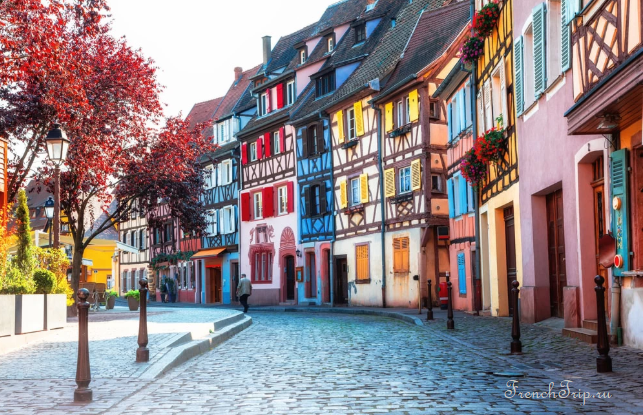
Half-timbered houses, in French maisons à colombages or maisons à pans de bois, are one of the most familiar sights of old France. They are built on a frame of wooden beams, and the spaces between the beams are filled with a mixture of clay and straw, with stone or, later, with brick. The timbers are left visible on the outside, so the frame itself becomes the decoration. Whole streets and old towns of them survive in Normandy, Brittany, Alsace, Champagne and the Basque country, and smaller groups in many other regions.
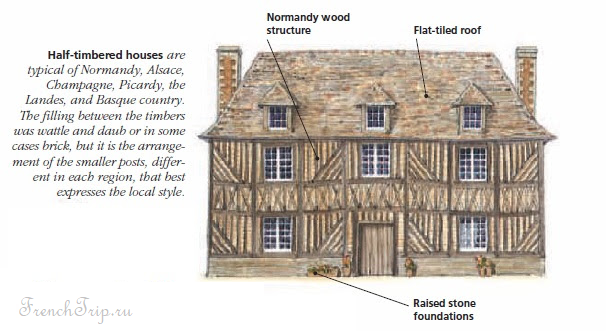
Colombages and pans de bois
The French word colombage comes from colombe, an old word for a vertical post, itself from the Latin columna, a column. Pan de bois means a “wall section of wood”. Today the two terms are used almost interchangeably for the same kind of building, although in Brittany people usually speak of pans de bois, and in Normandy and Alsace of colombages.
A short history
Building with a timber frame and earth infill goes back to prehistoric times, and the Romans used it as opus craticium. In the Middle Ages it was the ordinary way of building in much of northern France, in towns and villages alike, wherever there was plenty of wood. Timber was cheap and close at hand, while stone was expensive, and until canals and railways arrived, transporting heavy materials was the costliest part of any building. Oak, hard and long-lasting, was the main wood.
Towns grew fast in the late Middle Ages, especially after the Hundred Years’ War, and most of the half-timbered houses that survive date from the 15th to the 17th centuries. In the big cities they were gradually replaced by stone from the 16th and 17th centuries onwards, partly from fashion and partly from fear of fire. In 1720 a great fire destroyed some 900 houses in the centre of Rennes, and royal ordinances in several cities, Paris among them, banned new timber façades or required them to be covered with plaster. Many half-timbered houses were hidden under render for two centuries and have only been uncovered since the 20th century. In the countryside, timber-framed farms and barns went on being built until the 19th century, when cheap industrial brick took over.
Since the 1960s, many old town centres have been protected and restored, and half-timbered streets are now among the main attractions of towns such as Rouen, Rennes, Troyes and Colmar.
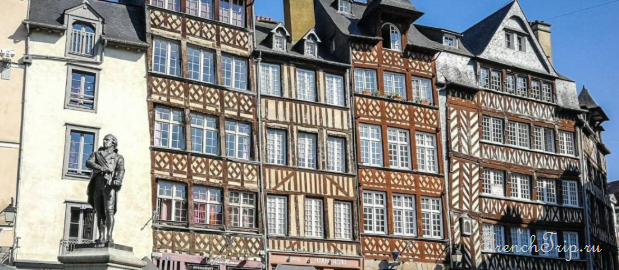
How a half-timbered house is built
- The foundation. The frame stands on a low wall of stone or brick that keeps the wood away from the damp ground. Often the whole ground floor is of stone, with timber only on the upper floors.
- The frame. On the foundation lies a heavy horizontal beam, the sablière, which carries the vertical posts. Each floor has its own sill and posts, and diagonal braces hold the whole frame rigid. The pieces are joined by mortise and tenon and fixed with wooden pegs, without nails, and the carpenters cut assembly marks into each piece to show where it belongs.
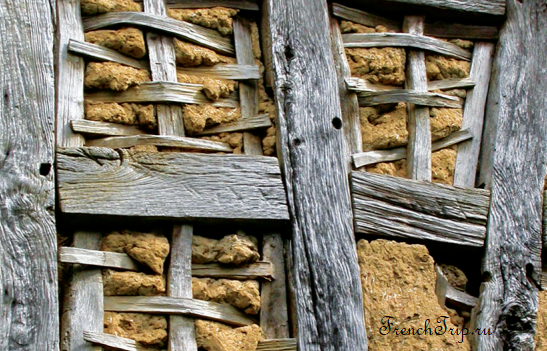
- The infill. Traditionally the spaces were filled with a lattice of wooden laths or woven hazel or willow, covered with torchis, a mixture of clay, straw, lime and water, sometimes with animal hair. Later the infill was often replaced by brick, laid in decorative patterns such as herringbone, or by stone.
- The finish. The infill was covered with lime plaster, often coloured, and the beams were sometimes painted too.
The oldest houses were built with long posts rising from the ground to the roof. From around the 16th century carpenters switched to short posts, one storey at a time, which needed less long timber and made it possible to build higher. Each storey could then project beyond the one below, a feature called jettying (encorbellement). It gave more floor space on narrow plots and sheltered the walls and the shop fronts on the ground floor from the rain. But the upper floors of facing houses almost met above the street, making the lanes dark and helping fires to spread.
Decoration
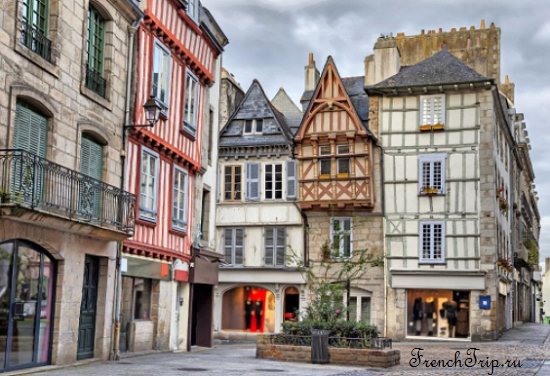
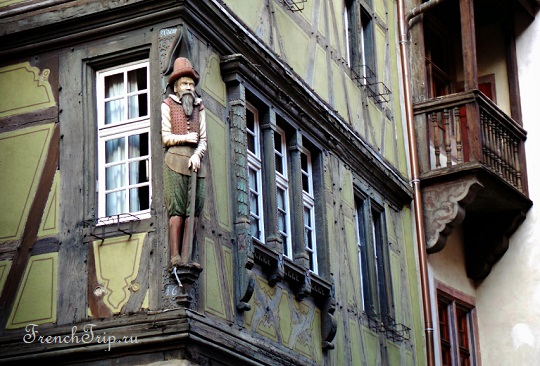
The frame itself is decorative: closely spaced posts in Normandy, wide frames with diagonal crosses in Alsace, patterns of braces that differ from region to region. The richest houses also have carved corner posts and beams, with figures of saints, animals, foliage and the dates and names of the builders. In Alsace the braces form recognisable figures, such as the “man” (a post with two braces like arms) and the curule chair (curved braces forming an X), whose meaning, if any, is still debated. Colour was a sign of wealth: red and yellow ochres were common, blue was rare and expensive.
Regional styles
- Normandy: tall, narrow houses with closely spaced vertical posts, in towns, and in the countryside low thatched cottages with an iris growing along the ridge of the roof.
- Brittany: tall town houses of three or four storeys with strongly projecting upper floors, often painted in bright colours.
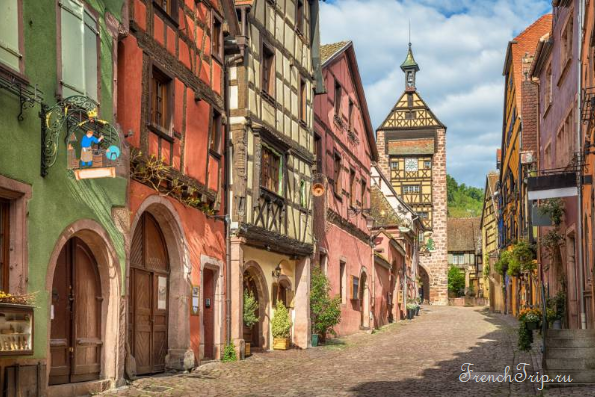
- Alsace: wide frames with diagonal braces and crosses, carved posts and brightly painted plaster, sometimes with an overhanging gallery.
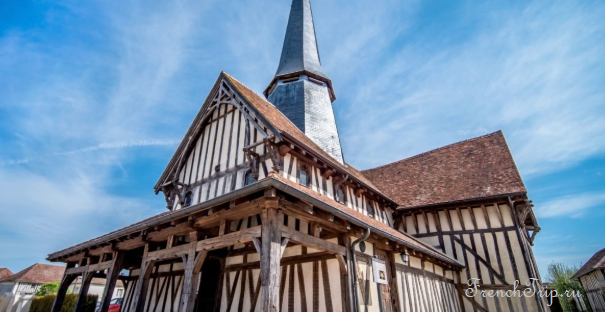
- Champagne: frames of oak and sometimes poplar, with two diagonal braces leaning on a central post, and unique half-timbered churches.
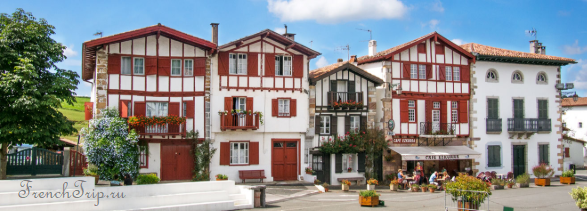
- The Basque country: whitewashed houses with timbers painted dark red or green.
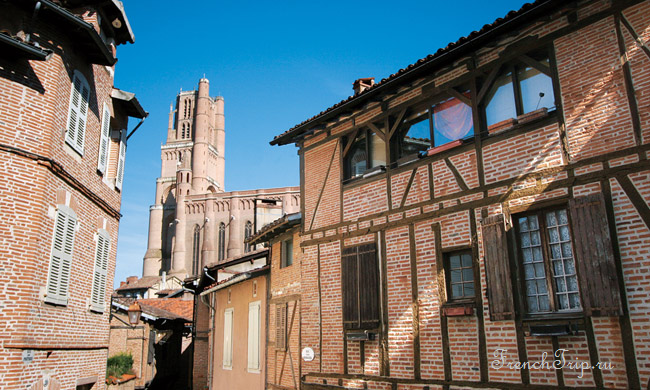
- The south-west: in Albi and Toulouse, frames filled with the red brick of the region.
Where to see half-timbered houses
Normandy
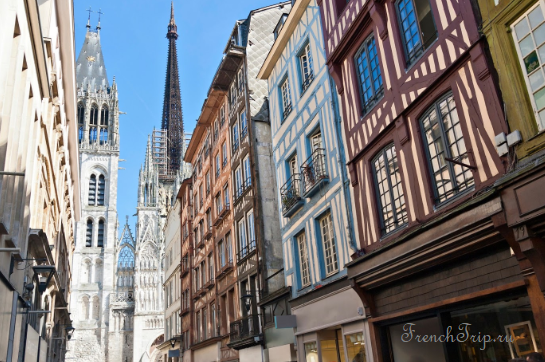
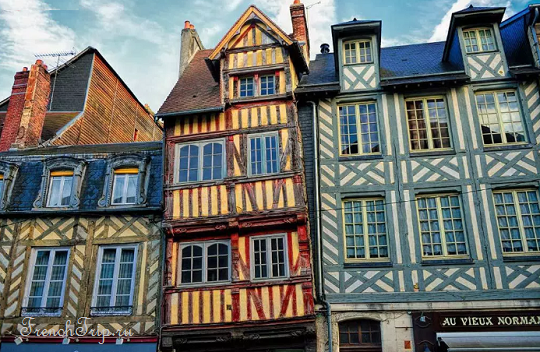
Rouen has the largest group of half-timbered houses in France, some two thousand of them, around the Gros-Horloge and the Place du Vieux-Marché. There are fine examples in Lisieux, Honfleur, Pont-Audemer, Bernay, Lyons-la-Forêt and Beuvron-en-Auge, and thatched cottages in the countryside of the Pays d’Auge and the Seine valley. See Normandy.
Brittany
Rennes has several hundred half-timbered houses, more than any other town in Brittany, especially around the Place Sainte-Anne and the Place du Champ-Jacquet. Vannes, Morlaix, Vitré, Dinan and Quimper also have whole streets of them.
Alsace
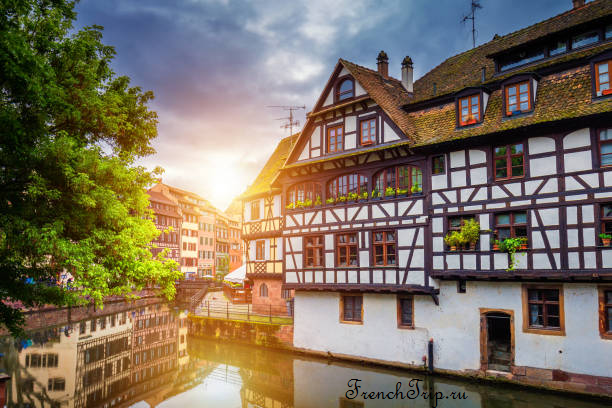
Follow the Alsace Wine Route through its villages of painted half-timbered houses, among them Riquewihr, Eguisheim, Kaysersberg, Ribeauvillé and Obernai. In the towns, see Petite Venise in Colmar and the Petite France quarter of Strasbourg. See Alsace.
Champagne
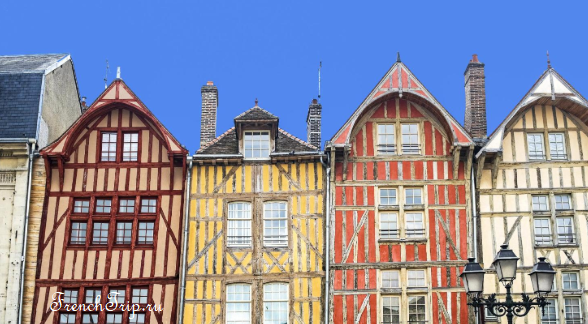
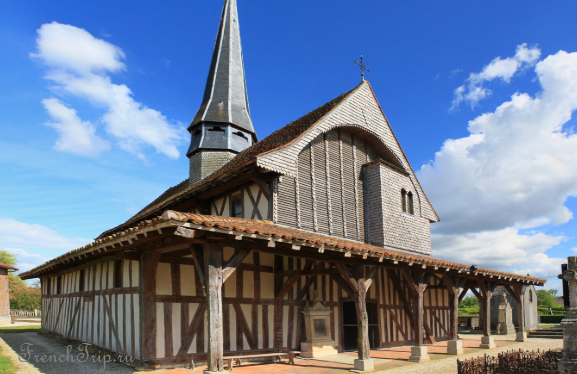
Troyes is the half-timbered capital of Champagne, with a whole old town of crooked, colourful houses, including the narrow Ruelle des Chats. Châlons-en-Champagne and Essoyes also have fine examples, while Reims and Épernay, rebuilt in stone, have few. Around the Lac du Der, the Route of the half-timbered churches links a dozen village churches built entirely with a timber frame, such as those of Longsols and Bailly-le-Franc, which are unique in France. See Champagne.
Elsewhere
- The Basque country: Ainhoa, Espelette and Sare, with their white houses and red timbers.
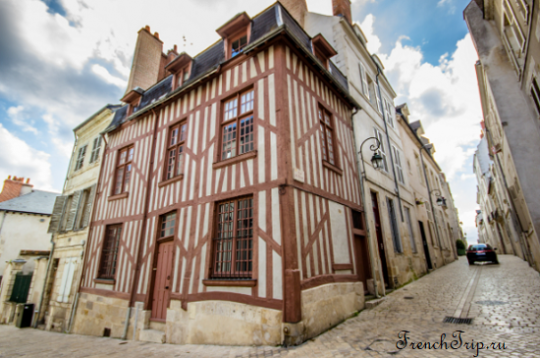
- The Loire valley and the Centre: Orléans, Beaugency, Bourges and Blois.
- Albi and Toulouse, where the frames are filled with brick.
- Limoges, Agen, and villages of the Périgord such as Saint-Jean-de-Côle.
Many of these towns are among the most beautiful small towns in France.
Did you know?
- Because the frame was pegged together, a half-timbered house could be taken apart and rebuilt elsewhere, and some were.
- The metal spikes on window sills and beams of old houses are not part of the architecture: they are a modern defence against pigeons.
- Half-timbering is coming back in a modern form: timber frames with infill of hemp concrete or other natural materials are valued today as an ecological way to build.
Updated: