Saint-Malo
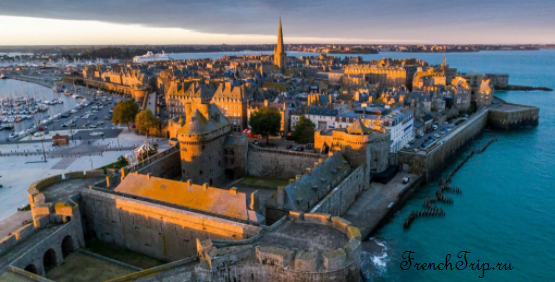
Saint-Malo is a walled city on the Channel coast of Brittany, built out onto a rock and surrounded by the sea at high tide. It was a corsair port — privateers licensed by the crown to raid enemy shipping — and it grew rich on it. The town inside the walls is called intra-muros, and it is the reason to come.
Around 50,000 people live here. In summer that becomes 200,000.
A city rebuilt from nothing
In August 1944, during the fighting to take the port, about 80% of the walled town was destroyed. What you walk through today is a reconstruction, carried out over more than a decade with the original granite, to the original plans, and to a standard that makes it hard to tell. Knowing this changes how the place reads: the tall grey houses with their steep roofs are a deliberate act of restoration, not survival.
The ramparts themselves came through, and so did the castle.
Walking the walls
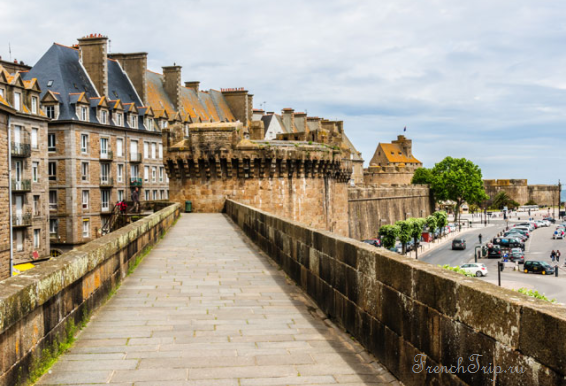
The circuit of the remparts takes about 45 minutes and is free and open at all hours. It is the single best thing in Saint-Malo: on one side the roofs and chimneys of the town, on the other the sea, the beaches below, the offshore forts and the islands.
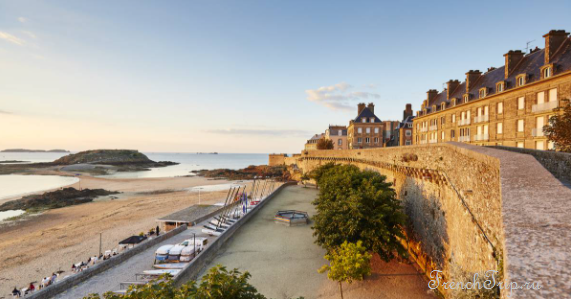
Do it at both high and low tide if you can. The tidal range here is among the largest in the world — over 12 metres at the spring tides — and the town looks like two different places.
What to see
- The château — the fifteenth-century keep at the corner of the walls, holding the town history museum
- Cathédrale Saint-Vincent — Romanesque and Gothic, badly damaged in 1944 and rebuilt with modern glass that works better than it has any right to
- Fort National — Vauban’s fort on a rock offshore, reachable on foot at low tide only
- Grand Bé — the island where Chateaubriand is buried, facing the open sea, again reachable only at low tide. Check the tide table before you cross; people get caught every year.
- Petit Bé — another Vauban fort on the next island out
- Grand Aquarium — outside the walls, large and good with children
The corsairs
Saint-Malo’s privateers operated under royal licence against English and Dutch shipping, and made the town wealthy enough to lend money to the crown. Robert Surcouf is the famous one. The malouinières — the country houses the shipowners built in the surrounding countryside — are the visible result, and several can be visited.
The other export was explorers: Jacques Cartier, who sailed from here in 1534 and claimed Canada for France, was a Malouin, and so were the sailors the Falklands are named after in French and Spanish — Îles Malouines, Islas Malvinas.
Beaches
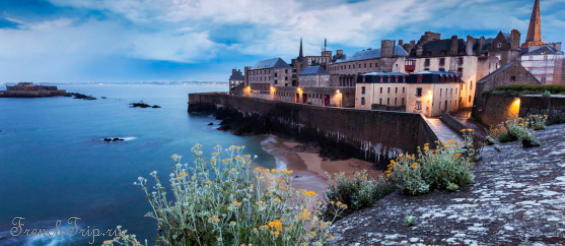
Plage du Sillon runs for 3 km east of the walls, with rows of wooden breakwater posts standing in the sand — the picture everyone takes. Plage de Bon-Secours, right under the ramparts, has a seawater pool that fills at high tide and stays full when the sea goes out, which is a genuinely good idea. The water is Channel-cold; that is not the point.
Festivals
- Festival des Folklores du Monde — early July, music and dance from everywhere, filling the streets inside the walls
- Route du Rhum — every four years in November, the single-handed transatlantic race to Guadeloupe starts here. The town is unrecognisable for a fortnight and the harbour is worth seeing.
- Étonnants Voyageurs — a travel-writing festival at Pentecost
Getting to Saint-Malo
- By train — the station is 1 km south of the walled town, about 20 minutes on foot. Three direct trains a day from Paris Montparnasse, roughly 3 hours; hourly services from Rennes in 50 minutes. See trains in France.
- By bus — cheaper and slower, including services to Pontorson for Mont-Saint-Michel and a direct coach to the abbey itself.
- By air — Dinard-Pleurtuit-Saint-Malo, 13 km away, with low-cost flights from the UK. There is no public transport from this airport — only taxis, around €25 into town. Rennes is the larger alternative.
- By ferry — from Portsmouth and Poole, and from Jersey and Guernsey in season. Arriving by sea is much the best approach.
- By car — park outside the walls; intra-muros is effectively closed to visitors’ cars. See parking in France.
What to eat
Breton: galettes of buckwheat with egg, ham and cheese, sweet crêpes after, and cider in a cup rather than a glass. Oysters from Cancale next door are among the best in France, and there are mussels, scallops and kouign-amann — a butter-and-sugar cake that is exactly as heavy as it sounds. Salted butter is used in everything here, including the caramel.
See French oysters and French cheeses.
Around Saint-Malo
- Mont-Saint-Michel — about an hour by road, and the obvious day trip
- Cancale — 15 km east, the oyster town, where you buy them on the quay and eat them on the sea wall
- Dinard — across the estuary, a Belle Époque resort with a reputation for its villas
- Dinan — a walled medieval town up the Rance, and one of the best-preserved in Brittany
- The Channel Islands — Jersey and Guernsey by fast ferry in about 90 minutes
- Rennes — 50 minutes, the Breton capital
When to go
May to September. July and August quadruple the population; June and September are much better and the weather is no worse. Winter is grey and windy, and the ramparts in a storm are a spectacle of their own — the sea comes over the wall at the Sillon in the big spring tides, which is worth planning around if you like that sort of thing.
See Brittany.
Where to park in Saint-Malo
| Car park | Spaces | Fee | From centre |
|---|---|---|---|
| Rempart 1 | — | paid | 200 m |
| Quai Saint-Vincent | — | paid | 240 m |
| Rempart 2 | — | paid | 240 m |
| Vauban | — | paid | 250 m |
| Quai Saint-Louis | — | paid | 280 m |
| Parking Saint-Vincent underground | — | paid | 330 m |
| La Bourse | — | paid | 390 m |
| Saint-Thomas La Galère | — | paid | 410 m |
Weather in Saint-Malo
| Month | Day | Night | Rainfall |
|---|---|---|---|
| January | +9° | +4° | 64 mm |
| February | +10° | +4° | 56 mm |
| March | +13° | +5° | 48 mm |
| April | +15° | +7° | 54 mm |
| May | +18° | +9° | 56 mm |
| June | +21° | +12° | 54 mm |
| July | +22° | +14° | 46 mm |
| August | +23° | +14° | 58 mm |
| September | +21° | +12° | 60 mm |
| October | +17° | +10° | 81 mm |
| November | +13° | +7° | 89 mm |
| December | +10° | +5° | 86 mm |
Updated: