Provins
Provins is a town of 12,000 in the Seine-et-Marne, 90 km south-east of Paris, and a UNESCO World Heritage Site — inscribed in 2001 as the outstanding surviving example of a medieval fair town.
In the twelfth and thirteenth centuries the Champagne fairs were the clearing house of European trade, and Provins hosted two of the six annual cycles. Cloth from Flanders, spices from the Levant and silver from Germany changed hands here, and the accounting techniques the Italian merchants developed at these fairs are the ancestors of modern banking.
Provins was also one of the capitals of the counts of Champagne, and the UNESCO listing covers at least 58 individual monuments, buildings and houses across the town.
When the trade moved to the sea routes in the fourteenth century, Provins stopped. That is why it is still standing.
The town has a small history in print: Honoré de Balzac’s 1840 novel Pierrette is set entirely in Provins, and Victor Hugo described its walls, gates and hilltop churches after visiting in 1835. Umberto Eco’s Foucault’s Pendulum mentions the town’s underground passages and the Grange aux Dîmes.
The upper town
On foot, the usual approach is through the Porte Saint-Jean, one of the gates in the ramparts, into the Place du Châtel, the old town’s square, lined with old houses.
A tourist mini-train with commentary in French and English does a circuit of the main sights, running from spring to the start of November.
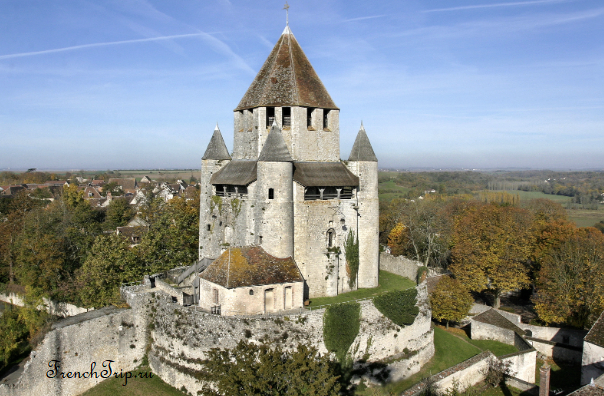
- Tour César — the twelfth-century keep, octagonal on a square base, 44 m; climb it for the view over the whole plain
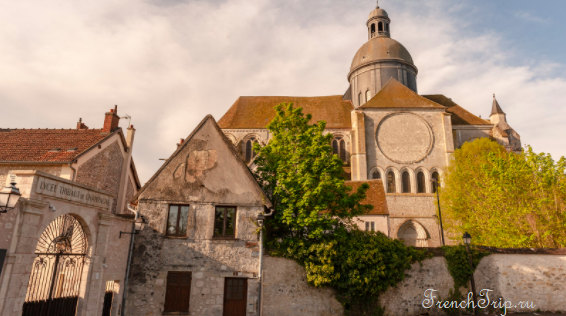
- Collégiale Saint-Quiriace — begun in the twelfth century and never finished, the money having run out with the fairs; the dome is seventeenth-century
- Grange aux Dîmes — the thirteenth-century tithe barn, originally a fair merchants’ hall, with an exhibition on the fairs
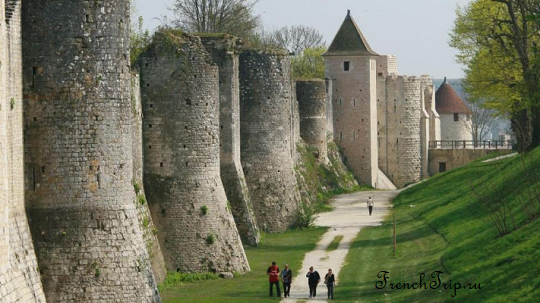
- The ramparts — 1,200 m of twelfth- and thirteenth-century wall with twenty-two towers, walkable outside
- Souterrains — a network of tunnels cut in the chalk below the upper town, open for guided visits, with medieval graffiti on the walls
- Maison Romane — one of the oldest houses in Provins, home to the town museum, with collections of ceramics, sculpture and religious objects tracing the area’s history from prehistory to the nineteenth century
- The old hospital — with a vaulted cellar known locally as the cellar of the Holy Spirit, also part of the visiting circuit
The lower town
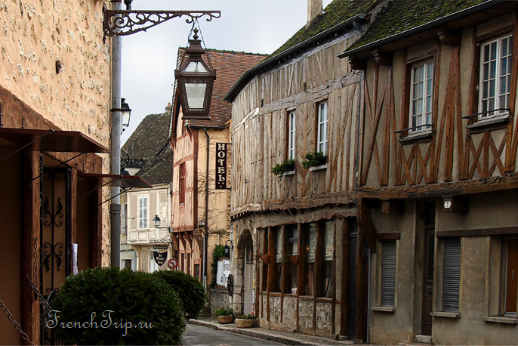
Below the hill, along the Durteint and the Voulzie: the merchants’ quarter, with timber-framed houses, the thirteenth-century Église Saint-Ayoul and the Tour Notre-Dame-du-Val. Less visited than the upper town and worth the walk down.
The lower town was built on marshland that was drained and reclaimed in the Middle Ages.
The rose
Thibaut IV, count of Champagne, is said to have brought back from the Crusades the red rose that became the Rose de Provins — Rosa gallica officinalis, the apothecary’s rose, grown here for medicine and preserves ever since.
The story goes further: through the house of Lancaster, which took the red rose as its badge, Provins claims responsibility for one half of the Wars of the Roses. The Roseraie below the walls grows several hundred varieties and is open from May.
The shows
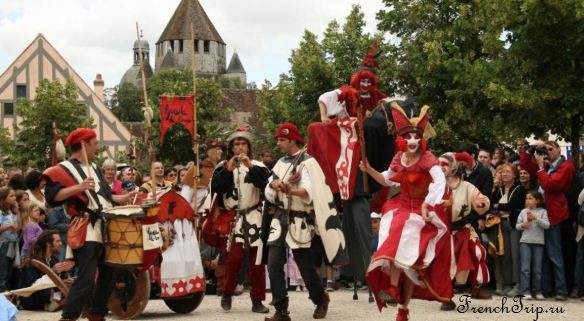
Provins runs its Middle Ages harder than anywhere else in France. From April to November there are daily spectacles: La Légende des Chevaliers (jousting and horsemanship), Les Aigles des Remparts (falconry from the ramparts), and a siege-machine display.
The Fête Médiévale in June turns the whole town over for a weekend — costume, markets, several tens of thousands of visitors. It is the largest event of its kind in France.
The festival is meant to recreate the atmosphere of the old Champagne fairs, with historical re-enactments alongside the shows.
Food

The local pastry is the niflette — a small puff-pastry tart filled with orange-flower custard, sold around All Saints’ Day, its name from ne flete, “do not weep”, offered to mourning children. Provins also sells everything conceivable made from roses, and the region is Brie country: Brie de Meaux and Brie de Melun are both made within an hour.
Provinois cheesemaking had lapsed and was only recently revived: a local Brie, Brie de Provins, was registered as a named brand in 1979, and a return to traditional production saw it shown at a Paris cheese fair in 2010.
The niflette’s medieval origin is often claimed but is unlikely: the custard and puff pastry it is made from were not invented until the seventeenth century. The pastries are also eaten during the medieval festival and other town events, beyond the All Saints’ season.
Markets
Provins holds a covered market at the Halle du Minage on Wednesday mornings, and an open-air market around Place Saint-Ayoul on Saturday mornings.
The Halle du Minage dates to the twelfth century, when it belonged to the abbey of Saint-Ayoul; its name comes from a toll once levied on the measuring of grain and other goods sold at the fairs and markets. Rebuilt in 1810, it served for decades as a school and then a town hall. A renovation that kept only the four original walls and the roof frame restored it as a market hall in 2008, with new cobbles and a large glass roof.
Getting to Provins
- By train — direct from Paris Gare de l’Est, about 1 h 25, roughly hourly. Easy as a day trip.
- By car — 90 km from Paris on the N4 or the A5; about 1 h 15. See parking in France.
- From the station — a shuttle bus links the railway station to the historic centre on weekends and public holidays in the tourist season, timed to the trains
- Getting around town — the Probus bus network and an on-demand local service cover Provins, with stops by the railway station, in the centre at the Gare Routière, and by the tourist office
When to go
April to October, when the shows run. June for the medieval festival, if you can face the crowds; May and June for the roses. Out of season much of the town closes and the upper town is empty and rather fine.
Weather in Provins
| Month | Day | Night | Rainfall |
|---|---|---|---|
| January | +7° | +2° | 64 mm |
| February | +8° | +2° | 57 mm |
| March | +12° | +4° | 56 mm |
| April | +16° | +6° | 52 mm |
| May | +20° | +9° | 65 mm |
| June | +23° | +12° | 57 mm |
| July | +26° | +14° | 59 mm |
| August | +26° | +14° | 55 mm |
| September | +22° | +11° | 57 mm |
| October | +16° | +9° | 70 mm |
| November | +10° | +5° | 67 mm |
| December | +7° | +3° | 83 mm |
Updated: