Troyes
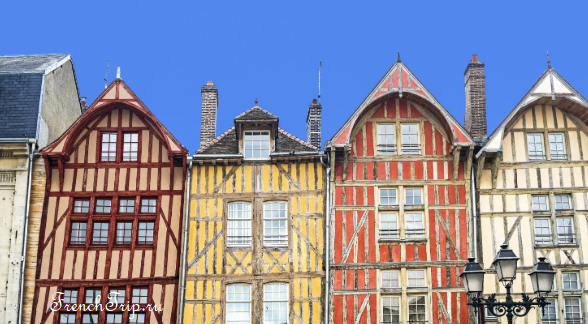
Troyes is the historic capital of Champagne and the second city of the region, with about 60,000 people. It has the best-preserved half-timbered old town in France outside Alsace, ten churches holding some 9,000 m² of stained glass, and — a completely different reason to come — the largest factory outlet complex in the country.
The old town is shaped like a champagne cork. This is a coincidence, and the town has never stopped pointing it out.
Why Troyes was rich
The Champagne fairs. From the twelfth to the fourteenth century, Troyes hosted two of the six great annual fairs where the cloth of Flanders met the spices and silk of Italy, and where much of European commerce was actually settled. Merchant banking, credit instruments and standard weights all developed around them.
One of those standards is still in use: the troy ounce, the unit gold and silver are weighed in worldwide, is named after this town.
Troyes also hosted an ecumenical council, and it was in the cathedral here in 1420 that the Treaty of Troyes was sealed with the marriage of Catherine of Valois to Henry V of England — briefly making an English king heir to France.
Later the town became France’s hosiery capital, and it still is: the knitwear industry is why the outlets are here.
The old town
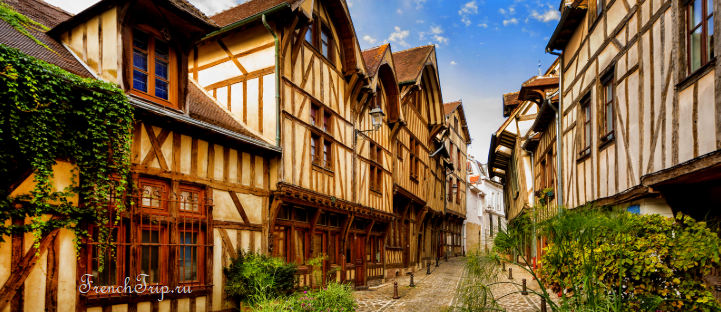
Streets of timber-framed houses in red, ochre, blue and white, leaning over the road, some so close at the upper storeys that things could be passed across.
- Ruelle des Chats — the famous one: an alley where the roofs almost meet overhead, named for the cats that could cross it in one step
- Rue Champeaux and the Maison du Boulanger — the postcard row
- Cour du Mortier d’Or — a hidden courtyard off Rue Champeaux, worth finding
- Hôtel de Vauluisant — a Renaissance mansion holding the hosiery museum and the Troyes and Champagne history collection
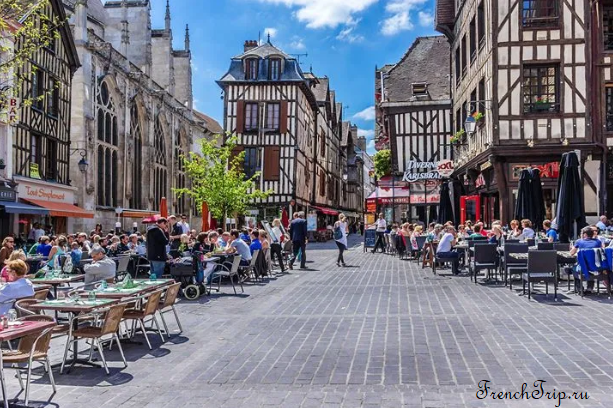
Cathédrale Saint-Pierre-et-Saint-Paul
114 m long and built over four centuries, so it shows every phase of Gothic in one building. Its glory is glass: 182 windows, about 1,500 m² of it, from the thirteenth century to the nineteenth. Troyes had its own schools of glaziers and sculptors, and this is where to see what they could do.
Basilique Saint-Urbain
Begun in 1262 by Pope Urban IV, who was born on the spot — his father was a cobbler here. It is High Gothic taken to its limit: so much glass and so little wall that it has been called a greenhouse, which sells it short.
Église Sainte-Madeleine
The oldest church in the town, with a carved stone jubé — a rood screen — from around 1510, in flamboyant Gothic stonework fine enough to look like lace. Most French rood screens were destroyed; this one survived.
The market hall and the quays
The covered market of 1876, iron and glass in the manner of the Halles in Paris, with cast-iron lion heads on the columns and a vast metal roof. Still a working food market and the right place to buy lunch.
Along the canal, the red-brick textile mills have been converted to flats without losing their fronts, and the modern sculpture on the quay includes the 3.5-metre Cœur de Troyes, a heart of steel ribbons standing in a fountain.
Museums
- Musée Saint-Loup — fine arts, archaeology and natural history in a former abbey
- Musée d’Art Moderne — in the old bishop’s palace, with the Lévy collection, strong on Fauvism and Derain in particular
- Maison de l’Outil — a huge collection of pre-industrial hand tools in a Renaissance mansion, and much more absorbing than that description suggests
- Cité du Vitrail — the stained glass centre, which explains the glass you have just been looking at
The outlets
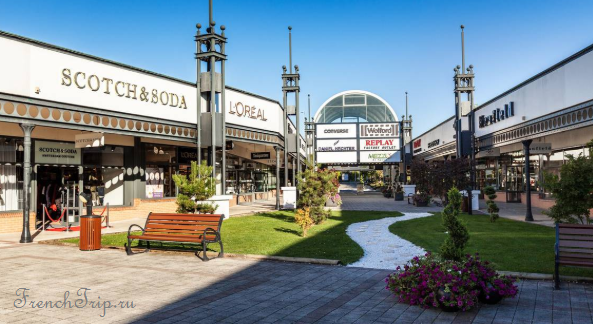
Troyes is the capital of French factory outlet shopping, a direct legacy of the knitwear industry. Three centres sit just outside the town — McArthurGlen, Marques Avenue and Marques City — together among the largest in Europe, with several hundred stores between them.
They are 5–10 minutes by car from the centre, at Saint-Julien-les-Villas and Pont-Sainte-Marie, with bus links. Weekends are heavy; the January and summer soldes are heavier.
What to eat and drink
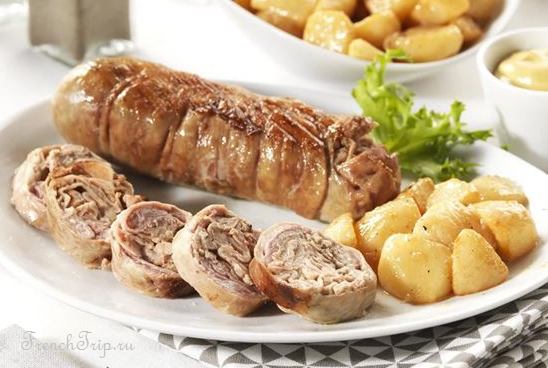
- Andouillette de Troyes — the town’s dish and a genuine test of nerve. It is a sausage made entirely of coarsely cut pork chitterlings and stomach, and it tastes and smells emphatically of what it is. People either love it or cannot finish it; there is no third group. Look for the AAAAA label of the andouillette guild.
- Chaource — a soft cow’s-milk cheese with a bloomy rind, made 30 km south and AOC since 1996. Much easier to like.
- Prunelle de Troyes — a 40° liqueur made from sloe stones, sold from a historic house by the cathedral
- Choucroute from the Briennois, Aube lamb, and chocolate from the local makers
Champagne and cider
The vineyards nearly touch the town. The Aube department has around 7,100 hectares under vine — 22% of the whole champagne appellation, which makes it the second-largest producing area — concentrated in the Côte des Bar and on the terroirs of Montgueux and Villenauxe-la-Grande. The Côte des Bar was long treated as the poor relation of the Marne and now produces some of the most interesting grower champagne in France.
The Aube also makes still wines, and the local rosé — from the same grapes as the champagne, hence the price — has a serious reputation.
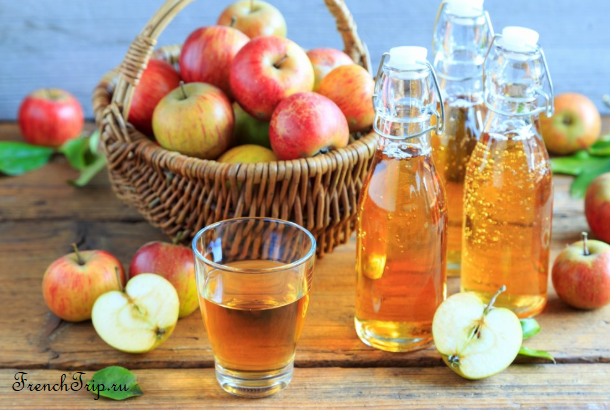
West of the town, the Pays d’Othe is cider country, with orchards worked since the sixteenth century and about a hundred thousand bottles a year. Try cacibel, cider with blackcurrant and honey.
See French wines and French cheeses.
Getting to Troyes
- By train — roughly hourly from Paris Est, about 1 h 30. Also direct trains from Reims, Dijon and Nancy. The station is a few minutes’ walk from the old town.
- By car — the A5 from Paris, around 2 hours. See parking in France.
- By coach — long-distance buses from Paris, slower and cheaper.
You can walk the length of the historic centre in half an hour. Allow half a day for a quick look, a full day to do it properly with a museum or two — and more if the outlets are part of the plan.
With children
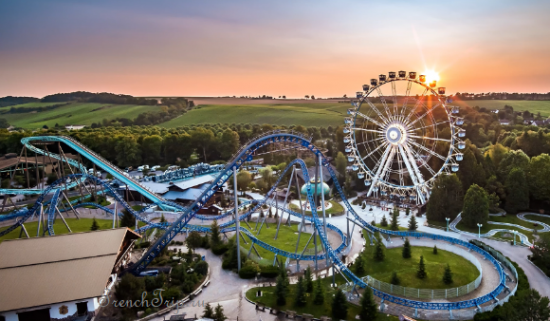
Nigloland is 48 km east, about 45 minutes by car: four themed areas, some 40 rides, and an unusually large number of them open to children under a metre tall — which makes it one of the better French theme parks for small children specifically. It runs from spring to early November.
Around Troyes
- The half-timbered churches route — a marked circuit through the Aube villages, where the churches are timber-framed like the houses; there is nothing else like it in France
- Côte des Bar — the champagne villages south-east, around Bar-sur-Aube and Les Riceys
- Abbaye de Clairvaux — Bernard of Clairvaux’s abbey, later a prison, now open in part
- Lac d’Orient — a large lake in a regional park east of town, for swimming and birdwatching
- Provins — the other great Champagne fair town, UNESCO-listed, an hour west
- Reims — an hour and a half north
When to go
May to October. The old town is at its best in low sun, when the timber colours come up. December brings a good Christmas market, and the outlets have their sales in January and late June.
See the most beautiful villages in France.
Where to park in Troyes
| Car park | Spaces | Fee | From centre |
|---|---|---|---|
| Langevin multi-storey | 99 | paid | 200 m |
| 14 Juillet | 150 | — | 430 m |
| Casimir Périer | — | paid | 450 m |
| Victor Hugo | 473 | — | 570 m |
| Open car park | 41 | free | 620 m |
| Open car park | 133 | paid | 620 m |
| Michel Laclos | 111 | paid | 640 m |
| Open car park | 69 | paid | 700 m |
Nearby
Other places on this site within easy reach, as the crow flies:
Weather in Troyes
| Month | Day | Night | Rainfall |
|---|---|---|---|
| January | +7° | +1° | 48 mm |
| February | +8° | 0° | 44 mm |
| March | +13° | +2° | 46 mm |
| April | +16° | +4° | 48 mm |
| May | +20° | +8° | 65 mm |
| June | +24° | +11° | 52 mm |
| July | +26° | +13° | 56 mm |
| August | +26° | +13° | 54 mm |
| September | +22° | +10° | 52 mm |
| October | +17° | +7° | 64 mm |
| November | +11° | +4° | 55 mm |
| December | +7° | +1° | 59 mm |
Updated: