Kaysersberg travel guide
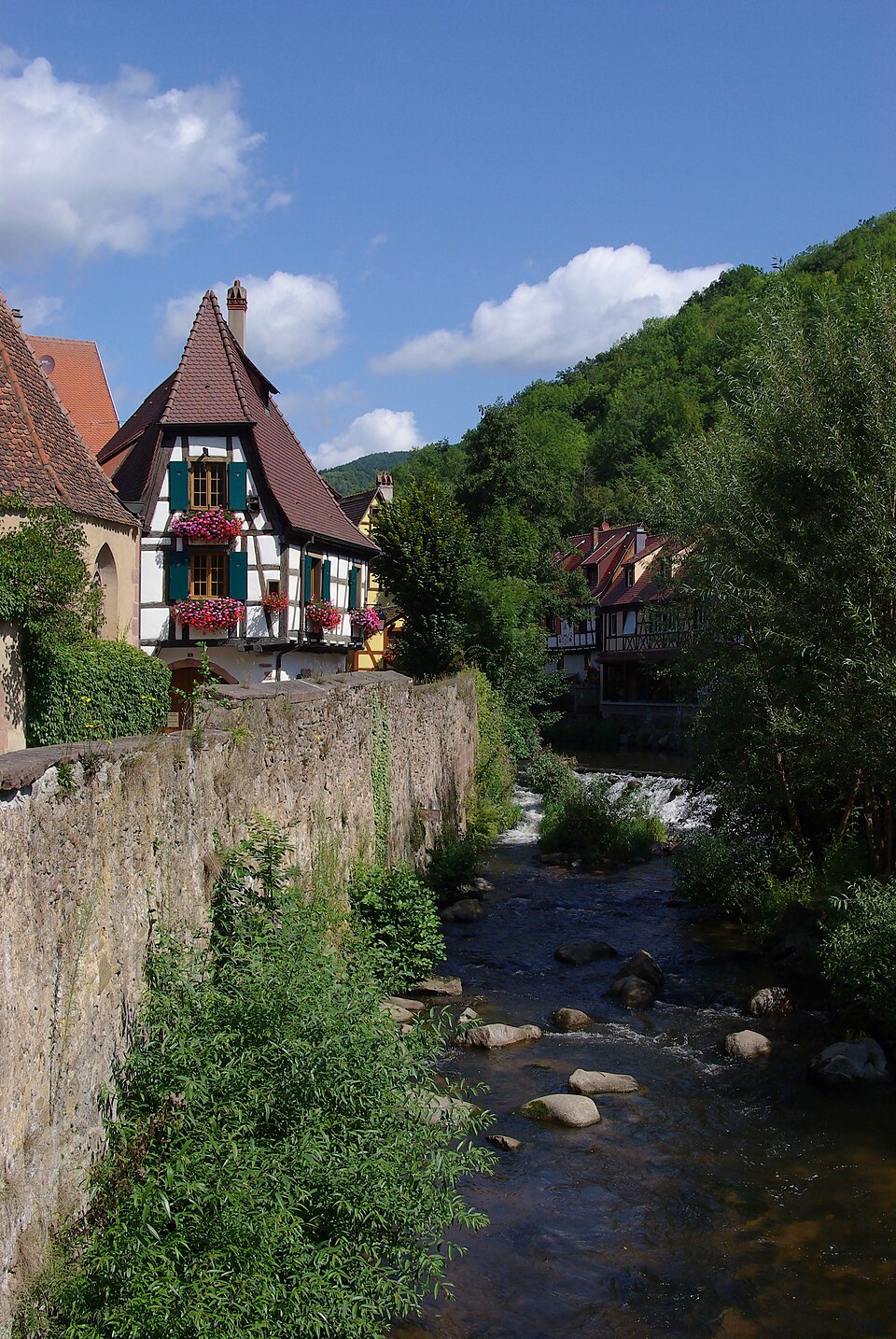
Kaysersberg is a small walled town on the Alsace wine route, 10 km north-west of Colmar, where the river Weiss comes out of the Vosges. It has a ruined castle on the crag above it, a fortified bridge over the river, and a claim that comes up regularly in French television polls: favourite village in France, which it won in 2017.
Its name means the emperor’s mountain, and the position explains everything about it: this valley was the road between Alsace and Lorraine, and whoever held the crag held the road.
History in short
Kaysersberg is first mentioned in 1227, the year Frederick II of Hohenstaufen bought the castle to control the valley. In 1293 King Adolf of Nassau made it an imperial town, and it was granted extensive privileges. Trade and crafts followed, and Kaysersberg exported its wine across the Rhine.
The Thirty Years’ War stopped the expansion and the town never fully recovered; after the Revolution it grew again slowly, on textiles. It was badly damaged in the fighting of December 1944 and rebuilt afterwards.
What to see
The fortified bridge
The pont fortifié of 1514 crosses the Weiss in the middle of the town, with a chapel and a guardroom built onto it. There are very few of these left in France, and it is the image of Kaysersberg.
The castle
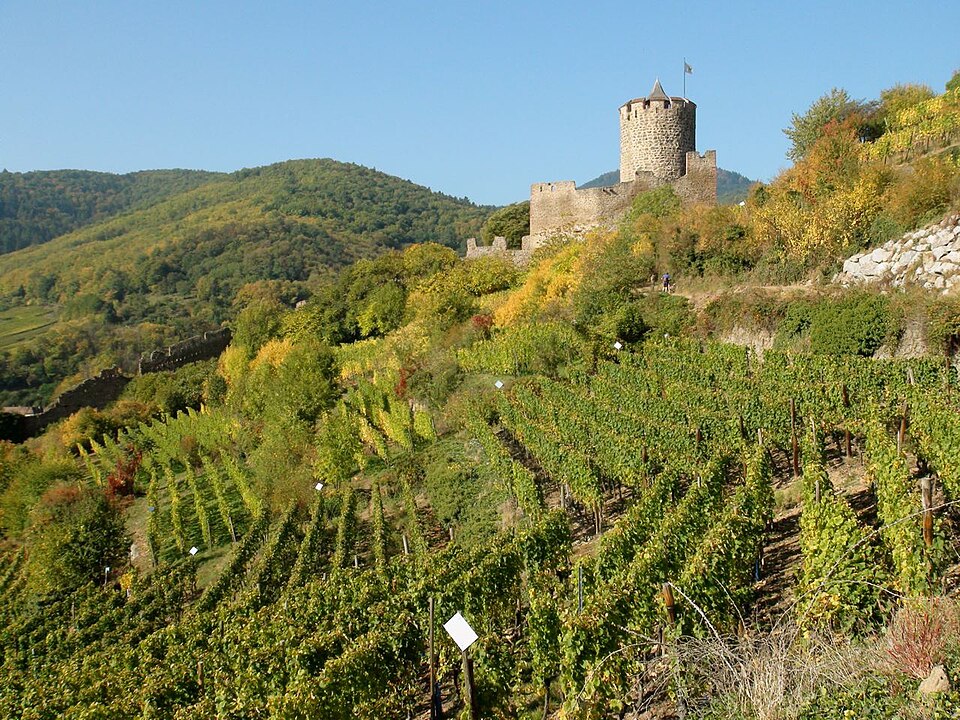
The imperial castle stands on the crag directly above the town, ruined but with its round keep intact. The climb takes fifteen minutes through the vines and the view along the valley is worth it. Free, always open.
Église Sainte-Croix
Twelfth to fifteenth century, with a Romanesque portal showing the Adoration of the Magi and, inside, a carved and painted altarpiece of 1518 by Jean Bongartz — sixteen panels of the Passion, and one of the finest things of its kind in Alsace.
The old town
- The town hall of 1604, Renaissance, with a gallery and an outside staircase
- Constantin’s fountain of 1521 on the main street
- Loewert House — timber-framed with a corner oriel, sixteenth century
- The ramparts and the surviving towers, walkable in part
- The Oberhof chapel of 1391 and the old Franciscan convent
Albert Schweitzer
Albert Schweitzer was born here in 1875 — theologian, organist, doctor, and the founder of the hospital at Lambaréné in Gabon, for which he was given the Nobel Peace Prize in 1952. His birthplace on the main street is a small museum, and the Protestant temple next door has the organ he played.
The wine
Kaysersberg has the Schlossberg grand cru above it — the first vineyard in Alsace to be classified grand cru, in 1975, on steep granite terraces facing south. Riesling above all. There are growers on the main street and the marked vineyard path from the castle takes you through it.
Christmas
Kaysersberg’s Christmas market is one of the best in Alsace, precisely because the town is small: five weekends in Advent, in the courtyards and squares rather than one big site, with an emphasis on craftsmen rather than stalls of imported goods. It is also, in consequence, extremely busy — come on a weekday if you can.
Getting to Kaysersberg
- By car — the obvious way, 15 minutes from Colmar on the wine route. Paid car parks outside the centre. See parking in France.
- By bus — line 145 from Colmar, roughly hourly on weekdays and thin at weekends. Check the last return.
- By train — no station; Colmar is the nearest.
The town takes an hour and a half to walk, half a day with the castle and a tasting.
Around Kaysersberg
- Kientzheim — 2 km, with the Château de la Confrérie Saint-Étienne and its wine museum
- Riquewihr — 10 km north
- Turckheim — 8 km south
- The Weiss valley — up into the Vosges towards the Lac Blanc and the ridge road
- Colmar — 10 km
When to go
September and October for the harvest, May and June for the flowers, Advent for the Christmas market — and early in the day in all three cases. See Alsace and the cooking of Alsace.
Photo credits
Photographs on this page come from Wikimedia Commons under free licences:
- The Weiss in Kaysersberg — JLPC, CC BY-SA 3.0, via Wikimedia Commons
- The castle above the vineyards — Anselrene, CC BY-SA 3.0, via Wikimedia Commons


Weather in Kaysersberg
| Month | Day | Night | Rainfall |
|---|---|---|---|
| January | +4° | -1° | 48 mm |
| February | +6° | 0° | 43 mm |
| March | +11° | +3° | 41 mm |
| April | +15° | +6° | 44 mm |
| May | +19° | +10° | 71 mm |
| June | +23° | +13° | 69 mm |
| July | +25° | +15° | 68 mm |
| August | +25° | +15° | 63 mm |
| September | +20° | +11° | 50 mm |
| October | +15° | +7° | 63 mm |
| November | +8° | +3° | 52 mm |
| December | +5° | 0° | 54 mm |
Updated: