Eze
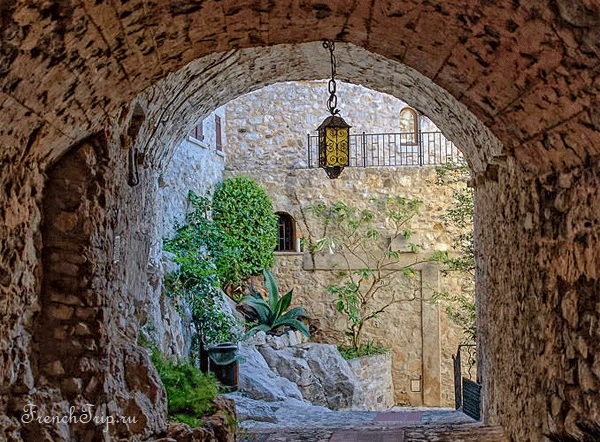
Èze is a medieval village perched on a rock 427 metres above the Mediterranean, between Nice and Monaco on the French Riviera. It is really two places with one name: Èze-sur-Mer down at sea level, and Èze-le-Village on the summit, reached by a steep climb and repaid with one of the best views on this coast.
The village motto is Isis Moriendo Renascor — “in death I am reborn” — and its emblem is a phoenix perched on a bone. Walt Disney spent a good deal of time here. So did Nietzsche, who worked out part of Thus Spoke Zarathustra on the path that now carries his name.
Èze is one of sixteen villages on the Route des Villages Perchés, the hilltop-village trail through the hinterland behind Nice.
Getting to Èze
The two halves of Èze are reached differently, and this catches people out. Trains stop only at the seaside; the medieval village on top is served by bus.
By train
The TER station Èze sits on the lower corniche, by the sea. In high season up to 80 trains a day call there.
- From Nice — about 15 minutes, twice an hour
- From Monaco — 7 to 9 minutes, twice an hour
- From Cannes — just under an hour
From the station to the hilltop village it is a climb of roughly 400 metres of altitude — on foot it takes about an hour and a half up the Nietzsche path, or you can take the shuttle bus. See how regional trains work in France.
By bus
Buses go directly to Èze-le-Village, which is why most visitors use them. Several routes serve the village from Nice, Monaco and Beaulieu, run by Lignes d’Azur and by the regional network. The journey from Nice takes from 30 minutes and costs a fraction of the train fare — but the road is winding, and in summer it can be slow.
By car
Three corniche roads run along this coast at different heights: the lower one by the sea, the middle one through Èze-le-Village, the Grande Corniche high above. The middle corniche is the one you want. Parking in the village is limited and paid, and fills by mid-morning in summer — see parking in France for how the French system works.
Nice Côte d’Azur airport is about 30 minutes away.
On foot
Three marked footpaths connect the three corniches:
- Chemin de Nietzsche — from the middle corniche down to the lower one, the classic route between village and sea
- Chemin Savaric — from the lower corniche up through the middle to the Grande Corniche
- Chemin Serre de Fourque — from the middle corniche to the Grande Corniche
History
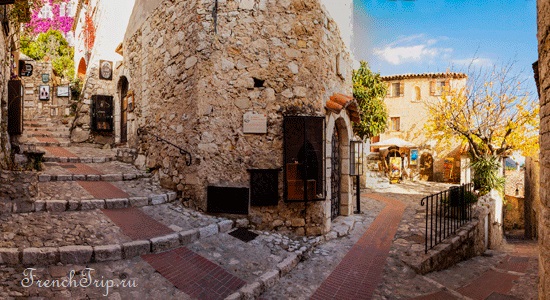
The hill was settled around 2000 BC, with an early settlement near Mont Bastide. The name first appears in the Antonine itineraries, as the bay of Saint-Laurent d’Èze.
A hoard of Greek silver phialae from the 3rd century BC was found here in the nineteenth century and is now in the British Museum. Romans held the area, then the Moors for some eighty years, until they were driven out by William of Provence in 973.
By 1388 Èze had passed to the House of Savoy, which fortified it because of its position above Nice. In 1543 the town was taken by combined French and Ottoman forces under Barbarossa; in 1706 Louis XIV had the walls pulled down during the War of the Spanish Succession. In April 1860 the inhabitants voted unanimously to become part of France.
The village has long been called an eagle’s nest, and the ochre church of Notre-Dame-de-l’Assomption, built in 1764, can be seen from far along the coast. The Egyptian cross inside points to older roots: the Phoenicians are said to have raised a temple to Isis on this spot — which is where the motto comes from.
What to see
Èze-le-Village
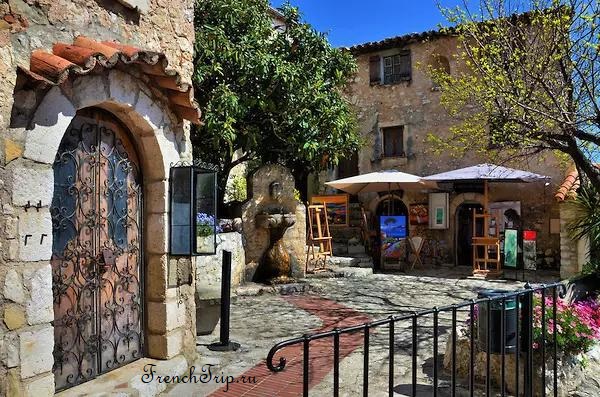
The medieval village is a knot of stepped lanes with galleries and workshops in the old houses. Worth finding:
- La Poterne — the fourteenth-century double gate, still the only way into the old village
- The church — eighteenth century, a single nave, classical and baroque inside
- Chapelle Sainte-Croix — fourteenth century, built for the brotherhood of White Penitents who cared for lepers and the poor
- Place du Planet — an Italianate fountain from 1930
- Maison Riquier — residence of the lords of Èze in the twelfth and fifteenth centuries
- The cemetery — where the actor Francis Blanche is buried
Le Jardin Exotique
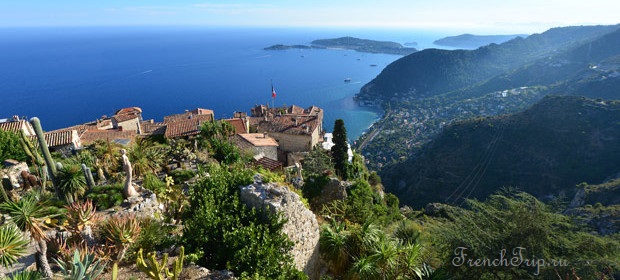
The exotic garden occupies the ruins of the castle at the very top, 429 metres up. It is planted with succulents — cacti, aloes, agaves — mostly from Central America, with sculptures by Jean-Philippe Richard along the paths. The northern side has waterfalls, grottoes and a Mediterranean garden of Provençal garrigue plants, and is the cooler place to sit in summer.
The view runs from Italy along the coast past the bay of Villefranche and Nice towards Saint-Tropez. On a clear day you can make out Corsica.
La Grande Corniche
The high road runs 675 metres above the sea with the widest views on the Riviera. Built on Napoleon’s orders, it follows the line of the Roman Via Julia towards La Turbie.
The Parc départemental de la Grande Corniche covers 610 hectares between 500 and 700 metres: hiking trails and picnic areas at Plateau de la Justice in the west, the archaeological site of Mont Bastide with its Celto-Ligurian oppidum in the centre, and the Revère plateau with its orientation table in the east.
Èze-sur-Mer
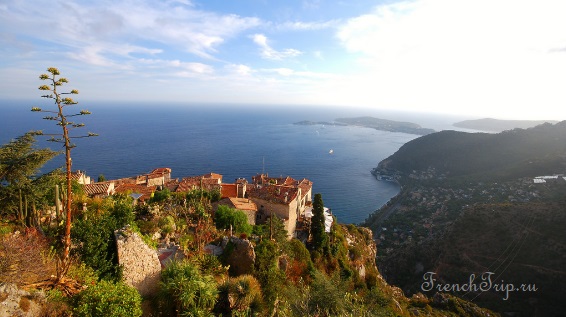
The seaside part sits below the lower corniche, with pebble beaches shaded by pines and a microclimate of its own. Saint-Laurent d’Èze was once a flower-growing area; a few greenhouses remain, along with the early seventeenth-century chapel of Saint-Laurent.
Chemin de Nietzsche
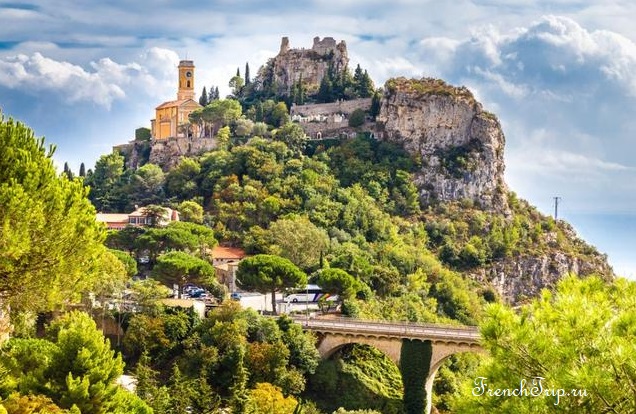
The path between the village and the sea is the walk most people come for. Nietzsche descended it while working on the third part of Thus Spoke Zarathustra. It is steep, unshaded in places and stony — proper shoes, water and a hat, and it is far easier going down than up.
The village plan
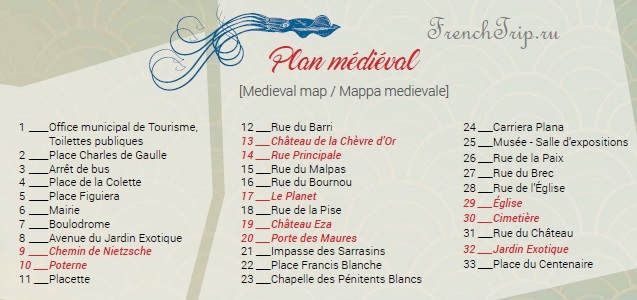
The numbered plan posted in the village keys the main sights. The legend below is the same numbering:
Practical notes
- The lanes are steep and cobbled. Comfortable shoes matter more here than in most Riviera towns.
- There is little shade in the village itself — the garden at the top and the north side of the hill are the cool spots.
- Èze is small and very popular. Coach parties arrive mid-morning; early or late in the day is a different place.
- The village and the seaside are two separate visits, connected by a demanding walk or a short bus ride. Plan for one or the other unless you have a full day.
Where to eat
The village has restaurants at every price level, including one of the best-known hotel restaurants on the coast at the Château de la Chèvre d’Or. Prices in the village reflect the view. For everyday Provençal cooking at ordinary prices, Èze-sur-Mer and neighbouring Beaulieu are better value.
More on the food of this region in Provençal cuisine.
Nearby
- Nice — 20 minutes by train, the transport hub for the whole coast
- Monaco — under 10 minutes by train
- Villefranche-sur-Mer — the deep bay just west, on the same railway line
- La Turbie — up on the Grande Corniche, with the Roman Trophy of the Alps
- Cannes — an hour west along the coast; see the Cannes guide
For more of the coast and the hinterland, see what to do in Provence and when to visit.
Nearby
Other places on this site within easy reach, as the crow flies:
- La Turbie — 4 km
- Saint-Jean-Cap-Ferrat — 5 km
- Nice — 8 km
- Roquebrune-Cap-Martin — 9 km
- Menton — 12 km
- Aéroport de Nice — 14 km
Weather in Eze
| Month | Day | Night | Rainfall |
|---|---|---|---|
| January | +11° | +4° | 75 mm |
| February | +11° | +4° | 54 mm |
| March | +14° | +6° | 51 mm |
| April | +17° | +9° | 68 mm |
| May | +20° | +12° | 43 mm |
| June | +24° | +16° | 36 mm |
| July | +27° | +19° | 15 mm |
| August | +27° | +19° | 20 mm |
| September | +24° | +16° | 85 mm |
| October | +20° | +12° | 120 mm |
| November | +15° | +8° | 134 mm |
| December | +12° | +5° | 90 mm |
This page in Russian: Èze (Эз)
Updated: