Moncontour
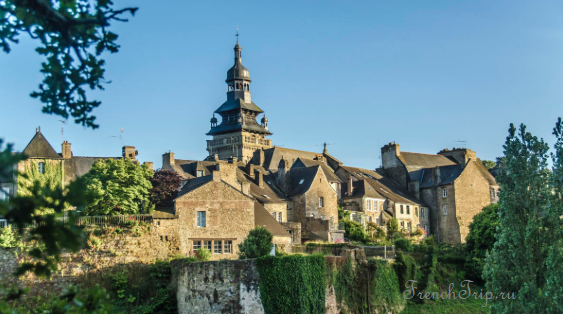
Moncontour is a walled medieval village of about 900 people in the Côtes-d’Armor, 25 km south of Saint-Brieuc. It belongs both to Les Plus Beaux Villages de France and to the Petites Cités de Caractère — a combination only a handful of places in Brittany hold.
It stands on a spur where two valleys meet, and it kept its thirteenth- and fourteenth-century fortifications: some 700 m of wall with six of the original fifteen towers still standing.
Why it is here
Moncontour was built to defend Lamballe, capital of the lordship of Penthièvre, from the south. Being a strategic point meant being fought over: the fourteenth-century War of the Breton Succession passed through repeatedly, and the walls were partly demolished on Richelieu’s orders in 1626 after the town backed the wrong side.
The town was fought over again in between: in the final battle between the Breton dukes and the French crown in the fifteenth century, and in the Wars of Religion in the sixteenth.
What made it rich came later. Like Locronan — the other Breton village in the same association — Moncontour lived on sailcloth before the Industrial Revolution, weaving the berlingues that were exported as far as India. The merchants’ houses, the town hall and the church all date from that prosperity and stopped when it did.
What to see
- The ramparts — the surviving towers and the walk round the outside, about half an hour
- Église Saint-Mathurin — sixteenth-century, with six Renaissance stained-glass windows of the sixteenth century that are the finest set in the Côtes-d’Armor
- The merchants’ houses — seventeenth and eighteenth century, in granite, on the streets below the church
- Château des Granges — eighteenth century, on the edge of the village
- Château de la Touche-Trébry — 4 km out, late sixteenth century and still lived in, open in summer
- La Poterne Saint-Jean — the one gate of the ramparts to survive, fifteenth century and a listed monument since 1926; it once led out to the southern suburbs
- Chapelle Saint-Michel — a chapel built on the site of the town’s former parish church, pulled down during the Revolution
- Maison de la Chouannerie et de la Révolution — the town museum, on the French Revolution and on the Chouannerie, the royalist and Catholic resistance that held out in the countryside around Moncontour under a local leader known as Boishardy
- Le Théâtre du Costume — a small museum of costumes made for the stage
Inside Saint-Mathurin
The body of the church is mostly sixteenth-century; the Baroque west front was added in the eighteenth, and the top of the ornate, faintly oriental-looking bell tower was altered in the twentieth. The stained glass is original, and unusually accomplished for Brittany — parishioners were paying to show off their prosperity. One set, from 1537, tells the story of Saint Yves, one of the region’s most venerated saints. There is also a set for John the Baptist, one for Saint Mathurin dated 1520, and one for Saint Barbara dated 1538.
Chapelle Saint-Michel
The chapel replaced the town’s former parish church, demolished during the Revolution. It was built using stone taken from another, older chapel — dedicated to Saint Mary Magdalene, at Épine du Bas Bourg — before that one too was pulled down in the early nineteenth century.
Château des Granges
The present, eighteenth-century house replaced an older castle of which only part survives. It had a moat around its courtyard, wrought-iron gates, a wide esplanade, ponds and a chapel. A wedding held here, between Marie-Anne Le Mintier and Gervais Geslin, president of the Parliament of Brittany, gave the house its old name, the château du Parlement.
The Pardon of Saint Mathurin
Held at Whitsun, and one of the oldest in Brittany. Saint Mathurin was invoked against madness, and the pardon drew people from across the region; it still fills the village for a weekend.
Moncontour also stages a medieval festival in August, in even-numbered years, which is done with rather more conviction than most.
A walk around the old town
A signed route loops through the walls, starting at the museum on Place de la Carrière, in a double town house of about 1800 that also holds a model of the town. From there it passes a restored timber-framed house on Rue Charbonnerie, crosses Place de la Carrière and continues along Rue Notre-Dame, past more timber-framed houses; nothing is left here of the old Notre-Dame-de-la-Porte church beyond a wayside shrine marking the processional route of the Pardon. The route opens onto Place Penthièvre, named for the family that founded the town and once entered through an upper gate that stood until 1770. Rich on the linen trade in the seventeenth and eighteenth centuries, the square is quieter now; during the Revolution, the Republican general Hoche met the Chouan leader Boishardy at a house here, on 19 March 1795. Past the church, the route follows Rue de la Poterie to a restored timber house that holds the Théâtre du Costume — worth a step back to see the carved bearded head on its front — then on to the Hôtel Ker-Jégu, a seventeenth-century mansion that is now the town hall, and down past the Jardin de l’Europe at the foot of the ramparts to the Poterne Saint-Jean.
Getting to Moncontour
- By car — the only practical way. Lamballe 16 km (19 min), Saint-Brieuc 25 km (30 min), Rennes 90 km (1 h), Mont-Saint-Michel 85 km (1 h 30), Nantes 198 km, Paris 440 km. See parking in France.
- By train — nearest stations Lamballe (then the D768) and Saint-Brieuc (N12 then D765), both on the Paris–Brest TGV line.
- By bus — regional services to Lamballe and Saint-Brieuc.
- Parking — outside the walls; the village is small and steep.
Around
- Lamballe — 16 km, with the national stud
- Saint-Brieuc and its bay — 25 km north
- Cap Fréhel and Fort la Latte — an hour, the best cliffs on this coast
- Dinan — 50 minutes east
- Quintin — 30 minutes, another Petite Cité de Caractère, also built on linen
When to go
April to October. An hour is enough for the village itself, which makes it a stop rather than a destination — but it is on the road between Saint-Brieuc and Rennes, and a far better break than the motorway services.
See Brittany.
Nearby
Other places on this site within easy reach, as the crow flies:
Weather in Moncontour
| Month | Day | Night | Rainfall |
|---|---|---|---|
| January | +9° | +3° | 104 mm |
| February | +10° | +3° | 87 mm |
| March | +12° | +4° | 69 mm |
| April | +15° | +5° | 71 mm |
| May | +18° | +8° | 63 mm |
| June | +21° | +11° | 57 mm |
| July | +23° | +12° | 46 mm |
| August | +23° | +12° | 59 mm |
| September | +20° | +10° | 66 mm |
| October | +16° | +8° | 103 mm |
| November | +12° | +6° | 113 mm |
| December | +9° | +3° | 119 mm |
This page in Russian: Moncontour (Монконтур)
Updated: