Lorient
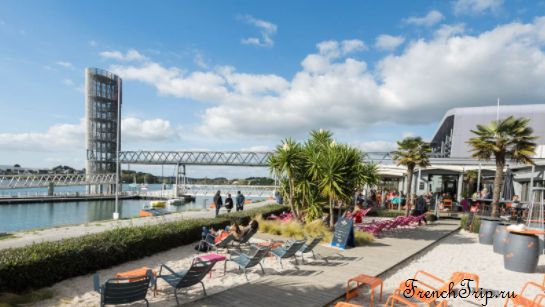
Lorient is a port of 57,000 in the Morbihan, in southern Brittany, at the mouth of the Scorff and the Blavet. It is the second fishing port in France and it owes both its existence and its appearance to two very different pieces of history.
The name is the first of them: the town was founded in 1666 as the base of the Compagnie des Indes orientales — the French East India Company — and grew up round the shipyard that built and loaded the Indiamen. L’Orient, the Orient, became Lorient.
The company had been set up by Colbert two years earlier and was based at first across the water at Port-Louis; the ground it was granted at Lorient, on the Blavet, was known as Faouédic. The navy followed in 1688, setting up its own yard, and the arsenal went on building warships for the next three centuries.
What the war left
The second is that Lorient held the largest German submarine base on the Atlantic. The Keroman bunkers were built in 1941–42 with roofs of reinforced concrete up to 7.5 m thick, and they proved impossible to destroy from the air. The Allies bombed the town instead: by 1943 Lorient was about 90% flattened, and the German garrison held out in the pocket until 10 May 1945, two days after the general surrender.
The bunkers are still there, because taking them down would cost more than leaving them. They now hold:
- La Cité de la Voile Éric Tabarly — a museum of ocean racing, named for the sailor who did more than anyone to make France a sailing nation; interactive, and good with children
- Le Musée sous-marin du Pays de Lorient and the submarine Flore, which you can go through
- The museum’s visit includes a submarine simulator built in 1942 to train crews, shown with a diving and history guide
- The base itself, visitable — the scale of it is the point, and it is genuinely sobering
- It was built to hold twenty submarines and their crews
The rebuilt town above is 1950s concrete on a grid, like Brest. Nobody comes to Lorient for the architecture.
Rebuilding went on for decades rather than finishing in one push: parts of the town were still being reconstructed into the 1970s.
A working port
Lorient still earns its keep from the sea. Besides the fishing port at Keroman, which opened in the 1920s, the town holds one of France’s main naval arsenals, a commercial port at Kergroise, and a cluster of ocean-racing and sailing facilities known locally as the Sailing Valley. Between the fishing, naval, commercial, sailing and passenger harbours, Lorient calls itself the city of five ports.
The town changed direction again in the late 1980s. The Université de Bretagne-Sud opened in 1995, and the same years saw the Interceltic Festival grow into one of the largest music festivals in France.
The Interceltic Festival
What Lorient is really known for. Every August the Festival Interceltique brings together the Celtic nations — Brittany, Ireland, Scotland, Wales, Cornwall, the Isle of Man, Galicia and Asturias — for ten days of pipe bands, harps, dance and a great deal of drinking.
It draws around 700,000 people and is one of the largest music festivals in Europe. If you want to be in Lorient in the first half of August, book months ahead; if you do not, avoid those dates entirely.
The rest
- Port de pêche de Keroman — the fish market, visitable early in the morning, and the real working heart of the town
- Église Notre-Dame-de-Victoire — the post-war church, in the concrete manner of the reconstruction, and better than that sounds
- Quai des Indes — the merchants’ mansions of the late eighteenth century, built on the profits of the Indies trade
- L’Enclos du Port — the East India Company’s original enclosure on the Faouédic site, now open to the public, with the Discovery Tower, the old Hôtel Gabriel (the company’s former sale house) and its windmills
- A cluster of 1930s houses, built by Italian stonemasons who had left Mussolini’s Italy, unusually original for their date and still standing
- Port-Louis — across the water, and the thing to do with an afternoon: a walled citadel of 1591 guarding the roadstead, holding the Musée de la Compagnie des Indes with the porcelain, textiles and ship models of the Indies trade. A small ferry runs across from Lorient in a few minutes.
What to eat
Lorient has a couple of dishes of its own. Kari Gosse, a spice blend from India, has been mixed here since the late nineteenth century and is served with seafood, and the gâteau lorientais was first made nearby in Port-Louis.
The rest of the kitchen follows the fishing fleet: Lorient is said to be France’s leading langoustine port, and hake is another local speciality. Cotriade, a soup made from whatever fish the boats could not sell, is the traditional way to use it up. Crêpes and cider, as everywhere in Brittany, are the standard; see the cuisine of Bretagne.
Getting to Lorient
- By train — TGV from Paris in about 3 hours; regional services to Vannes (40 min), Quimper (1 h) and Rennes.
- The regional network also reaches Brest, Redon and Nantes.
- By air — Lorient Bretagne Sud, with flights to Paris and Lyon.
- By car — the free N165 along the south coast. See parking in France.
- By car, Lorient sits almost exactly halfway between Quimper and Vannes, so a loop of the southern Brittany coast passes straight through.
Around Lorient
- Port-Louis — across the roadstead, by ferry
- Île de Groix — 45 minutes by ferry, with a convex beach of garnet sand that is the only one of its kind in Europe
- Quiberon and Belle-Île — an hour east
- Carnac — 45 minutes, the alignments
- Pont-Aven — 40 minutes west, where Gauguin painted
When to go
June to September. First half of August for the festival, with everything that implies for prices and rooms. Out of season Lorient is a working port and not much else, which is either a reason to come or a reason to go to Vannes instead.
See Brittany and the cities of France.
Weather in Lorient
| Month | Day | Night | Rainfall |
|---|---|---|---|
| January | +10° | +4° | 109 mm |
| February | +11° | +4° | 82 mm |
| March | +13° | +5° | 66 mm |
| April | +15° | +7° | 68 mm |
| May | +18° | +10° | 66 mm |
| June | +21° | +12° | 52 mm |
| July | +23° | +14° | 55 mm |
| August | +23° | +14° | 53 mm |
| September | +21° | +12° | 66 mm |
| October | +17° | +10° | 104 mm |
| November | +13° | +7° | 108 mm |
| December | +11° | +5° | 114 mm |
This page in Russian: Lorient (Лорьян)
Updated: