Locronan

Locronan is a picturesque village located in the Brittany region of France. It is known for its well-preserved medieval architecture and charming atmosphere. While it is a relatively small village, there are several main sights and attractions to explore:
- Place de l’Église: This is the central square of Locronan and is surrounded by beautiful half-timbered houses. The square is dominated by the Église Saint-Ronan, a stunning Gothic church that dates back to the 15th century. The church is a must-visit for its impressive architecture and interior.
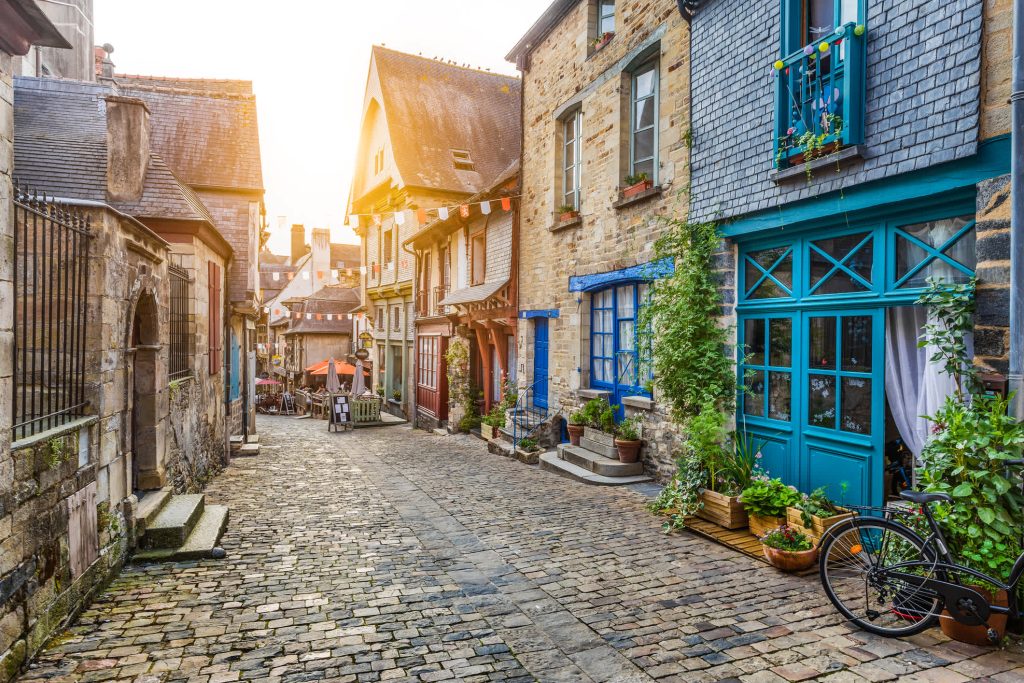
- Rue du Lion d’Or: This charming cobblestone street is lined with historic buildings, shops, and restaurants. It’s a great place to wander and soak in the medieval ambiance of the village. You can also find artisanal shops selling local crafts and products.
- Chapelle du Pénity: Built onto the side of the church on the main square, it holds the tomb of Saint Ronan — see below.
- Maison des Trompe-l’Œil: This house is known for its trompe-l’œil (deceptive painting) decorations on its facade. It’s a fascinating example of the artistry that can be found in Locronan.
- Musée d’Art et d’Histoire: This museum is housed in a former convent and showcases the history and art of Locronan and the surrounding region. It’s a great place to learn more about the village’s heritage.
- Chapelle Sainte-Anne: Another charming chapel, Chapelle Sainte-Anne is located at the entrance to the village. It’s a lovely spot to visit and is often used for local events and weddings.
- Hiking and Nature: Locronan is surrounded by beautiful countryside, making it a great base for outdoor activities like hiking. You can explore the nearby forest and enjoy the natural beauty of the region.
- Festivals and Events: Locronan hosts various festivals and events throughout the year, including traditional Breton festivals, craft fairs, and cultural celebrations. Check the local calendar to see if any events coincide with your visit.
History
Locronan has fewer than a thousand residents and sits around 15 km north-west of Quimper, in the Cornouaille area of Brittany. It belongs to the association Les Plus Beaux Villages de France (the Most Beautiful Villages of France) and carries the label Petite Cité de Caractère.
The site has been occupied for more than two thousand years. Long before the village existed it was a sacred place for the Celts, known as Nemeton. In the Middle Ages it grew into an important religious centre, and by the 16th and 17th centuries had become a significant centre of sailcloth production, weaving flax and hemp into the canvas used to rig ships for the local shipping trade. Each period left its mark on the village as it stands today.
The village takes its name from Saint Ronan, a Celtic monk who arrived from Ireland; his relics are kept in the church. In Breton, “loc” means a place of contemplation. Ronan is said to have taught the local people to weave, and the prosperity Locronan built on fine canvas in the centuries that followed is traced back to that teaching. Locronan was granted town status in 1505 by Anne of Brittany, who travelled there on pilgrimage.
The legend of Saint Ronan
According to the story, Ronan spent his life spreading Christianity across western Brittany and settled quietly in Locronan in old age. A local woman named Kében, resentful of her husband’s new devotion, falsely accused Ronan of having eaten her daughter. He was imprisoned, but the girl was found shut in a box, suffocated, and Ronan revived her. The tale made him a symbol of fertility, and the Dukes of Brittany later funded the Gothic church that still rises over the village in his honour, where a polished medieval image of the saint is kept.
The church and the Chapelle du Pénity
The church was built between 1424 and 1480 in the Flamboyant Gothic style. Its tower now stands 30 metres high; a spire that once rose to 38 metres was struck by lightning three times, in 1640, 1722 and 1808, and was never rebuilt. The pulpit, carved in 1707 by Louis Bariou of Quimper, carries ten medallions depicting scenes from Ronan’s life, including his conflict with Kében.
The adjoining Chapelle du Pénity, begun under Duke Francis II and finished under Anne of Brittany, holds Ronan’s tomb: a 15th-century slab of kersanton stone showing him as a bishop, supported by six carved angels. In one hand he blesses; in the other he forces a rod into the mouth of a monster, a symbol of the triumph over evil. Duchesses of Brittany came here to pray for an heir, Anne of Brittany among them.
The weavers’ town
Brittany’s climate and its small rivers suited flax and hemp, and from the 15th century Locronan wove them into sailcloth. The trade brought real wealth: canvas made here rigged commercial and naval ships out of Breton ports, and was exported as far as England and Spain. Merchants, shopkeepers and some of the local nobility built their fortunes on weaving.
The two classes left different houses behind. Substantial stone houses with dormer windows and carved fronts, built by cloth merchants, line the Place de l’Église; more modest weavers’ cottages, many dating from the 17th and 18th centuries, cluster along Rue Moal, once the busiest street in the village. Two buildings on the square recall the trade’s importance: the Bureau des Toiles (1669), where a royal officer inspected and stamped canvas before sale, and the Hôtel de la Compagnie des Indes (1689), which briefly held an office of the French East India Company. Reminders survive inside the church too: a weavers’ guild crest, a pair of scissors, is cut into a pillar to the right of the entrance, and a loom is engraved behind a pillar near the Rosary altar.
Around the village
The centre is built almost entirely from local grey granite under slate roofs and has survived from the Middle Ages with little alteration. Cars are left in a car park at the edge of the village; the walk in to the church is short. From there the Place de l’Église opens out: a broad cobbled square lined on all sides by houses mostly dating from the 17th and 18th centuries, with an old well at its centre.
Two streets off the square are worth the detour. Rue Saint Maurice follows the line of a Roman road that once linked Locronan to Quimper; house fronts still carry building dates from the 17th and 18th centuries, and the top of the street gives a view back over the church and the rooftops that has drawn painters, among them Maxime Maufra, Mathurin Méheut and Yvonne Jean-Haffen. Rue Moal runs north from the square to the Chapelle Notre-Dame de Bonne Nouvelle, a 15th-century chapel rebuilt in its present form in the 17th century, with a Gothic doorway and modern stained glass made in 1985 by Alfred Manessier. Beside it stands a fountain dedicated to Saint Eutrope, financed in part by cloth merchants, and a rare limestone wayside crucifix carved with a Madonna and Child on the reverse.
Rue Lann, also off the square, opens with a former priory house, once home to the head of a small community of Benedictine monks who lived by the church; a carved decoration over the door recalls this. The same house later belonged to the Breton surrealist painter Yves Tanguy, a close friend of Salvador Dalí, whose visitors there included Max Jacob and André Breton.
The Musée d’Art et d’Histoire, on the Place de la Mairie, was founded in 1934 by Charles Daniélou, then the village’s mayor. Its ground floor is given over to the textile trade, with an 18th-century loom and the tools used to turn flax and hemp into cloth; the upper floor holds a collection of Breton painting from the Cornouaille area, local stamps and ceramics from the first half of the 20th century, Breton headdresses and costumes, and a reconstruction of a Breton village interior.
The village’s survival owes a good deal to Daniélou himself. A politician, poet and novelist who lived at the Manoir de Kerguénolé (which has housed the town hall since 1912), he spent thirty years campaigning for the legal protection of historic buildings; after a 1913 law, the houses around the Place de l’Église were listed as historic monuments over the following two decades, which is a large part of why the square still looks as it did centuries ago.
Locronan has a number of cafés and crêperies, along with craft shops and a few small art galleries.
The Troménie
Locronan’s main pilgrimage festival is the Troménie, from the Breton “Tro Minihi”, a walk around the monastery grounds, and one of the traditional Breton “pardon” ceremonies. The Grande Troménie, a large procession, is held roughly every six years, always between the second and third Sunday of July; in the other years a smaller Petite Troménie takes place instead, on the second Sunday of July, on a route confined to the village and its church. The procession passes twelve traditional stopping points marked by 21 granite crosses and 42 small huts, each sheltering an old wooden or stone statue of a saint.
Nearby
Quimper, the old capital of Cornouaille, lies around 15 km away and makes a straightforward day trip from Locronan.
Weather in Locronan
| Month | Day | Night | Rainfall |
|---|---|---|---|
| January | +9° | +4° | 144 mm |
| February | +10° | +4° | 115 mm |
| March | +12° | +5° | 84 mm |
| April | +14° | +6° | 88 mm |
| May | +17° | +9° | 77 mm |
| June | +20° | +11° | 64 mm |
| July | +21° | +13° | 70 mm |
| August | +21° | +13° | 70 mm |
| September | +20° | +11° | 78 mm |
| October | +16° | +9° | 123 mm |
| November | +12° | +6° | 148 mm |
| December | +10° | +5° | 153 mm |
Updated: