Sisteron
Sisteron stands where the Durance forces its way through a wall of rock, and the geology is the town: a fold of limestone pushed up on end, so the strata run vertically, with the river cutting straight through the middle of it. On one side a citadel on a crag; on the other the Rocher de la Baume, the same fold, standing like a broken comb.
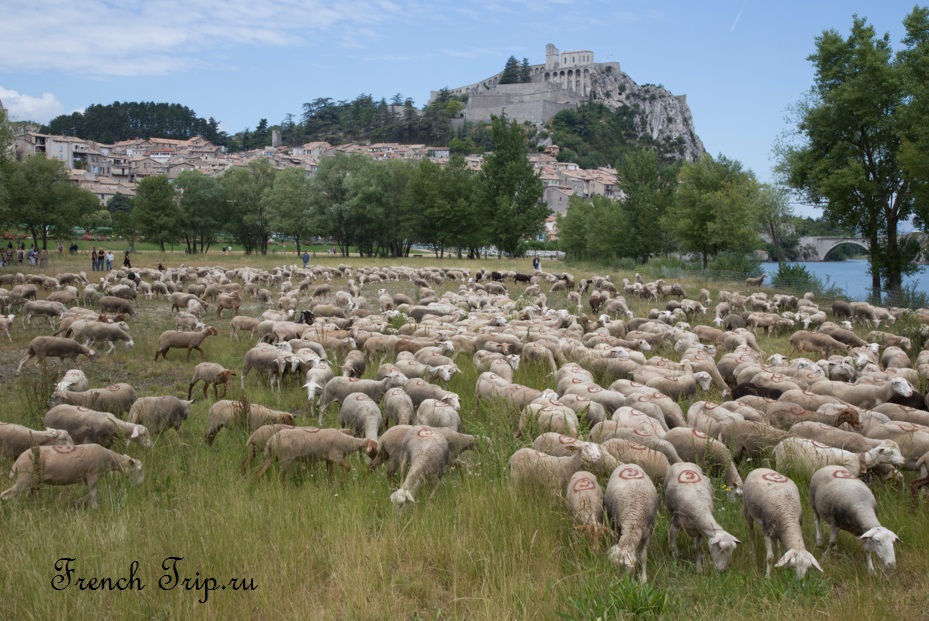
Napoleon called the place the gate of Provence, and it is exactly that — the road from the Alps to the Mediterranean has passed through this gap for two thousand years.
The town itself has around 7,000 residents, in the Alpes-de-Haute-Provence department, some 60 km south of Gap; Marseille and Grenoble are each around 130 km away, Nice about 180 km. Sisteron holds three flowers in the national “villes fleuries” ranking and belongs to the Plus Beaux Détours de France network, small towns judged worth the detour off the main road.
The citadel
Fortified since the Roman period, rebuilt in the twelfth century, and given its present form by Jean Erard, Henri IV’s military engineer, in the 1590s. Vauban inspected it a century later and added the lower works.
The climb through it is the reason to stop: a chain of towers, walls, a chapel and a stairway cut down inside the rock, ending on a terrace 500 m above the river with the Durance valley running north into the Alps and south into Provence.
The keep was destroyed by Allied bombing in August 1944 — the town was hit hard because the bridge was a supply route — and the ruins have been left as they are, with an open-air theatre now built into the citadel for the summer festival.
Inside, a ruined thirteenth-century chapel, Notre-Dame-du-Château, holds a small exhibition of paintings, and a short film inside the citadel sets out its history.
The prisoner
The citadel served as a state prison, and its most-remembered inmate was Jan Kazimierz, later king of Poland, held here in 1639 after being captured by the French. His cell is on the visitor route.
Napoleon
On 5 March 1815, three days after landing from Elba, Napoleon passed through Sisteron on his way north to Grenoble and Paris. The town could have stopped him — the bridge was the only crossing and the citadel commanded it — and did not. He ate lunch and moved on.
The Route Napoléon, the marked scenic road that follows his march from Golfe-Juan to Grenoble, runs through the town.
Part of the citadel’s interior is also given over to Napoleon, recalling his passage through the town on the march that opened the Hundred Days.
The old town
Between the citadel and the river: tall narrow houses on a slope, linked by covered stepped alleys called andrônes, which are unique to this corner of Provence — vaulted passages running under the buildings from one street level to the next. Four medieval towers survive from the fourteenth-century walls.
Below the citadel, several medieval towers still stand, among them the Tour de la Médisance. They are all that is left of the town walls, built around 1370, and they survived largely because of a visit by Prosper Mérimée, in his capacity as inspector of historic monuments.
A handful of old houses survive in the back streets: a fourteenth-century house on rue Mercerie with carved floral capitals over its window bays; the hôtel de la Baume, rebuilt in 1946 around original fourteenth-century windows and a capital; fifteenth- and sixteenth-century houses on rue de la Pousterle; and a seventeenth-century mansion on rue Droite with a carved door.
The former cathedral of Notre-Dame-des-Pommiers is twelfth-century Provençal Romanesque with Lombard influence, and larger than the town would suggest.
The cathedral stands on what is now Place du Général de Gaulle. Its nave was built without a transept, and, as in other Provençal churches, a conical dome sits over the entrance to the choir rather than at a crossing. It is listed as a monument historique in its own right.
Museums
The Musée Terre et Temps, behind the cathedral, holds an eclectic collection built around the theme of time and its measurement.
The Musée du Vieux Sisteron, near the Mairie, gathers finds from across the surrounding region going back to the Neolithic.
Lamb
Agneau de Sisteron is a protected regional product and the reason the town appears on menus across France: lambs raised on the aromatic hill pasture of Haute-Provence, and by common agreement among the best in the country. It is on every menu here, and it is what to order.
An annual lamb festival, the Fêtes de l’Agneau de Sisteron, celebrates the town’s long history of sheep farming each autumn. The Agneau de Sisteron label covers lambs slaughtered between two and five months old.
Shops around the old town sell local olive oil and lamb, alongside calissons, the Provençal almond sweet.
Getting to Sisteron
- By train — on the Marseille–Briançon line, about two hours from Marseille and an hour and a half from Aix. The station is a walk from the centre.
- By coach — direct coach services connect Sisteron with Nice, Marseille, Aix-en-Provence, Castellane, Manosque and Grenoble; trains also run direct to Gap.
- By car — on the A51, and this is the main road between Provence and the Alps. See parking in France.
Around Sisteron
- Les Mées — 20 km south: a row of eroded conglomerate pinnacles standing 100 m above the valley, known as the Pénitents, and one of the strangest sights in Provence
- Gorges de la Méouge — 25 km west, with river pools and a Roman bridge
- Forcalquier — 40 minutes south, with the Monday market
- Digne-les-Bains — 40 minutes east, and the start of the narrow-gauge Train des Pignes to Nice
- The Route Napoléon north to Gap and Grenoble, or south to Grasse and the coast
- Manosque — 55 km south, about 40 minutes
- Gorges du Verdon — 75 km, over an hour, said to be the most spectacular gorge in France
- Apt — 89 km, over an hour, across the Luberon
- Via Domitia — a Roman road built around 120 BC, said to be the oldest road in France, with a stretch passing near the town
Two of the region’s marked lavender routes pass close to Sisteron, though neither runs through the town itself; the fields on the Valensole plateau are in bloom in June and July.
Two further themed routes touch the area: a “route of time” linking sights connected with timekeeping, including the Musée Terre et Temps, and a restored stretch of pilgrim path once used by walkers from northern Italy heading for Arles — one of the four traditional French starting points for the Camino de Santiago.
When to go
May to October. July brings the Nuits de la Citadelle, a music and theatre festival staged in the fortress, which has been running since 1928. Sisteron is 500 m up and continental — hot in summer, genuinely cold in winter, and the light on the vertical rock is best early and late.
The festival is said to be the oldest in Provence.
Most people pass through on the way somewhere else. An hour and a half in the citadel is what it needs, and it repays it.
See Provence-Alpes-Côte d’Azur.
Weather in Sisteron
| Month | Day | Night | Rainfall |
|---|---|---|---|
| January | +9° | -3° | 57 mm |
| February | +11° | -3° | 50 mm |
| March | +15° | +1° | 58 mm |
| April | +19° | +4° | 71 mm |
| May | +23° | +8° | 71 mm |
| June | +28° | +12° | 53 mm |
| July | +31° | +14° | 36 mm |
| August | +30° | +13° | 48 mm |
| September | +25° | +10° | 74 mm |
| October | +20° | +6° | 115 mm |
| November | +13° | +1° | 123 mm |
| December | +8° | -3° | 80 mm |
Updated: