Moustiers-Sainte-Marie
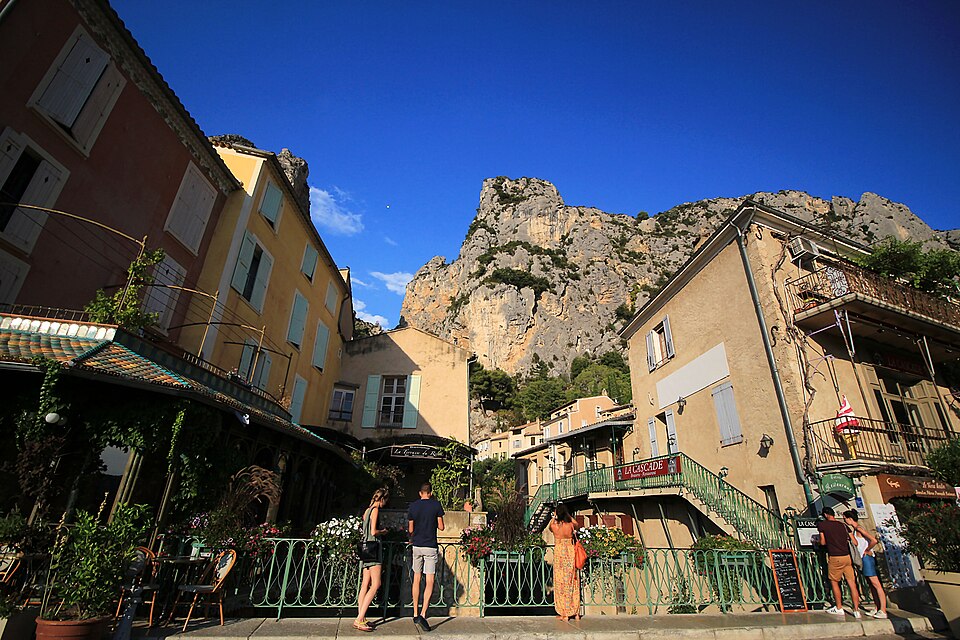
Moustiers-Sainte-Marie is built into a cleft in a limestone cliff at the western entrance to the Gorges du Verdon, with a waterfall running through the middle of it and a gilded star hanging on a chain across the gap, 227 m above the roofs.
It is one of the Most Beautiful Villages of France, and it is the capital of French faience.
The village has a population of well under 800. It lies in the Alpes-de-Haute-Provence department, built onto a rocky terrace roughly 100 m up the cliff face.
The star
A metal star hangs on a chain strung between the two cliffs above the village. The chain is 135 m long and the star weighs about 150 kg.
The story told locally is that a knight of Blacas, captured on crusade, vowed to hang a star over his village if he returned — and did. The documentary record is thinner than the legend, and the chain has broken and been replaced several times; the present one dates from 1957. Either way it has been there in some form since the Middle Ages, and nothing else in France looks like it.
The legend is the Provençal poet Frédéric Mistral’s telling of it. The star itself has changed size over the centuries, from as small as 30 cm across to as much as 1.8 m, and the chain has come down and been rehung more than once — on one occasion by helicopter. The current star has five points and measures 1.25 m across.
The village
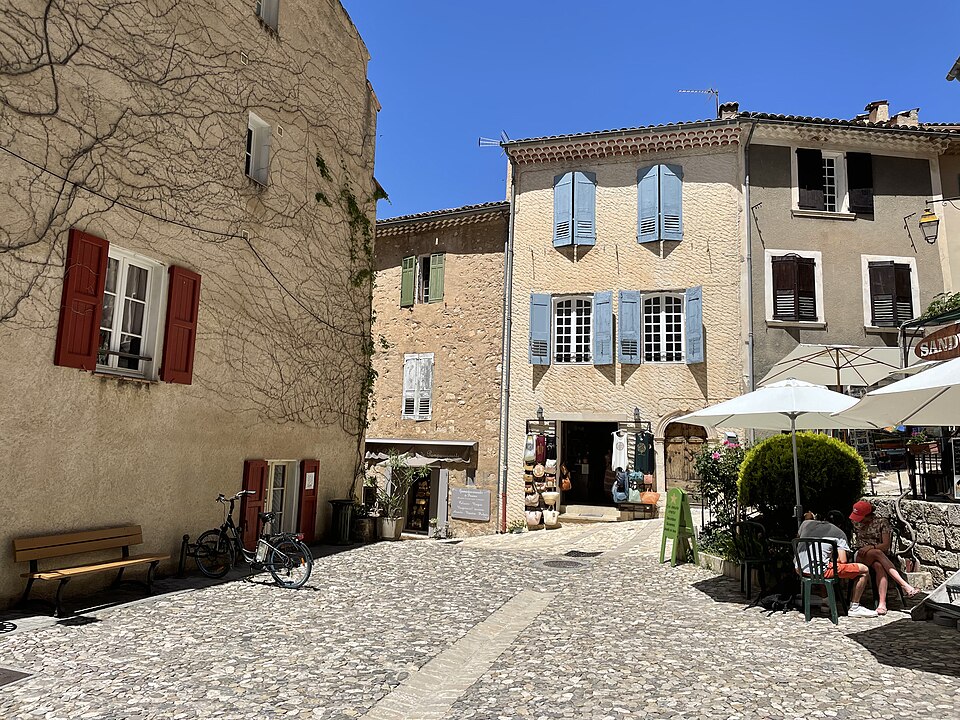
Tall houses on both sides of a ravine, linked by bridges and stairways, with the Adou torrent running down the middle. It is steep, small and extremely pretty, and in July it is extremely full.
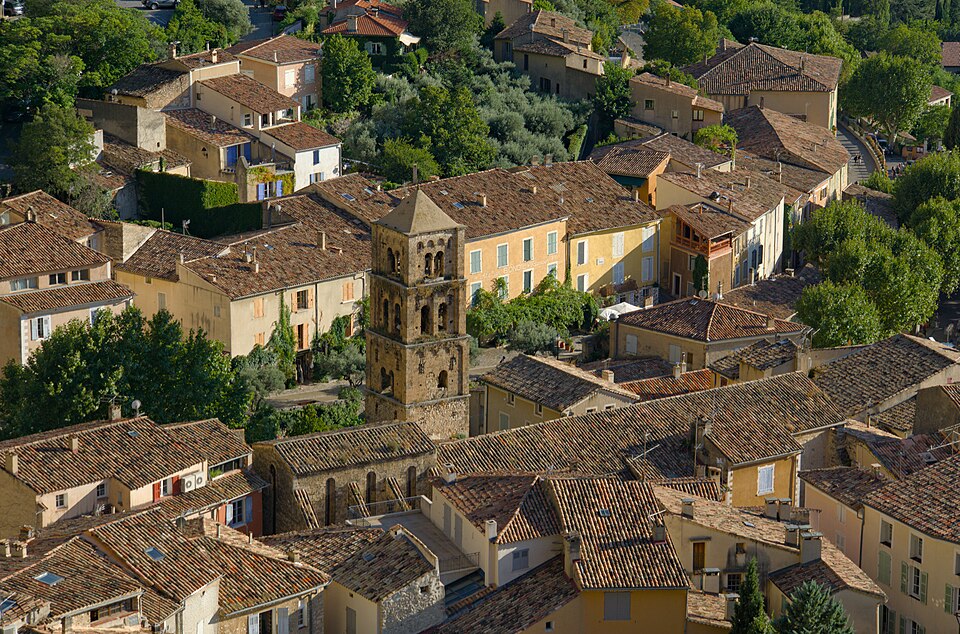
- Notre-Dame-de-l’Assomption — the parish church, twelfth-century, with a Lombard Romanesque bell tower
- Chapelle Notre-Dame-de-Beauvoir — up 262 steps beside the waterfall, on a ledge in the cliff. The climb takes twenty minutes and it is the thing to do here.
- Musée de la Faïence — the pottery museum, in the old bishop’s palace
The church
Notre-Dame-de-l’Assomption was listed as a historic monument in 1913. Its bell tower is built of tufa, square in plan, 22 m high and divided into four storeys with paired window openings; the tower is said to be one of only three “swaying” bell towers left in Europe. The Romanesque nave, from the same period, is divided into five bays under a stepped vault, with pilasters that lean outward at the top — unusual in Romanesque work — countered by buttressing on the outer walls, and three semicircular side chapels opening off it.
The prior Pierre de Pratis had the church enlarged in 1336, a project that shifted the axis of the nave; it isn’t known whether this was meant to point the church towards Jerusalem or to follow the tilt of Christ’s head on the crucifix. The altar is a white marble sarcophagus from the fourth century, carved with a scene of the crossing of the Red Sea.
Chapelle Notre-Dame-de-Beauvoir
The chapel was built at the end of the twelfth century on the site of an earlier, fifth-century shrine to the Virgin, and shows a mix of Romanesque and Gothic work added up to the sixteenth century; the date of the last alteration, 1536, is carved into the arch. It was listed as a historic monument in 1921.
The path up used to be lined with seven wayside oratories; these were replaced in 1860 by fourteen crosses, later decorated with ceramic work by Simone Garnier. In the seventeenth century, stillborn infants were baptised in the chapel in the belief that this opened the way to heaven for them.
Other sights
- Chapelle Sainte-Anne — a sixteenth-century chapel by the cemetery, built with stone taken from the old defensive towers and walls of the Paillerols district
- The aqueduct — once carried water from local springs to mills downstream, across the Adou; now only a relic
- The town walls — the cliffs above the village formed a natural defence, reinforced by ramparts around the village itself, as in many medieval Provençal towns
- Fountains and wash-houses — small public drinking fountains and communal lavoirs, where women once did the washing, are dotted through the streets and squares
- Chapelle du Clastre — thirteenth to fourteenth century
- the ruins of a former Saint-Martin monastery
Faience
Moustiers has made tin-glazed earthenware since 1679, when a monk is said to have brought the secret of the white glaze from Faenza. Through the eighteenth century it supplied the French court, and the style — fine blue monochrome on white, then polychrome grotesques — is recognisable enough that “Moustiers” is a category rather than a place name in ceramics.
Production collapsed in the nineteenth century and was revived in 1927. There are around a dozen working ateliers in the village today; the difference between them and the souvenir shops is obvious once you have seen both.
The Musée de la Faïence, in the old bishop’s palace, was founded in 1929 by the Académie de Moustiers, a local group of enthusiasts. Its five rooms hold around 500 pieces, from the first monochrome blue-on-white ware of the seventeenth century to the polychrome work that followed once the “petit feu” firing technique — credited to the Ferrat brothers around 1760 — allowed a wider palette of colours.
Food and drink
Local shops sell truffles from the surrounding hills, lavender honey, olive oil, tapenade, sheep’s cheese and charcuterie, as well as seasonal vegetables and traditional biscuits.
Getting to Moustiers
- By car — the only realistic way. An hour and a half from Aix, 45 minutes from Manosque, and 40 minutes across the Valensole plateau. Parking is the problem: the village is pedestrian, the car parks are below it, and they fill by ten in July and August.
- By bus — seasonal services from Aix, Marseille and Digne; slow and infrequent.
See parking in France.
Around Moustiers
- Gorges du Verdon — the village is the western gate; the Route des Crêtes starts 20 minutes away
- Lac de Sainte-Croix — the turquoise reservoir immediately below, with pedalos into the mouth of the gorge and beaches at Sainte-Croix and Bauduen
- Valensole — the lavender plateau, 40 minutes west
- Riez — with its four Roman columns, 25 minutes
The gorge’s cliffs rise as much as 700 m above the river in places, most dramatically on the stretch between Moustiers and Castellane.
Lac de Sainte-Croix
A scheme to dam the Verdon and flood the Salles valley was first proposed in 1908 by Georges Clemenceau, but only carried out in 1968, by Électricité de France; the reservoir filled in 1973, after completion of the Sainte-Croix dam. The villages of Sainte-Croix and Bauduen were preserved; the village of Les Salles was rebuilt.
It is now among the largest reservoirs in France, covering around 2,200 hectares — some 10 km by 2 km. Its dam holds back about 760 million cubic metres of water and generates hydroelectric power for the surrounding area; the lake itself is used for swimming, sailing, windsurfing and kayaking.
When to go
May, June and September. Moustiers in July and August is a queue on a staircase, and the car parks are full by mid-morning — arrive before nine or after five, or come out of season. The village is at its best in the evening, when the day trippers have gone and the star is lit.
On a clear evening, when the sun drops behind the cliff to the south, the village briefly turns pink.
See the natural sights of Provence.
Photo credits
Photographs on this page come from Wikimedia Commons under free licences:
- The village below the cliffs — Rosanna Delpiano, CC BY-SA 4.0, via Wikimedia Commons
- A square in the village — Einaz80, CC BY-SA 4.0, via Wikimedia Commons
- The bell tower — Polibil, CC BY-SA 4.0, via Wikimedia Commons


.jpg)
Weather in Moustiers-Sainte-Marie
| Month | Day | Night | Rainfall |
|---|---|---|---|
| January | +10° | 0° | 64 mm |
| February | +11° | -1° | 54 mm |
| March | +15° | +2° | 62 mm |
| April | +18° | +6° | 78 mm |
| May | +22° | +9° | 81 mm |
| June | +27° | +13° | 64 mm |
| July | +30° | +15° | 35 mm |
| August | +29° | +15° | 52 mm |
| September | +25° | +12° | 54 mm |
| October | +20° | +9° | 89 mm |
| November | +14° | +5° | 100 mm |
| December | +11° | +1° | 72 mm |
Updated: