Forcalquier
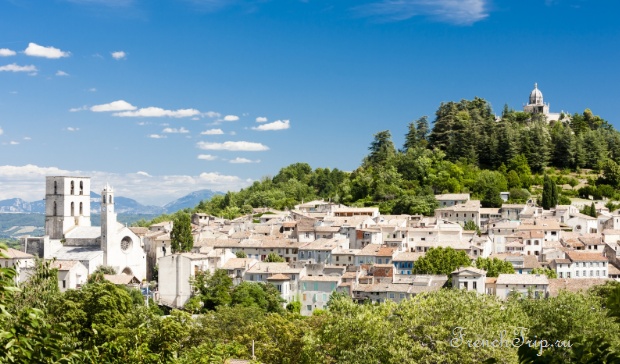
Forcalquier is a town of about 5,000 in Haute-Provence, an hour north-east of Aix, built up a hill under a citadel. In the twelfth century it was the capital of a county that rivalled Provence itself; today it is the centre of a region that trades on plants — lavender, herbs, essential oils and honey.
It is also, and this is not a tourist-board claim, under one of the darkest skies in Europe.
History
The town sits south of Sisteron, on the eastern edge of the Luberon. In Roman times it stood on a trade route between Italy and Spain; its Latin name, Furnus Calcarius, refers to the lime kilns that gave the settlement its name, and a Roman bridge still stands in the valley south of town.
The County of Forcalquier was created at the end of the eleventh century and became the capital of Haute-Provence along the river Durance, a territory that took in Manosque, Sisteron, Gap and Embrun; the town minted its own currency and its church was raised to the rank of cathedral. The rivalry with the County of Provence ended in 1195, when Garsende de Sabran, Countess of Forcalquier, married Alfonso II, Count of Provence; their son inherited both counties.
A generation later, Raymond Berenger V, by then count of both Provence and Forcalquier, married his four daughters to four kings: Marguerite to Louis IX of France (Saint Louis), Eleanor to Henry III of England, Sanchia to Henry’s brother Richard of Cornwall, King of the Romans, and Beatrice to Charles of Anjou, Saint Louis’s brother and later king of Naples and Sicily.
The Monday market
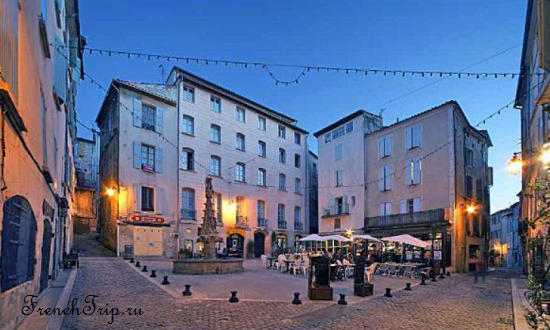
The reason most people come, and one of the best markets in Provence: producers rather than resellers, herbs and plants above all, cheese, honey, and the small production of the surrounding plateau. It fills the whole centre on Monday mornings and has done since the Middle Ages.
The citadel and the octagonal chapel
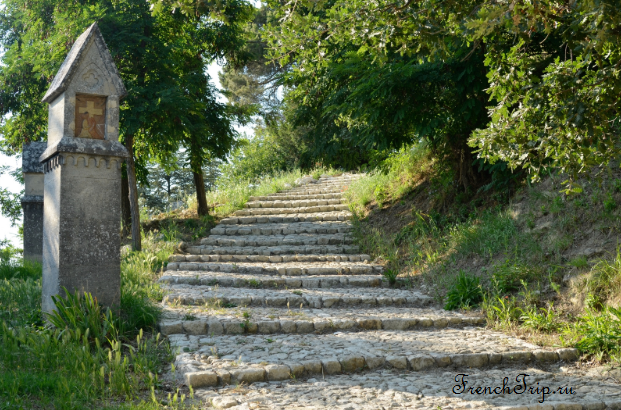
A stepped path climbs from the square to the top of the hill, where the castle of the counts stood until Richelieu had it demolished. What remains is the Notre-Dame-de-Provence chapel of 1875, octagonal, with a carillon of eighteen bells that is played on Sunday mornings — and a panorama over the whole Lure mountain and the Luberon.
The chapel was built in a Romano-Byzantine style, begun in 1869 at the initiative of a Canon Terrasson, and decorated with statues of angel-musicians and saints of Provence. The path up is marked by a series of wayside crosses.
Fifteen minutes up, and worth it for the view alone.
The town
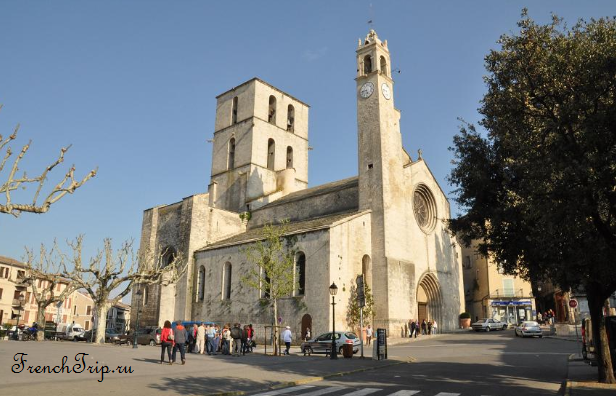
- Notre-Dame du Bourguet — the former cathedral, Romanesque nave and Gothic choir, disproportionately large for the town because Forcalquier had its own bishop
- The cemetery — an unlikely recommendation, but it is a listed monument: yew hedges clipped into a series of green vaulted rooms, laid out in the eighteenth century and unlike any other cemetery in France
- The old streets — arcades, fountains, and the Place du Bourguet where everything happens
- Place Saint-Michel — the oldest quarter, with doorways dating from the twelfth to the sixteenth centuries and a Gothic fountain of 1512, a listed monument whose base is carved with scenes of the vices that Saint Michael tramples
- Porte des Cordeliers — a fourteenth-century gate, the last survivor of the six that once closed the town
- A Romanesque house known locally as the synagogue — there is no firm evidence it was ever used as one, but it stood at the heart of the town’s medieval Jewish community
- The municipal museum — prehistoric and Gallo-Roman finds, glassware and ceramics from Mane, Apt and Moustiers-Sainte-Marie
Les Mourres
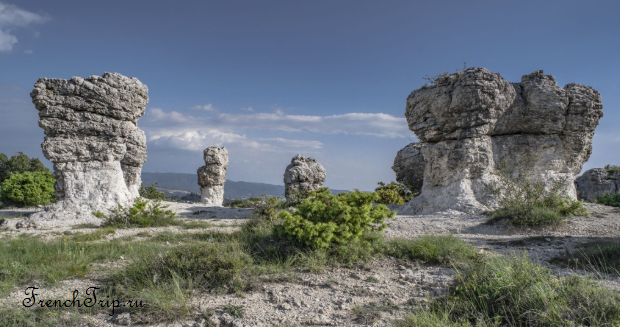
Two kilometres east: a field of freestanding limestone formations eroded into mushroom and animal shapes, standing loose on open grassland. They are the remains of a freshwater lake bed, and there is nothing else like them in Provence. Free, unfenced, and best in low sun.
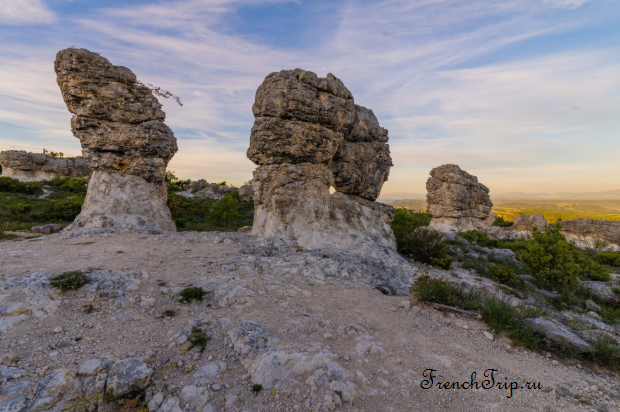
The formations continue upstream as the Petits Mourres and downstream as the Mourreisses, over some hundred metres, with the tallest rocks more than twenty metres high. Around twenty-five million years ago, at the end of the Oligocene, the site was a marshy lake bed; fossils of freshwater snails and molluscs still turn up among the rocks.
Plants and distilleries
Haute-Provence is the centre of the French aromatic plant trade, and Forcalquier is its capital: the Université Européenne des Senteurs et Saveurs is here, along with distilleries, herbalists and the makers of Distilleries et Domaines de Provence, who produce pastis and the local Rinquinquin peach aperitif in the town.
The university occupies the former Couvent des Cordeliers, a Franciscan monastery founded around 1236 and one of the first in Provence. Its Gothic cloister, rebuilt in the early fourteenth century, can be visited free of charge.
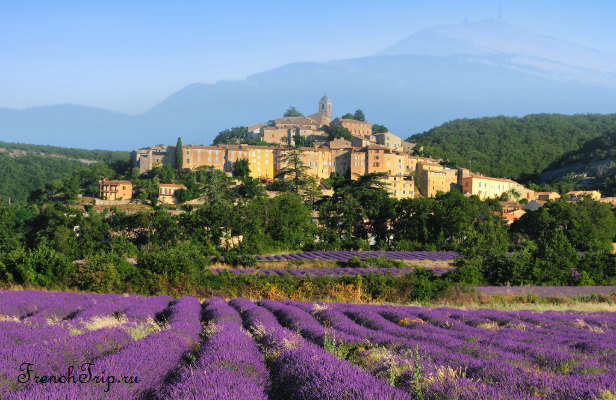
Several open for visits, and the plateau around is lavender and lavandin from late June.
The dark sky
The Observatoire de Haute-Provence, 10 km south at Saint-Michel-l’Observatoire, was where the first planet orbiting a sun-like star outside our solar system was discovered, in 1995 — work that won the Nobel Prize in 2019. The area has some of the least light-polluted sky in western Europe, and both the observatory and the neighbouring astronomy centre open to visitors for evening sessions.
Getting to Forcalquier
- By car — an hour from Aix, 45 minutes from Manosque, and the practical way. See parking in France.
- By bus — services from Manosque and Digne; check the return.
- By train — no station; Manosque, 25 km, is the nearest.
Around Forcalquier
- Prieuré de Salagon — a Romanesque priory 4 km south with ethnobotanical gardens: medieval, medicinal, scented and modern plots, and the best introduction to the region’s plant culture
- Mane, Lurs and Simiane-la-Rotonde — hill villages within half an hour
- Montagne de Lure — the mountain north, an extension of Ventoux, with almost nobody on it
- Manosque — 25 km south
- Valensole — the lavender plateau, 40 minutes south-east; see lavender in Provence
- Bories — small drystone huts scattered through the surrounding countryside, marked on some maps as cabanons pointus; examples stand beside the D950 a couple of kilometres west and along the GR6 footpath north of town
When to go
Monday, for the market. Late June and July for the lavender on the plateau. Haute-Provence is 500 m up and noticeably cooler than the Luberon in summer, which makes it a good base when the lower valleys are unbearable.
Nearby
Other places on this site within easy reach, as the crow flies:
- Valensole — 21 km
- Colorado Provençal — 23 km
- Sisteron — 30 km
- Riez — 30 km
- Sault — 31 km
- Apt — 32 km
Weather in Forcalquier
| Month | Day | Night | Rainfall |
|---|---|---|---|
| January | +9° | -2° | 50 mm |
| February | +11° | -3° | 43 mm |
| March | +14° | 0° | 51 mm |
| April | +18° | +3° | 63 mm |
| May | +22° | +7° | 55 mm |
| June | +27° | +11° | 44 mm |
| July | +30° | +12° | 26 mm |
| August | +30° | +12° | 34 mm |
| September | +25° | +9° | 48 mm |
| October | +19° | +6° | 98 mm |
| November | +14° | +2° | 102 mm |
| December | +10° | -2° | 80 mm |
This page in Russian: Forcalquier (Форкалькье)
Updated: