Aix-en-Provence
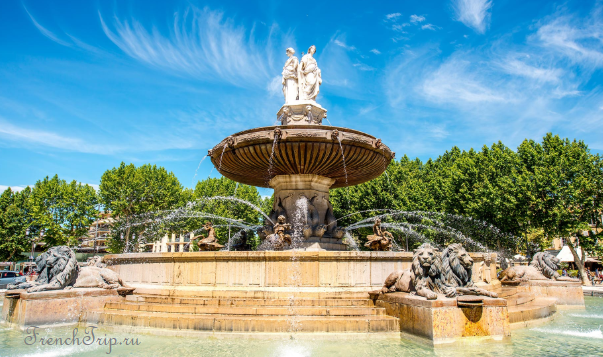
Aix-en-Provence — usually just Aix, and pronounced like the letter X — is the old capital of Provence and one of the most agreeable towns in the south. Shaded streets, several dozen fountains, ochre facades and carved doorways, and a market that is among the best in the region.
It has always been wealthy, in contrast to Marseille half an hour down the road, and it shows in the architecture: this is a town of parliamentarians’ mansions rather than merchants’ warehouses.
Two things draw most visitors: Cézanne, who was born here and painted the mountain outside it for forty years, and the markets.
The town of fountains
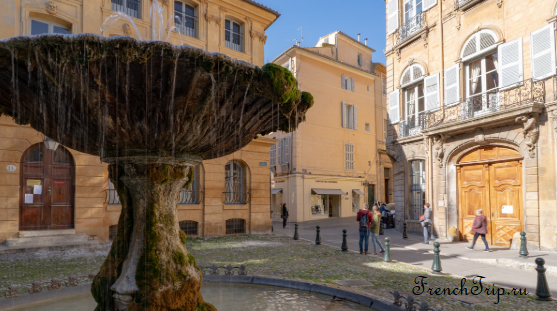
Aix was founded by the Romans in 123 BC as Aquae Sextiae — the waters of Sextius — around thermal springs, and water has defined it since. There are around forty fountains in the old town, from the vast Rotonde at the head of the Cours Mirabeau to small mossy basins in side streets that most visitors walk past.
The Fontaine d’Eau Chaude on the Cours still runs at 34 °C from the original hot spring, under a thick coat of moss.
What to see
Cours Mirabeau
The plane-tree avenue that divides the old town from the eighteenth-century Quartier Mazarin. Cafés along the sunny north side — including Les Deux Garçons, where Cézanne and Zola drank as schoolfriends — and mansions along the shaded south.
The old town
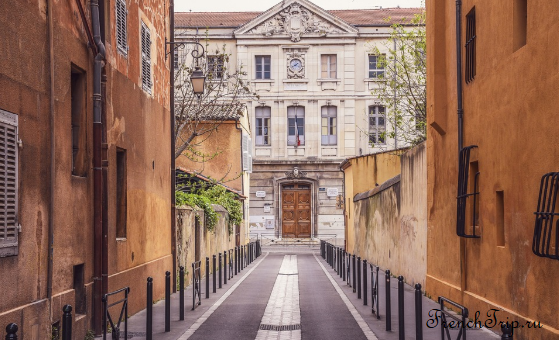
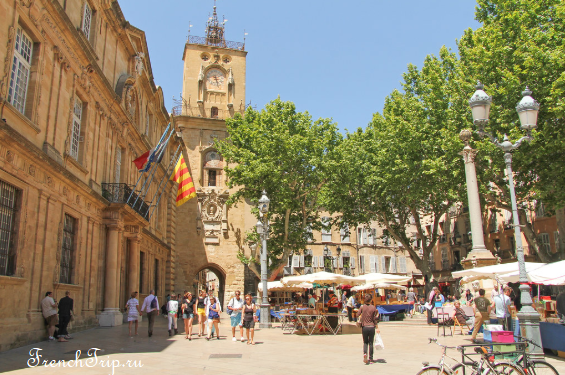
North of the Cours: a knot of pedestrian lanes, small squares with fountains, and the Hôtel de Ville with its clock tower and, beside it, the old grain market. Almost everything worth seeing is within a fifteen-minute walk.
Cathédrale Saint-Sauveur
A building assembled over a thousand years, from a fifth-century baptistery through Romanesque and Gothic to the sixteenth century, with a Romanesque cloister attached. The Burning Bush triptych by Nicolas Froment is its treasure.
Musée Granet
The town’s art museum, with works by Cézanne, Picasso, Giacometti and a strong holding of Provençal painting.
Cézanne
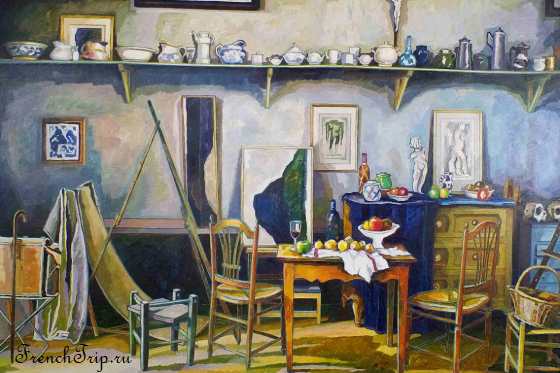
Paul Cézanne was born in Aix in 1839 and worked here most of his life. Three places matter:
- Atelier Cézanne — his studio on the hill north of the centre, kept as he left it in 1906, with his coats, bottles and skulls still on the shelves
- Carrières de Bibémus — the ochre quarries east of town whose geometry fed straight into his late painting
- Terrain des Peintres — the viewpoint from which he painted Montagne Sainte-Victoire over and over; the mountain itself is a straightforward day’s walk from town
A marked route through the town links the places he lived and worked, with bronze markers set in the pavement.
The markets
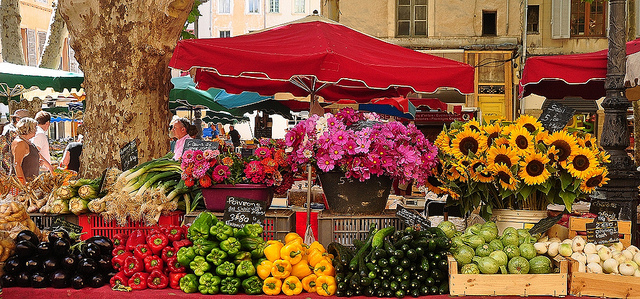
Aix has markets most mornings, and they are the reason many people come:
- Produce — Place Richelme, every morning, under the plane trees
- The big market — Place des Prêcheurs, Tuesday, Thursday and Saturday: food, flowers, fabric, the lot
- Flowers — Place de l’Hôtel de Ville, Tuesday, Thursday and Saturday
- Antiques and brocante — Place de Verdun on the same days
See the full Provençal market schedule for the region.
What to eat
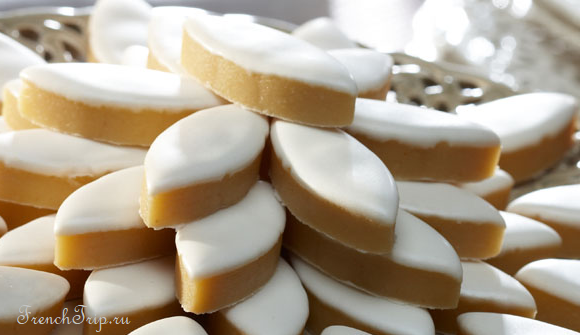
The local sweet is the calisson: a lozenge of ground almonds and candied melon on a wafer, under a white icing, made in Aix since the fifteenth century. Every confectioner in town sells them and they travel well.
Otherwise the cooking is Provençal — and the region immediately around Aix has its own wine appellation, Coteaux d’Aix-en-Provence, mostly rosé. See Provençal cuisine.
Getting there
- By train — two stations, and the distinction matters. Aix-en-Provence TGV is 15 km out, with fast trains from Paris (about 3 hours) and a shuttle bus into town. Aix-en-Provence Centre is in the town but served only by the regional line from Marseille.
- By bus — the coach from Marseille runs every few minutes and takes about 30 minutes; the coach from Marseille airport comes straight here too.
- By air — Marseille-Provence is 25 km away, with a direct coach.
- By car — the old town is pedestrian and parking inside it is not realistic. Use the car parks on the ring or the park-and-ride. See parking in France.
Around Aix
- Montagne Sainte-Victoire — Cézanne’s mountain, walkable from town
- Marseille — 30 minutes, and a complete change of register
- The Luberon — the hill villages an hour north; see the Luberon
- Avignon — an hour and a quarter
- Gorges du Verdon — about an hour and forty minutes east
When to go
Aix is a student town, so it empties somewhat in summer — and July and August are hot. The best months are April to June and September to October, when the markets are at their best and the plane trees give shade without the heat. The July music festival fills the town; book ahead if you want it, avoid it if you do not.
See when to visit Provence and what to do in Provence.
Where to park in Aix-en-Provence
| Car park | Spaces | Fee | From centre |
|---|---|---|---|
| Parc Cardeurs (piétons) underground | — | paid | 40 m |
| Parking Cardeurs underground | 125 | paid | 100 m |
| Parking Therm'Park multi-storey | — | paid | 300 m |
| Bellegarde multi-storey | 340 | paid | 340 m |
| Signoret | — | — | 410 m |
| Parking Signoret multi-storey | 350 | — | 410 m |
| Parking Pasteur multi-storey | 650 | paid | 490 m |
| Parking Mignet underground | — | paid | 600 m |
Weather in Aix-en-Provence
| Month | Day | Night | Rainfall |
|---|---|---|---|
| January | +12° | +1° | 53 mm |
| February | +13° | +1° | 36 mm |
| March | +16° | +4° | 33 mm |
| April | +19° | +7° | 58 mm |
| May | +23° | +11° | 48 mm |
| June | +28° | +15° | 36 mm |
| July | +31° | +17° | 16 mm |
| August | +31° | +17° | 34 mm |
| September | +26° | +13° | 88 mm |
| October | +21° | +10° | 77 mm |
| November | +15° | +5° | 79 mm |
| December | +12° | +2° | 51 mm |
Updated: