Montpellier
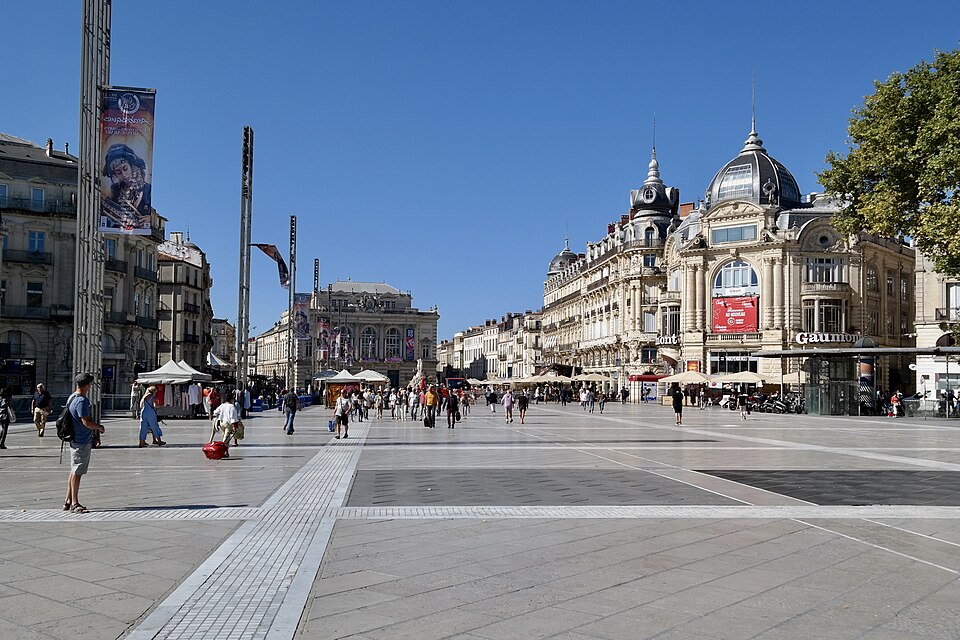
Montpellier is the capital of Occitanie, a city of about 300,000 ten kilometres from the Mediterranean, and the youngest large city in France — roughly a third of the population are students, and it shows in the pace of the place.
It is also, unusually for the south, not Roman. Montpellier appears in the record only in 985, which makes it a thousand years younger than Nîmes or Arles down the road.
The oldest medical school in the world
The university’s faculty of medicine was founded in 1220 and has taught without interruption ever since — the longest-running medical school anywhere still in operation. It grew out of the city’s position on the trade routes: Jewish, Arab and Christian physicians met here, and Arab medical texts reached Europe through Montpellier.
Rabelais studied here; Nostradamus enrolled and was thrown out. The Jardin des Plantes, founded in 1593, is the oldest botanical garden in France, created to grow the plants the school needed.
What to see
Place de la Comédie
An enormous oval square at the centre of the city, paved and pedestrian, with the opera house at one end and the Three Graces fountain in the middle. Locals call it l’Œuf, the egg, from its shape. Everything in Montpellier starts here.
L’Écusson
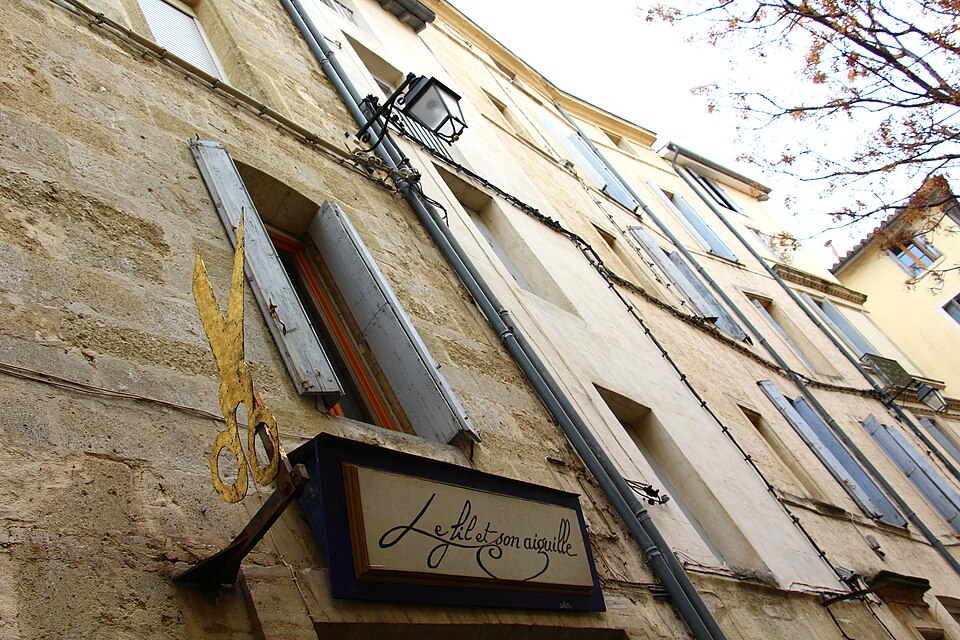
The old town, named for its shield shape: a knot of medieval lanes north of the Comédie, full of seventeenth-century hôtels particuliers with courtyards and staircases behind plain doors. Several open during heritage days and a few all year.
Promenade du Peyrou and the aqueduct
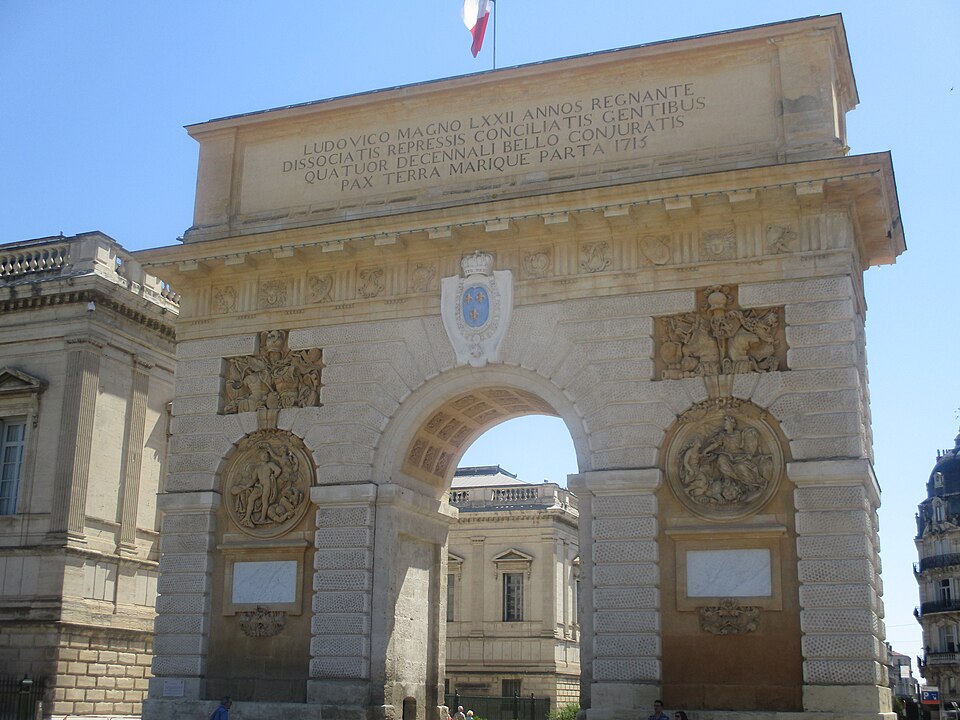
A formal terrace at the highest point of the city, with an equestrian Louis XIV, a water tower, and the view to the sea one way and the Cévennes the other. The Arc de Triomphe of 1693 stands at its entrance.
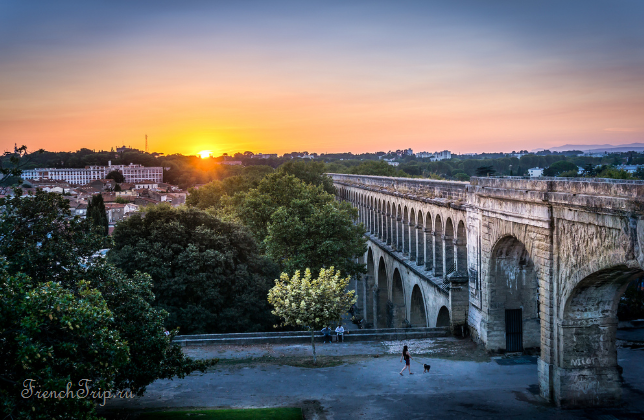
Behind it the Aqueduc Saint-Clément strides off on two tiers of arches — an eighteenth-century work in deliberate imitation of the Pont du Gard, carrying water 14 km into the city. The park beneath it is where the city goes on a Sunday.
Musée Fabre
One of the best art collections in France outside Paris — Courbet, Delacroix, Géricault, Bazille (who was from Montpellier), and a strong holding of Soulages. Founded in 1825 on a painter’s bequest.
Cathédrale Saint-Pierre
Fourteenth-century, and unmistakable: the west door is sheltered by a porch carried on two vast round towers like rocket boosters, which is an arrangement found nowhere else.
Antigone
The other Montpellier: a whole quarter built from 1979 by Ricardo Bofill in monumental postmodern classicism — colonnades, pediments and cornices at enormous scale, in concrete. It divides opinion sharply and it is worth the twenty-minute walk to form one.
The beach
Montpellier is not on the sea, but the tram and a short bus take you to Palavas-les-Flots and Carnon in half an hour, and to the wilder sand of l’Espiguette beyond. Between city and sea lie lagoons with flamingos on them.
Getting to Montpellier
- By train — Montpellier Saint-Roch is in the centre, with TGV from Paris in about 3 h 20 and frequent services to Nîmes (30 min), Marseille (1 h 40) and Toulouse (2 h 15). A second station, Montpellier Sud de France, sits outside the city — check which one your ticket says.
- By air — Montpellier-Méditerranée, 10 km east, with a shuttle.
- Getting around — four tram lines, and the trams are worth mentioning: each line is decorated by a different designer, one of them Christian Lacroix, and they are the most cheerful public transport in France.
- By car — the A9. The centre is pedestrian; use the tram park-and-ride. See parking in France.
What to eat
Languedoc cooking, with the sea and the lagoons: oysters and mussels from Bouzigues on the Étang de Thau, tielle sétoise — an octopus pie from nearby Sète — brandade, and the wines of the Languedoc, which are the best value in France. The covered Halles Castellane and the Arceaux market under the aqueduct are where to go.
See French wines.
Around Montpellier
- Sète — 30 minutes, a working fishing port built on a lagoon, with water jousting in summer
- Saint-Guilhem-le-Désert — 45 minutes, an abbey village in a gorge, on the Santiago route and UNESCO-listed
- Pic Saint-Loup — the limestone peak north, and a serious wine appellation
- Nîmes and the Camargue — half an hour east
- Carcassonne — an hour and a half west
When to go
April to June and September to October. Montpellier is one of the hottest cities in France in July and August, and it empties of students in summer, which changes its character entirely. Spring is the best of it.
See Occitanie.
Photo credits
Some photographs on this page come from Wikimedia Commons under free licences:
- Place de la Comédie — Choinowski, CC BY-SA 4.0, via Wikimedia Commons
- The Arc de Triomphe — Thomon, CC BY-SA 4.0, via Wikimedia Commons
- A street in the Écusson — Fred Romero, CC BY 2.0, via Wikimedia Commons


.jpg)
Weather in Montpellier
| Month | Day | Night | Rainfall |
|---|---|---|---|
| January | +12° | +4° | 51 mm |
| February | +13° | +4° | 38 mm |
| March | +16° | +7° | 42 mm |
| April | +18° | +9° | 48 mm |
| May | +22° | +13° | 40 mm |
| June | +26° | +16° | 31 mm |
| July | +29° | +19° | 18 mm |
| August | +29° | +19° | 33 mm |
| September | +25° | +15° | 76 mm |
| October | +20° | +12° | 91 mm |
| November | +16° | +7° | 72 mm |
| December | +12° | +5° | 51 mm |
Updated: