Camargue
The Camargue is the delta of the Rhône: 900 km² of salt marsh, reed bed, lagoon and sand between the two arms of the river, south of Arles. It is a regional nature park and the largest river delta in western Europe, and it looks like nowhere else in France — flat, wide, half water, with a horizon in every direction.
Three things are its emblems: pink flamingos, black bulls and the white Camargue horses.
The landscape
The Rhône splits above Arles and the two arms enclose the delta. It divides into three:
- Petite Camargue — west of the Petit Rhône
- Grande Camargue — the centre, between the two arms, mostly lagoon
- Plan du Bourg — east of the Grand Rhône
It is not dramatic country. There is nothing here like the Verdon or the calanques — the point is not the landform but what lives in it, and you do not have to look hard. Bulls stand in the fields by the road, flamingos feed in the roadside lagoons, and the horses are everywhere.
The other Camargue industry is salt. The pans at Salin-de-Giraud are among the largest in Europe, and in late summer the evaporation ponds turn deep pink.
The birds
The Camargue is one of the great bird sites of Europe — a stopover on the migration route with resident populations on top of it. Greater flamingos breed here, the only regular breeding colony in France, and several thousand stay through the winter.
Parc Ornithologique de Pont de Gau
The place to go if you want to actually see them. A 120-hectare reserve with around 260 species, a marked trail with hides and viewing platforms set so you can watch without disturbing the birds, and information boards along the way. Most of the flamingo photographs you have seen of the Camargue were taken here.
It is a few kilometres north of Saintes-Maries-de-la-Mer on the main road. Allow two hours at least; the full circuit takes longer. The trail map comes with the ticket.
The horses
Around 4,000 Camargue horses live semi-wild in the delta. They are a distinct and very old breed — genetically close to the horses of the upper Palaeolithic that ranged across Europe some 45,000 years ago, and unusually hardy and undemanding compared with modern breeds.
The distinctive thing about them: foals are born bay or black and only lighten to white over the first few years.
The breeding tradition here is Roman. After the conquest of Gaul, Julius Caesar settled veterans of the Sixth Legion at Arles, and they took up horse-breeding — profitably enough that it helped make the town rich.
The bulls are the other half of the same culture. They are raised by manades under mounted herdsmen — gardians — and used for the course camarguaise, in which men in white try to snatch a rosette from between the bull’s horns. The bull is not killed. This is not Spanish bullfighting and locals will tell you so.
How to see the Camargue
- On foot or by bike — several marked routes, including one from Saintes-Maries-de-la-Mer and a themed flamingo trail. Flat, and the wind is the only difficulty.
- By boat — cruises up the Petit Rhône from Saintes-Maries, about an hour and a half, stopping at horse and bull farms so you can photograph them from the water. Three operators run them from the harbour; the season runs roughly March to October and boarding is fifteen minutes before departure.
- On horseback — the classic way, and the only way into parts of the marsh. Rides run from an hour upwards, booked ahead.
- By 4×4 safari — a couple of hours with a guide, into areas closed to cars.
- By little tourist train — from Saintes-Maries. Cheap, and bumpy.
- By car — the D570 south from Arles and the D36 down the eastern side to Salin-de-Giraud. Stop often; most of what you want to see is beside the road.
Saintes-Maries-de-la-Mer
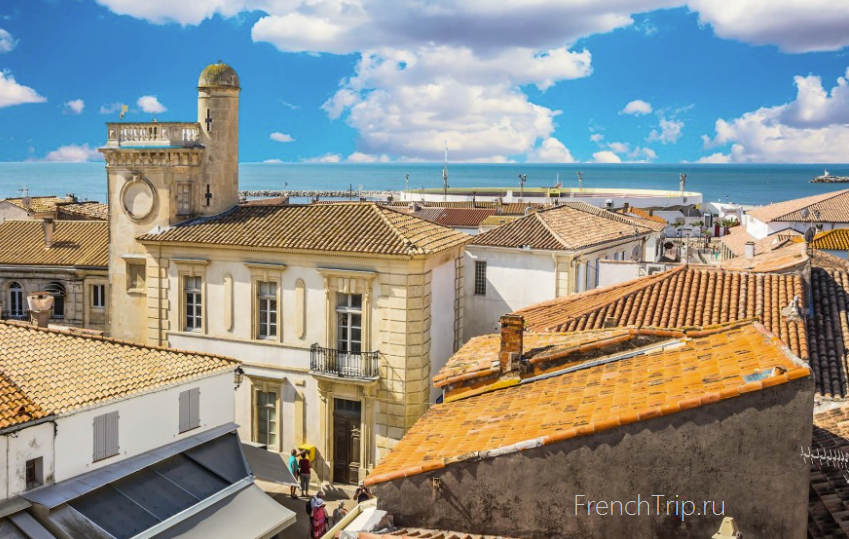
The town on the delta’s coast, and the usual base. Whitewashed, low, built around a fortified twelfth-century church with a battlemented roof you can climb for the view over the whole flat expanse.
It is a pilgrimage site: according to the legend, Mary Salome, Mary Jacobe and their servant Sara landed here after the crucifixion. Sara is the patron saint of the Roma, and every 24–25 May thousands gather for the pilgrimage and carry her statue into the sea. It is one of the most striking religious events in France, and the town is full for it.
See the Saintes-Maries-de-la-Mer guide.
Practical
- Mosquitoes. This is a marsh and they are serious about it, particularly at dusk from May onwards. Bring repellent — this is the single most useful thing on this page.
- The mistral blows hard here and there is nothing to stop it. It also clears the sky, which is why the light is so good.
- Much of the delta is restricted — nature reserve, private manades, or both. Stay on the marked routes.
- There is no railway into the Camargue. Buses run from Arles to Saintes-Maries; otherwise a car is close to essential.
Getting there
- From Arles — the natural gateway, with buses to Saintes-Maries and Salin-de-Giraud, about an hour
- From Nîmes — half an hour to the western edge
- From Avignon — an hour, and there are day tours if you have no car
- By car — from Arles on the D570; see parking in France
What to eat
The delta grows rice — introduced after the war and now a protected product — and produces fleur de sel from the pans. The local dishes are gardiane de taureau, bull stewed slowly with red wine, olives and orange peel, served with Camargue rice, and tellines, tiny clams from the beach cooked with garlic. The wines are the sables of the coastal dunes, mostly rosé.
See Provençal cuisine.
When to go
April to June is the best window: the flamingos are breeding, the birds are at their most numerous, the light is clear and the mosquitoes have not yet reached their peak. September and October are the next best. July and August are hot, flat and busy, and the flamingo numbers drop. Winter is bleak, windy and beautiful, and several thousand flamingos stay.
See the natural sights of Provence.
Nearby
Other places on this site within easy reach, as the crow flies:
- Fontvieille — 26 km
- Aigues-Mortes — 30 km
- Les Baux-de-Provence — 32 km
- Saint-Rémy-de-Provence — 37 km
- Miramas-le-Vieux — 38 km
- Martigues — 42 km
Weather in Camargue
| Month | Day | Night | Rainfall |
|---|---|---|---|
| January | +11° | +3° | 54 mm |
| February | +13° | +3° | 33 mm |
| March | +16° | +6° | 34 mm |
| April | +19° | +9° | 57 mm |
| May | +23° | +12° | 40 mm |
| June | +27° | +16° | 27 mm |
| July | +30° | +18° | 13 mm |
| August | +30° | +18° | 27 mm |
| September | +25° | +14° | 84 mm |
| October | +21° | +12° | 81 mm |
| November | +15° | +7° | 76 mm |
| December | +12° | +4° | 44 mm |
This page in Russian: Камарг (Camargue)
Updated: