Biot
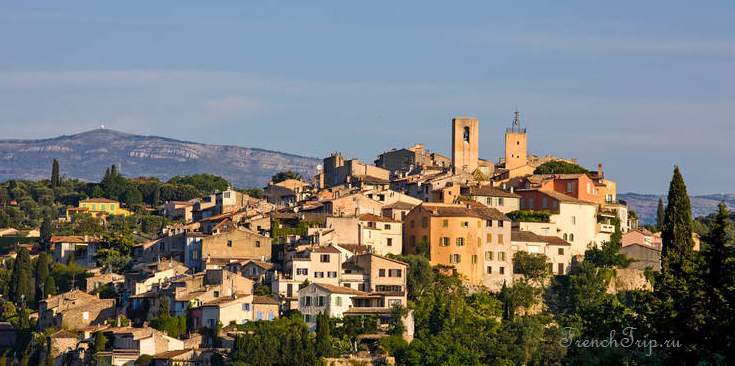
Biot is a hill village of about 10,000 between Antibes and Cannes, four kilometres back from the sea. It has made things out of earth and fire for two thousand years, and it still does.
The village was first settled by Gallo-Romans, on a hilltop with a view out to the Mediterranean. By the mid-twentieth century it was known again for decorative pottery as well as for glass, and today it works as a village of open workshops: potters, ceramicists and jewellers show visitors what they do, alongside the glassblowers.
Two crafts define it: the great storage jars it produced from Roman times until the nineteenth century, and the bubbled glass it invented in 1956, which is now sold everywhere in Provence.
The glass
Verre bullé — glass with bubbles deliberately trapped inside it — was developed at the Verrerie de Biot in 1956 by Éloi Monod, a ceramics engineer who wanted to do with glass what Biot had always done with clay. The bubbles come from a chemical added to the molten batch; the result is the thick, faintly cloudy tableware in green, amber and blue that you will recognise.
Several workshops are open below the village, and you can watch the blowing. The village also has a small Musée d’Histoire et de Céramique Biotoises on the older trade.
The museum can be seen in under an hour, and is mainly of interest to people who already collect glass or ceramics, but it explains why Biot became the coast’s centre for glassblowing: the local clay beds also yield an unusually good sand for glass. The bubble glass the village is known for dates from 1956.
The village
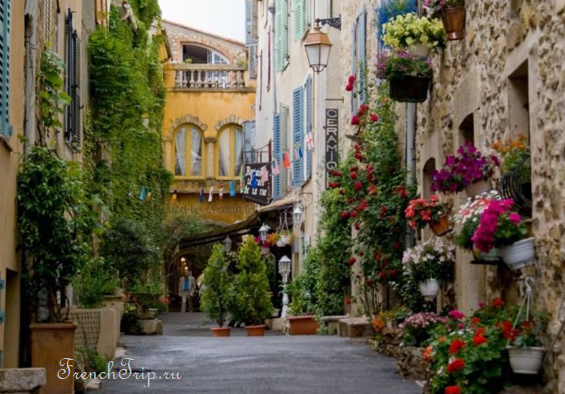
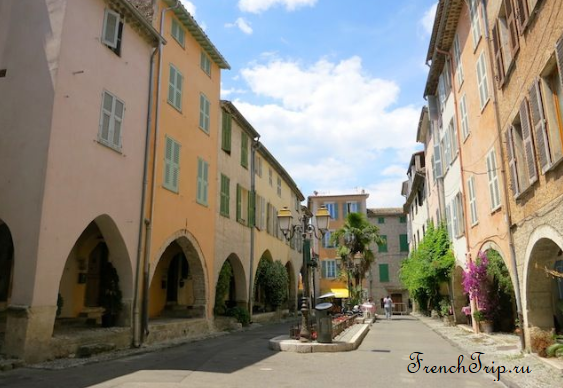
- Place des Arcades — the arcaded square at the top of the village, thirteenth and fourteenth century, with pointed and rounded arches side by side; the best thing in Biot
- Porte des Migraniers and Porte des Tines — the sixteenth-century gates
- Église Sainte-Marie-Madeleine — with two fifteenth-century altarpieces attributed to Louis Bréa and Giovanni Canavesio
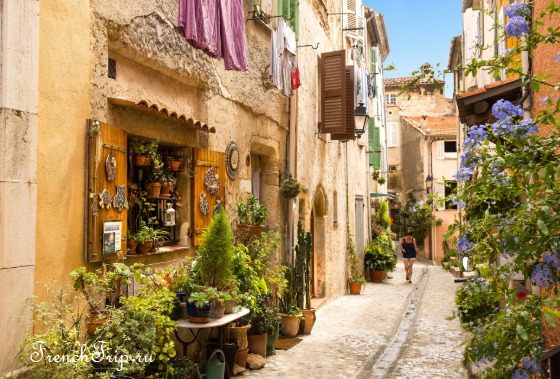
- The lanes between them, steep, narrow and heavily flowered
The Templars and the Genoese
Biot belonged to the Templars from 1209 and passed to the Knights of Malta. In 1387 it was wiped out — plague and war together — and stood empty for a hundred and eighty years. In 1470 the bishop of Grasse repopulated it with fifty families brought from Oneglia in Liguria, and the Genoese surnames are still on the doorbells.
Sainte-Marie-Madeleine
The present church is mostly fifteenth century, built by the Italian families who had just repopulated the town. Its red-and-gold Retable du Rosaire is by Louis Bréa; the recently restored Christ aux Plaies, showing Christ’s wounds, is by Giovanni Canavesio. An earlier church on the site, built around 1155, was decorated with frescoes that the bishop of Grasse had painted over in 1699, judging them indecent.
Two smaller chapels survive from the same period: the Chapelle des Pénitents Blancs on rue Saint-Sébastien, put up in 1612, and the Chapelle Saint-Roch on the route de Valbonne, from 1581; both are listed historic monuments.
The church still holds a series of classical concerts, Les Heures Musicales, usually on a Friday or Saturday evening.
Musée National Fernand Léger
At the foot of the hill, and worth the trip on its own. Fernand Léger bought a property at Biot in 1955 and died a fortnight later; his widow built the museum on the land and gave it to the state in 1969.
The façade carries a ceramic mosaic 500 m² in area, designed by Léger for a stadium in Hanover and never installed there. Inside are some 450 works — paintings, ceramics, tapestries and stained glass — covering his whole career, and it is the most complete collection of his work anywhere.
In the grounds is a sculpture in polychrome ceramic, Le Jardin d’enfant; inside, two floors of paintings, ceramics and tapestries work through Léger’s recurring subjects — cranes, acrobats, scaffolding, railway signals, nudes, and the cowlings and crankshafts from his years painting industrial machinery. The most unusual picture, La Joconde aux Clés, shows Léger’s version of the Mona Lisa studying a bunch of keys, with a wide-mouthed fish hanging above her head.
Getting to Biot
- By train — Biot station is on the coast at Villeneuve-Loubet, 4 km from the village, on the Nice–Cannes line; a bus runs up.
- By car — 10 minutes from Antibes, 20 from Cannes, 25 from Nice. Park below the village. See parking in France.
- By air — Nice airport is 15 km.
- Direct trains also run from Monaco and from Menton, further east along the coast; travelling from Fréjus or Saint-Raphaël means a change at Cannes.
- In summer a shuttle bus links the station with the village roughly every twenty minutes.
Around Biot
- Marineland — at the foot of the hill, the largest marine park in Europe
- Antibes — 10 minutes, with the Picasso museum in the Château Grimaldi
- Vallauris — 15 minutes, the other ceramics town, where Picasso worked
- Saint-Paul-de-Vence — 20 minutes, with the Fondation Maeght
- Sophia Antipolis — the technology park next door, which is why Biot has 10,000 residents and a village of 1,500
When to go
April to June and September to October. Biot is close enough to the coast to fill with day visitors in the middle of a summer day and to empty again by six; late afternoon on the Place des Arcades is the moment to be there.
See the Côte d’Azur.
Weather in Biot
| Month | Day | Night | Rainfall |
|---|---|---|---|
| January | +13° | +4° | 88 mm |
| February | +14° | +4° | 60 mm |
| March | +16° | +6° | 58 mm |
| April | +18° | +9° | 74 mm |
| May | +22° | +13° | 47 mm |
| June | +26° | +16° | 30 mm |
| July | +29° | +19° | 17 mm |
| August | +29° | +19° | 24 mm |
| September | +26° | +15° | 90 mm |
| October | +21° | +12° | 132 mm |
| November | +17° | +8° | 156 mm |
| December | +14° | +5° | 103 mm |
Updated: