Gordes
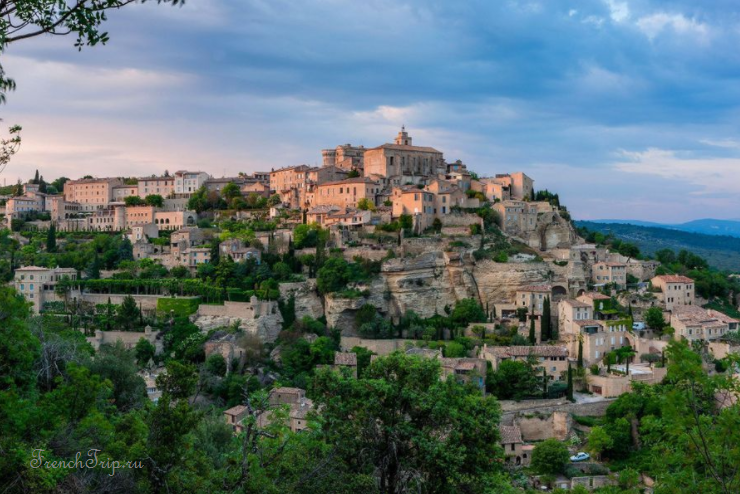
Gordes is the picture people have in their heads when they think of the Luberon: a village of pale stone stacked up a cliff face in tiers, with a castle at the top and the Vaucluse plain below. It is on the list of the Most Beautiful Villages of France and it is the most visited village in the region.
It sits 38 km east of Avignon, and the approach from the D15 with the whole village rising in front of you is the reason to come by car.
The village
Gordes was a fortified position from the eleventh century and the stone is all the same pale limestone, which is what gives the place its unity. The château at the top is Renaissance on medieval foundations, with a monumental carved chimneypiece of 1541 inside; it houses the town hall and exhibitions.
The first written record of a stronghold here is from 1031, linked to Guillaume d’Agoult, an heir of the feudal family that raised Gordes’ original walls; his successor strengthened them in 1123. The keep was enlarged with a vaulted undercroft in the mid-14th century, as elsewhere in Provence, and the château withstood a siege during the Wars of Religion before passing through the Simiane and Soubise families to the House of Condé in the eighteenth century. Revolutionaries seized it in 1789 without destroying it, and it has been a listed historic monument since 1931. It also houses the tourist office.
Below it the calades — stepped cobbled lanes — drop through vaulted passages to the terraces. It is steep, and comfortable shoes matter more here than anywhere else in the Luberon.
The old town can be seen comfortably in half a day, though the ground is steep throughout: any path down from the château has to be climbed again on the way back up.
The village was largely abandoned in the nineteenth century and revived after the war by artists — Chagall, Vasarely and André Lhote all worked here — which is why its restoration is so thorough.
Other things to see in the old town
- A fountain south of the château, dated to 1342, was for centuries the only water source in the upper village.
- Église Saint-Firmin — an eighteenth-century church on the site of a thirteenth-century predecessor. Its square tower dates from the fourteenth century and once served as a belfry; an external staircase, now leading nowhere, is a remnant of a building that once stood against it and has since been demolished, and a door at its foot opens onto a former prison.
- The calades — cobbles of limestone set on edge rather than laid flat, a technique found across Provence — run south from the château past a surviving stretch of the old fortified wall and its Porte de Savoie gate, first recorded in 1540.
- Hôtel Pluvinel, a seventeenth-century house, was once home to the painter André Lhote and is listed as a historic monument; the adjoining Chapelle Pluvinel, also seventeenth-century, takes its name from it.
- Aumônerie Saint-Jacques, a former hostel for pilgrims on the way to Santiago de Compostela, has carved capitals close in style to those at Sénanque, though the building itself is a century or two later.
Abbaye de Sénanque
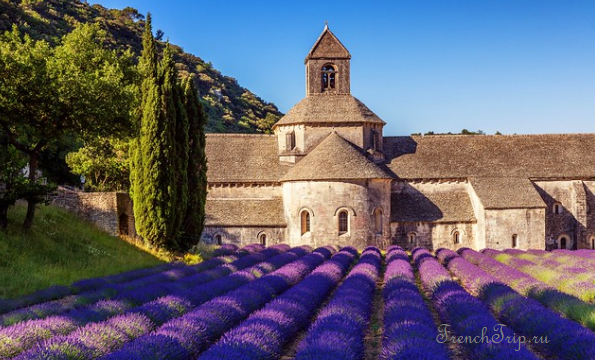
Four kilometres north, in a fold of the hills, stands the Cistercian abbey of Sénanque, founded in 1148. Cistercian building is deliberately plain — no sculpture, no colour, just proportion — and the abbey church, cloister and dormitory are among the purest Romanesque interiors in France.
Sénanque is usually grouped with two other Cistercian houses, Le Thoronet and Silvacane, as the three most celebrated Cistercian abbeys in Provence. The order was founded in 1098 by Robert of Molesme, seeking a stricter observance of the Rule of Saint Benedict; for its first years its only house was Cîteaux, which gave the order its name, and it was only from the 1120s that the order began to expand quickly.
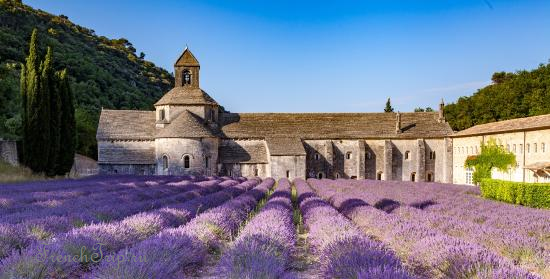
It is also the single most photographed lavender field in the world, because the monks grow lavender in the field in front of the church. Two things to know: the flowering runs roughly from mid-June to mid-July, and the abbey is a working monastery — a dozen monks live there, the interior is visited by guided tour only, and it needs booking.
Village des Bories
Two kilometres south-west: a settlement of about twenty bories — beehive huts of dry-laid limestone, no mortar at all, built as shelters and sheepfolds. The technique goes back to prehistory and these were in use until the nineteenth century. It is an open-air museum now, and quietly remarkable.
Getting to Gordes
- By car — effectively the only way. Under an hour from Avignon, 40 minutes from Aix. Parking is the problem: the village car parks fill by mid-morning in season and the approach road backs up. Come before ten.
- By bus — sparse services from Cavaillon and Apt; possible to get in, often not possible to get back the same day.
See parking in France.
The classic view of the village massed on its cliff, the one used on postcards, is from the approach road itself rather than from inside Gordes; there are a few places to pull off and stop, though not many, and they fill quickly in season.
Around Gordes
- Roussillon — 10 km, and the complete opposite in colour
- Fontaine-de-Vaucluse — the spring where the Sorgue comes out of the rock, one of the largest karst springs in the world
- L’Isle-sur-la-Sorgue — the antiques town, with its Sunday market
- Ménerbes and Bonnieux — the villages along the south side of the Luberon
- Avignon — under an hour
When to go
June and July for the lavender at Sénanque, September and October for everything else — Gordes in August is a traffic jam with a view. The light on the stone is best in the late afternoon, which is also when the coaches have left.
See the lavender fields of Provence and when to visit Provence.
Nearby
Other places on this site within easy reach, as the crow flies:
- Fontaine-de-Vaucluse — 6 km
- Luberon — 7 km
- Oppède-le-Vieux — 10 km
- Venasque — 10 km
- Lacoste — 11 km
- L'Isle-sur-la-Sorgue — 12 km
Weather in Gordes
| Month | Day | Night | Rainfall |
|---|---|---|---|
| January | +10° | +2° | 64 mm |
| February | +11° | +2° | 50 mm |
| March | +15° | +5° | 54 mm |
| April | +19° | +8° | 65 mm |
| May | +22° | +11° | 76 mm |
| June | +27° | +15° | 53 mm |
| July | +30° | +17° | 21 mm |
| August | +30° | +17° | 32 mm |
| September | +25° | +14° | 66 mm |
| October | +19° | +10° | 102 mm |
| November | +14° | +6° | 115 mm |
| December | +10° | +3° | 60 mm |
This page in Russian: Gordes (Горд)
Updated: