Fontaine de Vaucluse
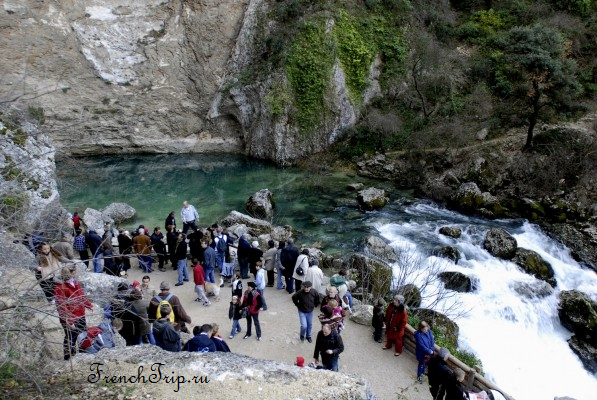
Fontaine-de-Vaucluse is a village of 600 people at the head of a closed valley east of Gordes, and it exists because of one thing: the spring of the Sorgue, the most powerful in France and the fifth most powerful in the world.
The Latin name of the valley — vallis clausa, the closed valley — gave the whole department its name.
History
The valley has been occupied since prehistoric times, and the village grew up on the site of a Roman settlement. The old centre keeps its medieval street plan and character, and holds several small museums, including ones devoted to local geology and to local history. On the left bank of the Sorgue are the remains of a Roman canal, and a stone column near the church, raised in 1804, commemorates Petrarch.
The spring
At the foot of a 230 m cliff, water emerges from a cave mouth at an average of 20 cubic metres a second, and in flood at more than 100. It drains a limestone plateau of about 1,100 km² including Mont Ventoux — rain that fell weeks earlier, filtered through the rock.
The cave mouth lies about 200 metres upstream from the village, closing the head of the valley beneath cliffs on both sides. It was among the first karst springs to be studied scientifically.
Nobody has reached the bottom. Cousteau dived it in 1946 and again in 1955; unmanned submersibles went down in stages over forty years, and in 1985 a robot touched a floor at −308 m. Whether that is the true bottom is still unsettled.
What you see depends entirely on the season. In late winter and spring the cave overflows and the whole gorge roars. In late summer the mouth is often dry and the water rises further down the bed — impressive as geology, disappointing as spectacle. March to May is the time to come.
The walk from the village to the spring takes about ten minutes, uphill on a stony path lined with stalls.
Petrarch
Petrarch lived here on and off between 1337 and 1353, and wrote much of the Canzoniere in the valley — the poems to Laura that shaped European love poetry for the next three centuries. He called it his transalpine solitude.
A small museum, the Musée-bibliothèque Pétrarque, stands on the supposed site of his house, with early editions and works by later visitors. Chateaubriand, Mistral, Mirabeau and René Char all came.
The museum’s collection also includes early editions of works by Petrarch and his followers, along with drawings and prints depicting Laura, the woman he addressed the poems to. The writer Georges de Scudéry also wrote about the valley.
The village
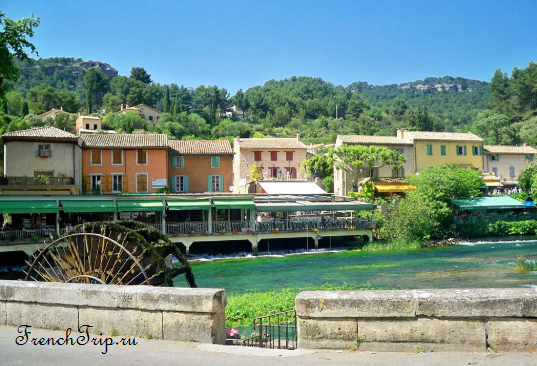
- Le Moulin à Papier Vallis Clausa — a working reconstruction of a fifteenth-century paper mill, its great wheel turned by the Sorgue; paper is made by hand and the visit is free
- Musée d’Histoire 1939–45 — on the Resistance in the Vaucluse, which was strong in these hills
- Le Monde Souterrain — the collection of Norbert Casteret on the exploration of the spring itself
- Église Notre-Dame-et-Saint-Véran — eleventh-century Romanesque, with the tomb of the saint
- The castle ruins — on the crag above, held by the bishops of Cavaillon
The castle ruins date from the thirteenth and fourteenth centuries. At the paper mill, the gallery sells paper made on site, and the valley once held several other paper mills drawing on the same stretch of river. The Ecomusée du Santon et Traditions de Provence displays over 2,000 santon figures of various sizes in around 60 scenes of Provençal village life, including a scene said to be the smallest in the world: 39 figures inside a walnut shell. Le Monde Souterrain holds around 400 cave crystals gathered over fifty years by the speleologist Norbert Casteret, and runs a 40-minute guided tour, in French, of the exploration of the spring, suitable for all ages.
Saint Véran
The village’s patron saint is Véran, born in the Vaucluse in the sixth century. He was ordained a priest in 540 and became bishop of Cavaillon around 28 years later. Various miracles are attributed to him, including ridding the Sorgue of its dragon. The church of Notre-Dame-et-Saint-Véran is named for him; it was listed as a historic monument in 1840 and restored between 1952 and 1966.
The dragon
Saint Véran, bishop of Cavaillon, is said to have rid the Sorgue of the Coulobre — a winged serpent that lived at the spring. The name comes from the Latin coluber. In the local telling she had been abandoned by her dragon and bore a small black salamander; the saint drove her off to the Alps. It is one of the better Provençal monster stories and the village has not let go of it.
Getting there
- By train — no station in the village. L’Isle-sur-la-Sorgue–Fontaine-de-Vaucluse on the Avignon–Marseille TER line is 7 km away, with a bus or taxi on.
- By bus — services on the Cavaillon–Apt–Avignon axis.
- By car — 30 minutes from Avignon, 20 from L’Isle-sur-la-Sorgue. Parking is paid and at the entrance to the village; the centre is closed to traffic. See parking in France.
Around
- L’Isle-sur-la-Sorgue — 7 km, the antiques town on the same river
- Gordes and Sénanque abbey — 20 minutes
- Roussillon — 30 minutes, the ochre village
- Cavaillon — 15 km, melons and a Roman arch
- Mont Ventoux — an hour; the rain that falls on it comes out here
- Venasque — 9 km, another of the Plus Beaux Villages de France
- Ménerbes — 12 km, also among the Plus Beaux Villages de France
- Carpentras — 16 km, a market town in the northern Vaucluse
When to go
Spring, for the water. Arrive before ten or after five — this is one of the most visited sites in the Vaucluse and the path to the spring can be shoulder to shoulder in the middle of the day. Out of season it is quiet and the village is closed.
See the Luberon and when to visit Provence.
Nearby
Other places on this site within easy reach, as the crow flies:
- Senanque Abbey — 5 km
- Pernes-les-Fontaines — 10 km
- Oppède-le-Vieux — 11 km
- Lacoste — 15 km
- Bonnieux — 18 km
- Sénas — 20 km
Weather in Fontaine-de-Vaucluse
| Month | Day | Night | Rainfall |
|---|---|---|---|
| January | +11° | +1° | 58 mm |
| February | +12° | +1° | 38 mm |
| March | +17° | +4° | 40 mm |
| April | +20° | +7° | 64 mm |
| May | +24° | +11° | 58 mm |
| June | +28° | +14° | 39 mm |
| July | +31° | +16° | 22 mm |
| August | +31° | +16° | 40 mm |
| September | +26° | +13° | 92 mm |
| October | +21° | +10° | 100 mm |
| November | +15° | +5° | 95 mm |
| December | +11° | +2° | 51 mm |
This page in Russian: Fontaine-de-Vaucluse (Фонтен-де-Воклюз)
Updated: