Cavaillon
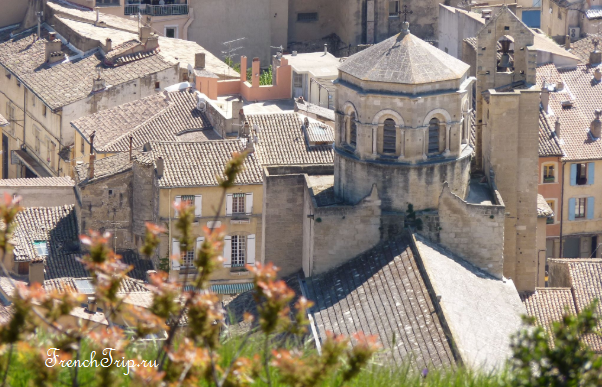
Cavaillon is a working town of about 27,000 at the western gate of the Luberon, and it is not a picture-postcard village — which is rather the point. It is the market town the villages depend on, France’s largest fruit and vegetable wholesale market after Rungis, and the place whose name is on the melons.
It is also the transport hub: Cavaillon has a railway station, which none of the famous Luberon villages do.
Cavaillon is about 22 km from Avignon, and the old town can be seen properly in a couple of hours. The centre is workaday rather than handsome — mostly plain two-storey houses, with the odd better facade — and parts of the old quarter look distinctly tired; most travellers use Cavaillon as a stepping stone into the Luberon rather than a base for its own sake.
The melon
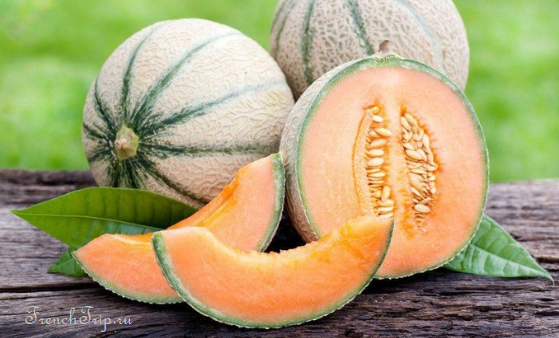
Melon de Cavaillon is a charentais melon — small, round, ribbed, orange-fleshed and intensely perfumed — and the town has been identified with it since the popes at Avignon had them grown here in the fourteenth century.
Alexandre Dumas is the town’s best melon story: in 1864 he offered Cavaillon’s library the complete set of his works — some four hundred volumes — in exchange for an annuity of twelve melons a year. The town agreed, and paid it until he died.
The Fête du Melon in early July is the town’s event of the year. Buy at the morning market rather than a supermarket; the difference is not subtle.
The festival also brings a craft market, a display of local farm animals, a procession of horses in Camargue harness, menus built entirely around melon, and a young chefs’ competition.
What to see
The Roman arch
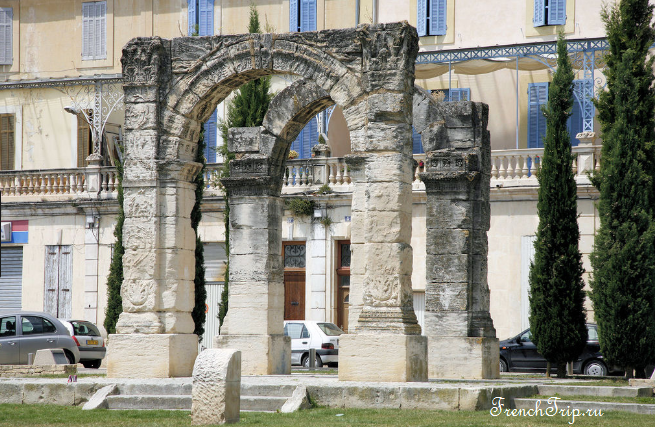
A first-century BC arch standing in a square in the middle of town — moved there in 1880 from its original position, and carved with vines and acanthus. Cavaillon was Cabellio, a Roman town on the road between Italy and Spain.
Cathédrale Saint-Véran and its cloister
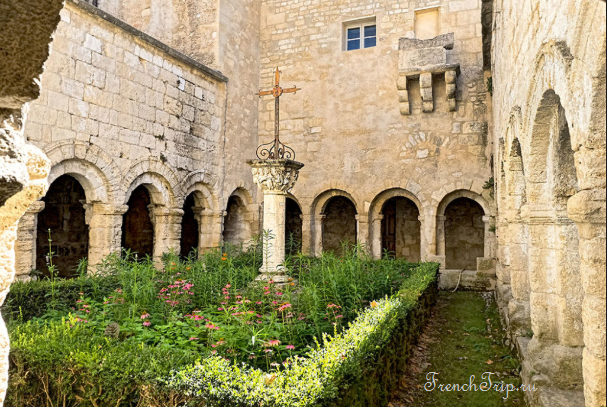
Twelfth-century Romanesque with later chapels, and beside it a small cloister with carved capitals — quiet, free and almost always empty.
The site has been a bishop’s seat since the fourth century, though nothing that old survives above ground. The cathedral built here burned down in 991 and was rebuilt, consecrated in 1023, only to be badly damaged again; the surviving Romanesque west front, with its two small windows set into the arch and its pair of buttresses, dates from that rebuilding, and the two arched south buttresses were added around 1115–1125. A local baron later tried to burn the cathedral down and managed to destroy only the gate; the building was restored in 1740, by which point the interior had accumulated the gilded Baroque stucco and side chapels seen today.
The cloister beside the cathedral dates from the thirteenth century. Inside the cathedral are paintings by Nicolas and Pierre Mignard, well-known seventeenth-century painters. One chapel is dedicated to Saint Véran, who was bishop of Cavaillon for thirty years and sat on several church councils. According to legend he freed the town from a dragon by chaining it and releasing it in the Luberon — from where it is said to have leapt as far as the village that now bears his name, Saint-Véran, in the Hautes-Alpes.
The old town
The Grand’Rue is the oldest and busiest street in Cavaillon, laid out before the Roman period and still the town’s main artery. Off it, the Hôtel de Ville — the town hall, on passage du Planet — was rebuilt in the 1750s on the site of the old one and extended at the end of the nineteenth century; its glass roof is worth a look.
Further on, past place Castil-Blaze, a pedestrian street leads into what was the old Jewish quarter, or carrière. On rue Hébraïque stands the synagogue (below). Nearby, the Grand Couvent chapel was rebuilt in the seventeenth century; its cloister and the narrow lanes beyond it lead through to the northern edge of the old town. Near the start of the road to Avignon is the Hôtel-Dieu chapel, the only surviving stretch of the town’s medieval walls, rebuilt in 1755 and later bought by the Jouve family, who turned it into a museum of local archaeological finds, with an audiovisual display that forms part of the Jewish heritage trail through the town. One more building worth a glance in passing is the Hôtel d’Agar, carved with a row of large, tooth-baring gargoyles.
The synagogue
The most unexpected thing in Cavaillon. Under papal rule the Comtat Venaissin was one of the very few places in France where Jews were permitted to live, in four communities known as the carrières — Cavaillon, Carpentras, Avignon and L’Isle-sur-la-Sorgue.
The synagogue of 1774 survives complete: an eighteenth-century interior in pale blue and gold, more like a Provençal salon than a place of worship, with the bakery for unleavened bread underneath. It is a listed monument and a museum, and it is one of the two oldest surviving synagogues in France — the other is at Carpentras.
The reading desk, where the Torah was read, stood on an upper floor reserved for men; the decoration around it — mostly floral motifs in traditional colours and gold leaf — picks out the pulpit and the tabernacle. Downstairs, where the women sat, a marble slab and an oven recall the unleavened bread once baked here, known locally as coudoles. Since the 1960s the building has also housed the Jewish Comtadin Museum, with documents on life in the carrière; the ritual baths survive too, though they are closed to visitors.
Colline Saint-Jacques
The hill above the town, with a Romanesque chapel on top and a path up from the Roman arch. Twenty minutes of climbing gets you the whole Durance valley, the Alpilles and Mont Ventoux.
The hill is a limestone outcrop of the same rock as the Luberon and the Alpilles, covering some 300 hectares — the only high ground on the Cavaillon plain, and at around 180 m the highest point in the Durance valley. It was fortified as early as the second century BC, and a scattering of ruins survives from those defences. The hermit César de Bus lived here in the late sixteenth century and is remembered inside the chapel. The Jouve family, who did a good deal for the town, bought the chapel and part of the hill in the early twentieth century and kept the ground in its natural state, which is why it is still good walking country today.
Getting to Cavaillon
- By train — this is why Cavaillon matters. Regional trains from Avignon in about 20 minutes and from Marseille in an hour. The station is a few minutes from the centre.
- By bus — the road hub for the Luberon: services to Gordes, Roussillon, Bonnieux and Apt leave from the bus station beside the railway station. They are infrequent, so check both directions.
- By car — off the A7. See parking in France.
The market
Monday morning, and it is a real Provençal market rather than a tourist one — produce, cheese, olives, fabric — spread through the streets of the centre. In summer it is where the melons are.
From March to October there is also an evening farmers’ market, on Thursdays at place du Clos — fresh produce sold directly by the growers, with tastings. Most of the surrounding Luberon towns run their own weekly market on a different day, so it is worth timing a visit around them: Gordes on Tuesdays, Saint-Rémy-de-Provence on Wednesdays, and L’Isle-sur-la-Sorgue, the biggest of the lot, on Sundays.
Other festivals
The Corso de Cavaillon, held over Ascension weekend, is a procession of costumed marchers with music and fanfares, run in the town centre for decades, alongside traditional Provençal bull games and folk dancing.
Around Cavaillon
- L’Isle-sur-la-Sorgue — 10 km, the antiques capital of Provence, with waterwheels and a Sunday market
- Fontaine-de-Vaucluse — the great karst spring, 20 minutes
- Ménerbes, Bonnieux, Gordes — the Luberon villages, all within half an hour
- Avignon — 20 minutes by train
- Abbaye de Sénanque — the Cistercian abbey near Gordes, known for its lavender fields, 20 km, about 26 minutes
- Saint-Rémy-de-Provence — with the Roman ruins of Glanum nearby, 20 km, about 23 minutes
- Les Baux-de-Provence — hilltop village and ruined castle, 29 km, about 35 minutes
When to go
July for the melons and the festival. Otherwise spring and autumn, like everywhere in Provence. Cavaillon is the sensible base if you are doing the Luberon without a car — but understand that the villages beyond it still need one.
See Provençal cuisine.
Nearby
Other places on this site within easy reach, as the crow flies:
- L'Isle-sur-la-Sorgue — 9 km
- Oppède-le-Vieux — 10 km
- Sénas — 11 km
- Fontaine-de-Vaucluse — 12 km
- Luberon — 16 km
- Pernes-les-Fontaines — 18 km
Weather in Cavaillon
| Month | Day | Night | Rainfall |
|---|---|---|---|
| January | +11° | +1° | 58 mm |
| February | +12° | +1° | 38 mm |
| March | +17° | +4° | 40 mm |
| April | +20° | +7° | 64 mm |
| May | +24° | +11° | 58 mm |
| June | +28° | +14° | 39 mm |
| July | +31° | +16° | 22 mm |
| August | +31° | +16° | 40 mm |
| September | +26° | +13° | 92 mm |
| October | +21° | +10° | 100 mm |
| November | +15° | +5° | 95 mm |
| December | +11° | +2° | 51 mm |
This page in Russian: Cavaillon (Кавайон)
Updated: