Lacoste
Lacoste is a village of about 400 people on the south side of the Luberon, between Ménerbes and Bonnieux, built in pale stone up a hillside under a ruined castle.
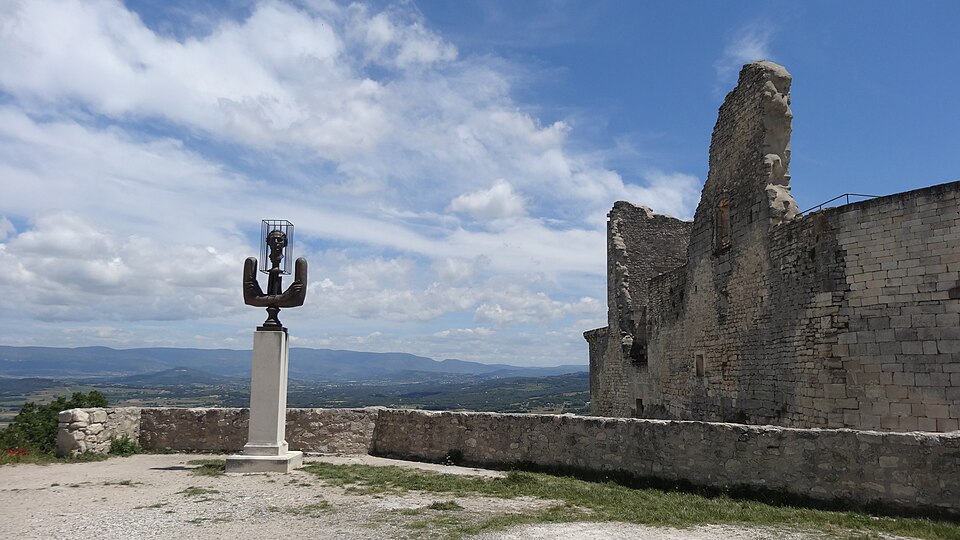
The castle belonged to the Marquis de Sade, and it now belongs to Pierre Cardin. That sentence covers most of what makes Lacoste unusual.
Sade
Donatien Alphonse François de Sade inherited the château in 1763 and used it as a refuge whenever Paris became unsafe for him, which was often. The scandals that made his name — and eventually put him in the Bastille — were partly staged here, and the villagers sacked the castle during the Revolution.
It stood ruined for two centuries. In 2001 Pierre Cardin bought it, restored part of it, filled the grounds with monumental sculpture and began staging an opera and theatre festival in the quarry below in July. He bought a good deal of the village as well, which is a matter of some local feeling: houses became galleries and summer lets, and Lacoste is now unusually quiet out of season.
The village
Stepped lanes of unrendered stone, mostly car-free, climbing to the castle gate. There is a belfry, a fourteenth-century church below the village, and a set of viewpoints over the valley to Bonnieux opposite.
It takes twenty minutes to walk, and the pleasure is that — unlike Gordes or Roussillon — there is nobody in it.
The quarries
The old stone quarries below the village supplied the pale Luberon limestone the whole area is built from. Part of them is now the open-air theatre used for the summer festival, and the cut faces are worth seeing on their own.
The art school
The Savannah College of Art and Design runs a campus in the village, in buildings bought and restored across the old centre. In term time the population is substantially American students, which gives Lacoste an atmosphere found nowhere else in the Luberon.
Where it sits in the Luberon
The Luberon takes its name from the range behind the village, which rises to about 1,100 m, and most of it is protected as the Parc Naturel Régional du Luberon. The massif lies roughly 40 km from Arles and Avignon and north of Aix-en-Provence, across two departments: the Vaucluse to the west and the Alpes-de-Haute-Provence to the east.
It divides in two. The Petit Luberon is the western half, cut off by the Combe de Lourmarin; the Grand Luberon lies east of that gorge. Lacoste is in the Petit Luberon, on the north face, in the line of perched villages that also holds Bonnieux, Ménerbes, Gordes and Oppède-le-Vieux — all within a few kilometres of each other, and all best seen early or late in the day.
Getting to Lacoste
- By car — the only realistic way. 25 minutes from Cavaillon, 15 from Apt. Park below the village; the lanes are steep and mostly stepped.
- By bus — a very thin service from Cavaillon and Apt, not usable as a day trip.
See parking in France.
Around Lacoste
- Bonnieux — 5 km east, and the view across at Lacoste from its old church is the best angle on the village
- Ménerbes — 5 km west along the same ridge road
- Oppède-le-Vieux — a half-abandoned village under its ruined castle, and the least visited in the Luberon
- Abbaye de Saint-Hilaire — a small thirteenth-century Carmelite house between Lacoste and Ménerbes, still lived in and open to visitors
- Gordes and Roussillon — across the valley on the north side
When to go
May, June, September and October. July brings the festival in the quarry and the only crowds Lacoste gets. The village is one of the better places in the Luberon to be in high summer precisely because there is no single sight for coaches to stop at.
See when to visit Provence and the most beautiful villages in France.
Image source: Château de Lacoste — photo: Suwannee.payne / Wikimedia Commons, CC BY-SA 3.0.
Weather in Lacoste
| Month | Day | Night | Rainfall |
|---|---|---|---|
| January | +10° | +2° | 56 mm |
| February | +11° | +1° | 38 mm |
| March | +15° | +4° | 41 mm |
| April | +18° | +7° | 65 mm |
| May | +23° | +11° | 64 mm |
| June | +27° | +14° | 43 mm |
| July | +30° | +16° | 34 mm |
| August | +30° | +16° | 40 mm |
| September | +25° | +13° | 88 mm |
| October | +20° | +10° | 89 mm |
| November | +14° | +5° | 97 mm |
| December | +10° | +2° | 55 mm |
Updated: