Alsace Christmas Markets
Alsace does Christmas markets better than anywhere else in France, and it has the oldest one in the country: Strasbourg’s Christkindelsmärik has run since 1570. The whole region turns over to it from late November to the end of December.
This page is about which to go to, and how to survive the ones everyone else goes to.
The big ones
Strasbourg
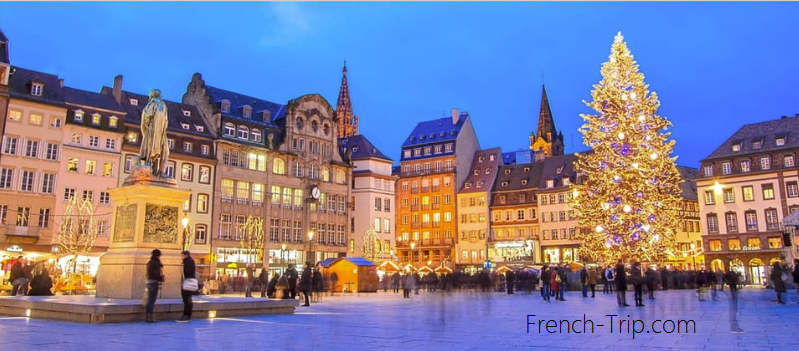
Around a dozen separate markets across the city, some 300 chalets, and a 30 m tree on Place Kléber. It calls itself the Capital of Christmas and roughly two million people come, which is the problem as much as the attraction.
The best parts are away from Place Kléber: the market around the cathedral, the one on Place Broglie (the original, 1570), and the food market at Place du Marché-aux-Poissons. See Strasbourg.
Colmar
Six markets in a small centre, and by common agreement the prettiest — the one in Petite Venise, on the water, is the picture. Colmar is more manageable than Strasbourg and more crowded per square metre. See Colmar.
Mulhouse
Unlike any other: each year a new fabric is designed and printed locally, and the whole market is dressed in it — a direct inheritance of the city’s textile industry. Smaller, less visited, and the one with a real idea behind it. See Mulhouse.
The village markets — where to actually go

The villages are the reason to come to Alsace rather than to any other Christmas market in Europe, and they are where the crowds are bearable:
- Kaysersberg — five weekends in Advent, in courtyards rather than one site, with a genuine emphasis on craftsmen. Widely reckoned the best in Alsace, and correspondingly full at weekends.
- Riquewihr — the sixteenth-century village lit and decorated; also the worst traffic in the region
- Eguisheim — small, in the castle courtyard at the centre of the rings
- Obernai — reachable by train from Strasbourg, which very few of these are
- Ribeauvillé — a medieval Christmas market, costumed, on the two weekends before Christmas, and unlike all the others
- Rouffach, Turckheim, Wissembourg — small, local, and nearly empty on a weekday
Dates
Most open in the last week of November and close on 24 or 31 December. Strasbourg and Colmar run the whole period; the village markets often run only at weekends, which catches people out — check before driving to a village on a Tuesday.
Some, including Kaysersberg, run only on the Advent weekends. Ribeauvillé’s medieval market is two weekends only.
Getting around — the real problem
This is the practical heart of the matter. In December the wine-route villages take far more cars than they were built for:
- Weekend traffic into Riquewihr and Kaysersberg queues for kilometres. Cars park along the tracks between the vines and people walk the last half-kilometre.
- Go on a weekday if you possibly can. The difference is not marginal — it is the difference between a village and a crowd.
- Base yourself in Colmar or Strasbourg and take shuttles or trains where they exist. Obernai, Sélestat, Barr, Mulhouse and Turckheim all have stations.
- Seasonal shuttle buses run from Colmar to several villages in December; the tourist office publishes the timetable.
What to eat and drink
- Vin chaud — mulled wine, white as often as red in Alsace, which is unusual and better
- Bredele — the small spiced Christmas biscuits, made in dozens of shapes; every household has its own recipes and the markets sell them by weight
- Pain d’épices, kougelhopf, and mannele — little brioche men eaten on Saint Nicholas’s day, 6 December
- Tarte flambée and choucroute from the food stalls
- Winstubs — the wood-panelled wine taverns, which is where to go when standing outside stops being fun
What to buy
Much of what is sold at the big markets is imported and generic. What is actually Alsatian: blown glass baubles, wooden decorations, bredele from the bakers, storks in every form, glazed pottery kougelhopf moulds from Soufflenheim, and Christmas table linen printed in Mulhouse.
Practical
- Book accommodation months ahead. Colmar and the villages sell out for December weekends by summer.
- It is cold — Alsace in December is properly continental, regularly below freezing.
- Weekdays and mornings for everything. The markets are lit from dusk, so the compromise is a weekday afternoon into the evening.
- Sélestat is worth a detour for the exhibition around the town’s 1521 archive entry, the oldest written record of a Christmas tree anywhere.
See Alsace and festivals in France.
Updated: