Gourmet and culinary restaurants in France
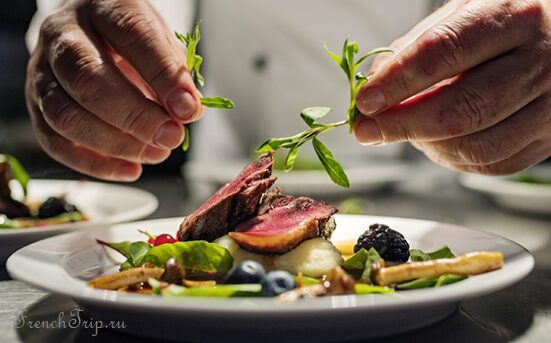
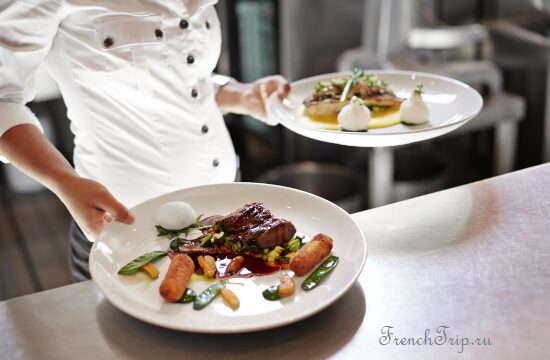
A gourmet restaurant in France is not an ordinary restaurant with better ingredients. It is closer to a performance: small portions, many of them, arranged with a precision that has nothing to do with hunger. You go to one for the sequence of flavours, not to be fed.
What the stars mean
The Michelin guide awards up to three stars, and the wording is precise:
- One star — a very good restaurant in its category, worth a stop.
- Two stars — excellent cooking, worth a detour.
- Three stars — exceptional cuisine, worth a special journey. There are only a couple of dozen in the whole country.
Paris holds the largest concentration: roughly ten three-star houses, a dozen or two with two stars and around fifty with one. The numbers shift with every edition of the guide, and so do the names — a restaurant can gain or lose a star in a year — so check the current guide before booking on the strength of a list.
The other Michelin mark worth knowing is the Bib Gourmand: good cooking at a moderate price, awarded to bistros and small restaurants rather than grand rooms. For most travellers this is the more useful symbol of the two.
The Paris names
The houses that have carried three stars in Paris over the past decades include L’Arpège (Alain Passard, famous for vegetables), Le Bristol – Epicure, Guy Savoy, L’Ambroisie on the Place des Vosges, Le Grand Véfour under the arcades of the Palais-Royal, Ledoyen, Le Meurice, Alain Ducasse au Plaza Athénée and Astrance. Several have changed chef, status or format since; treat the list as a map of the territory rather than a current ranking.
Outside Paris the gastronomic tradition is just as strong and often better value: Lyon and its surroundings, the Alps around Megève and Courchevel, Vienne on the Rhône, Rouen and Caen in Normandy, and a long list of one-star kitchens in villages with nothing else in them.
What it costs, and how to spend less
A tasting menu in a starred restaurant runs from about 100€ to 250€ per person, depending on the stars, the reputation and the number of courses; wine pairings add roughly as much again. Three stars in Paris can go well beyond that.
The way in, for anyone not planning a special occasion, is lunch. Most starred restaurants serve a shorter lunch menu at a fraction of the evening price — often 60–90€ where dinner is 200€ — from the same kitchen and in the same room. Book it, dress properly, and take the afternoon off afterwards.
Booking and manners
Book early. Weeks for a one-star, months for a three-star, and longer for the handful of rooms everyone wants. Many take reservations online; some still want a phone call. Confirm if your plans change — no-shows in small dining rooms are taken personally, and increasingly are charged for.
Say what you cannot eat when you book, not when you sit down. Allergies and vegetarian menus are handled well if the kitchen knows in advance; sprung on the night they are an imposition.
Dress. Jacket for men in the grand hotels; smart otherwise. Few places still refuse entry, but you will feel the difference.
Allow the evening. A full tasting menu takes three hours and sometimes four. Plan nothing afterwards.
Gourmet without the stars
France has an entire tier below the guide that does the same job for a quarter of the money: bistronomie, small kitchens run by chefs trained in starred houses, serving five or six dishes a day on a blackboard. Look for a short menu, a hand-written wine list and no tablecloth. In the countryside the equivalent is the auberge attached to a hotel, where the cooking is serious and the room is plain.
And the produce itself is the point of the exercise: see foie gras, truffles, cheeses and wines.
See also the best restaurants in France, the oldest restaurants in France and French cuisine.
Updated: