Best restaurants in France
The best restaurant in France is rarely the famous one. Every village has a place serving traditional dishes made from what is grown nearby, and outside the big cities that is usually where you eat best. What follows is how the system works, what things cost, and how to avoid the disappointments.
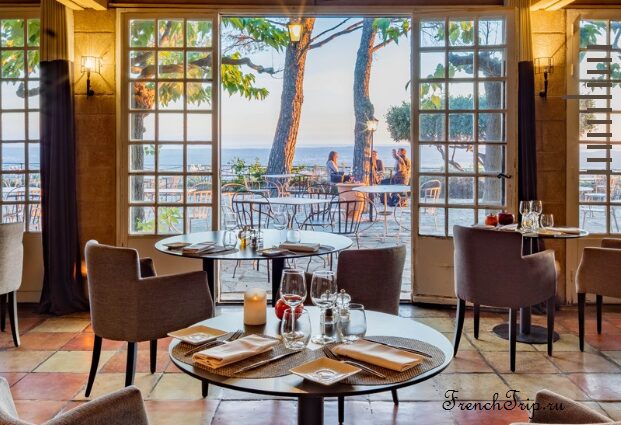
Opening hours, and how strict they are
Hours are short and not flexible: roughly 12:00–14:00 and 19:30–21:00 or 21:30, a little later in tourist towns and big cities. Arriving outside them does not get you served. Nearly every restaurant closes one full day a week, often Monday, and frequently one additional evening or lunch service.
On a weekend evening or in high season, book. Phoning on the day is normally fine.
Where to look
Village restaurants. Local produce, a short menu, sometimes a separate list of regional dishes. This is the backbone of eating in France and the reason a drive through the countryside is worth planning around lunch.
Hotel restaurants. Do not dismiss them. In rural France the hotel dining room is often the serious kitchen in the area, and the cooking is the point rather than an amenity.
Chef-driven restaurants. For more elaborate cooking you generally book ahead at a formal restaurant, and a surprising number of them are out in the countryside rather than in town.
Bistros and brasseries. Livelier, more modern, mostly a big-city phenomenon — along with the ethnic restaurants, largely Indian, North African and Chinese. A traditional brasserie serves French dishes at any hour of the day, which makes it the solution when you have missed the kitchen everywhere else.
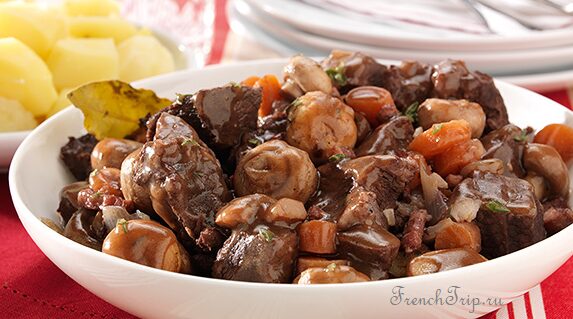
Menu or à la carte
In French, menu means a fixed set of two or three courses at a fixed price, and it is always the cheapest way to eat. Every restaurant has a few, starting with a basic one offering a couple of choices per course. The middle price bracket is where the interesting cooking usually sits, particularly if there is a regional menu. At the top come the gastronomic and tasting menus, sometimes with a wine matched to each course.
The list of individual dishes is the carte, and eating à la carte — choosing freely from it — costs considerably more. As a rule of thumb, a two-course fixed menu is only 2–3€ more than the same main course ordered alone.
Children are offered a cheap menu enfant almost everywhere.
Two words that trip people up
Entrée is the starter, not the main course. The mains are les plats or plats principaux. And at the end of a meal you will be offered a café, which means an espresso and is never included in the price of the menu.
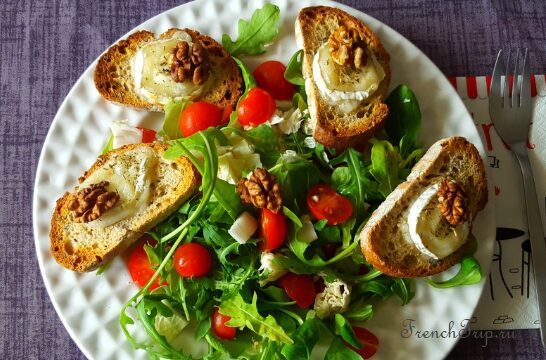
What it costs
- Bistro level: menus at 10–15€.
- Good restaurant: a main course 18–25€, fixed menus 25–35€.
- Michelin-starred: tasting menus from roughly 100€ to 250€, depending on the stars, the reputation and the number of courses.
- The plat du jour, the dish of the day, starts around 10€ and is the cheapest hot meal in a proper restaurant.
If you are economising: a quiche or a sandwich from a bakery is filling and under 10€; a kebab runs 5–6€ in any sizeable town. A better compromise is to eat properly at lunch, when the same kitchens serve the same food for less, and to buy bread, cheese and a bottle of wine for the evening — which doubles as a tasting of whatever the region makes. And do not skip the markets: in Provence a market paella costs around 10€ a kilo, which feeds two.
Where it goes wrong
Very small, very touristy places — Mont Saint-Michel is the standard example — may have no inexpensive restaurant at all. Big cities, Paris above all, are where the price and the quality most often fail to match, and where a full room means little, since the room may be full of people who will never come back. In small villages the opposite holds: there are no expensive restaurants, and the one that exists is plain and good.
Compared with Spain, Italy or Germany, eating out in France is dearer — often simply because the ingredients are.
See also traditional regional restaurants, the oldest restaurants in France, and French cuisine for what to order once you are seated.
Updated: