Salon-de-Provence
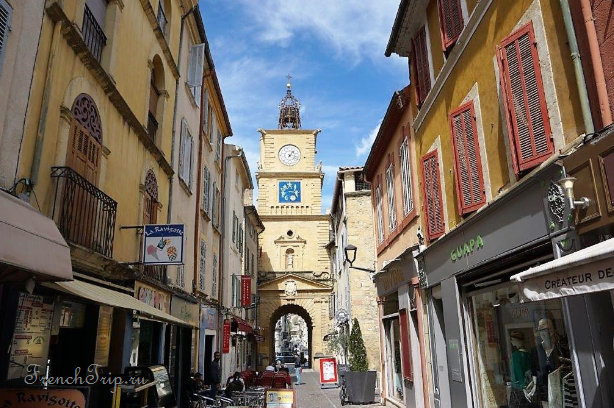
Salon-de-Provence sits between Aix, Arles and Marseille, at the exact centre of the Provençal triangle. It is a real town of 45,000 rather than a village, and it has three things worth the stop: Nostradamus lived and died here, it is the capital of Provençal olive oil and soap, and it is home to the French air force academy and the Patrouille de France.
It is also, thanks to those first two, one of the few Provençal towns where you are not surrounded by other visitors.
Nostradamus
Michel de Nostredame moved to Salon in 1547, married a local widow, wrote the Prophéties here and died in the town in 1566. His house on Rue Nostradamus is a museum, laid out room by room as it would have been, and he is buried in the collegiate church of Saint-Laurent — where his tomb was opened during the Revolution and hurriedly restored afterwards.
Whatever you think of the prophecies, the house is a good sixteenth-century interior and the town wears the association lightly.
Château de l’Empéri
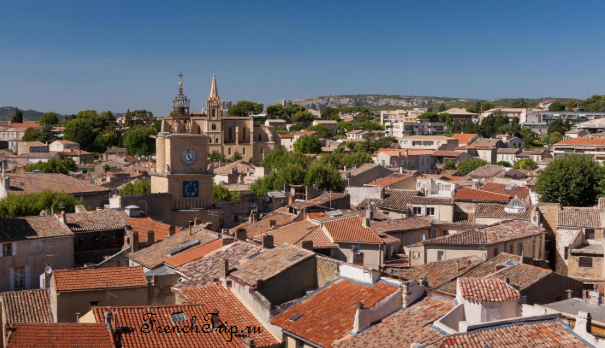
The castle on the rock in the middle of the town is one of the largest surviving medieval fortresses in Provence — tenth-century in origin, the residence of the archbishops of Arles for six hundred years. It now holds a museum of French military history from Louis XIV to 1918, with several thousand uniforms, weapons and mounted figures. It is much better than the average regimental collection.
The old town
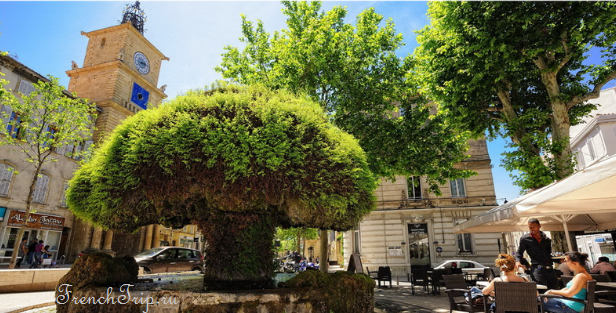
Compact, walled and entered through gate towers. The thing everyone photographs is the Fontaine Moussue on Place Crousillat — an eighteenth-century fountain so thickly covered in moss that it looks like a giant mushroom, kept alive by the constant flow of water.
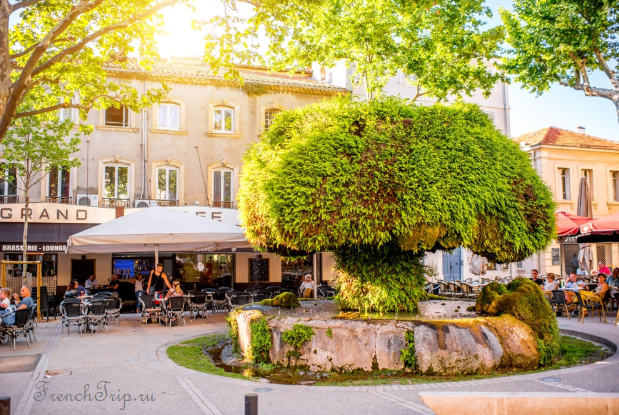
Also worth finding:
- Porte de l’Horloge — the seventeenth-century clock gate into the old town
- Collégiale Saint-Laurent — fourteenth-century Meridional Gothic, with Nostradamus’s tomb
- Église Saint-Michel — twelfth-century Romanesque, with a carved tympanum
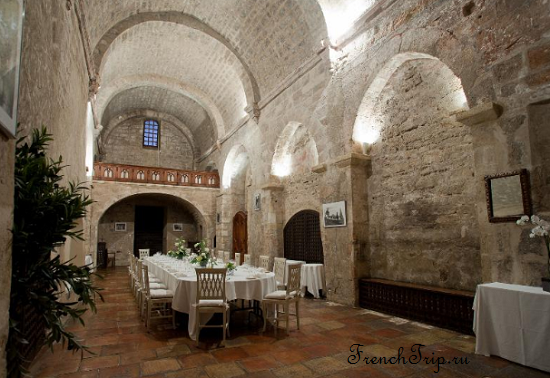
- Abbaye de Sainte-Croix — a twelfth-century abbey on the hill outside town, now a hotel, with vaulted rooms you can eat in
Soap and olive oil
Salon is where savon de Marseille is actually made. Several of the historic soapworks are here rather than in Marseille, and the largest of them — Marius Fabre, working since 1900 — runs a museum and shop with the cauldrons still in use.
The plain around the town is olive country, and Salon has been a centre of the oil trade since the Middle Ages: the canal that made it possible was cut by Adam de Craponne, a local engineer, in the 1550s, and it still runs through the town.
The Patrouille de France
The École de l’Air, the French air force academy, has been at Salon since 1936, and the Patrouille de France aerobatic team is based here. They train over the town, which means that on an ordinary weekday you may look up and find eight Alphajets in formation. The base opens to the public on certain days.
The town and how it got here
Salon has about 35,000 inhabitants and sits almost exactly between the places people actually visit: 53 km north-west of Marseille, 37 km north-west of Aix-en-Provence, 47 km south-east of Avignon. That position is the whole story of the town.
It began as a Gallo-Roman oppidum on the trade routes linking the Adriatic, the Atlantic and the Mediterranean, and stretches of the Via Aurelia can still be made out beyond the modern edges. The region was under Phocaean influence from the sixth century BC; the first record of the place under a recognisable name is from the ninth century, as Villa Salone, and for centuries afterwards it was controlled by the archbishops of Arles. The name itself is usually traced to the Latin sal, salt.
Olive oil made it prosperous from the fifteenth century, and soap made it famous later. One local name belongs on the map as much as Nostradamus does: Adam de Craponne (1527–76), born here, who built the canal that still irrigates the stony plain of the Crau and carries his name.
The modern town owes a good deal to the French air force officers’ school, which is based here — and for four days each summer it turns the other way round and stages a Nostradamus festival, with the sixteenth century taking over the streets.
Getting to Salon
- By train — on the Marseille–Avignon line, about 45 minutes from Marseille and 40 from Avignon.
- By car — where the A7 and A54 meet, which is why the town is where it is. Park outside the walls. See parking in France.
- By air — Marseille-Provence is 30 km away.
Around Salon
- La Barben — a castle and zoo 10 km east, good with children
- Les Alpilles — Saint-Rémy and Les Baux, half an hour north-west
- Étang de Berre — the lagoon south, with Roman remains at Saint-Chamas
- Aix-en-Provence — 35 km east
When to go
April to June and September to October. Salon works as a base for the whole of central Provence — it is cheaper than Aix, better connected than the villages, and half an hour from most of what people come to the region for.
See Provence-Alpes-Côte d’Azur.
Weather in Salon-de-Provence
| Month | Day | Night | Rainfall |
|---|---|---|---|
| January | +11° | +2° | 54 mm |
| February | +13° | +2° | 34 mm |
| March | +16° | +4° | 37 mm |
| April | +19° | +7° | 56 mm |
| May | +23° | +11° | 44 mm |
| June | +28° | +15° | 31 mm |
| July | +31° | +17° | 14 mm |
| August | +30° | +17° | 30 mm |
| September | +26° | +14° | 79 mm |
| October | +21° | +10° | 86 mm |
| November | +15° | +6° | 84 mm |
| December | +12° | +2° | 45 mm |
Updated: