Perpignan
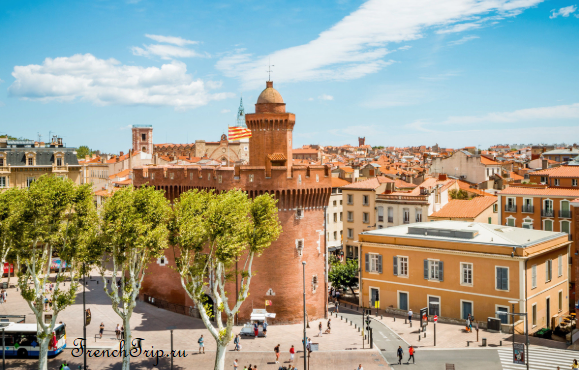
Perpignan is the capital of French Catalonia — the Pyrénées-Orientales, known locally as Catalunya Nord — a city of 120,000 thirty kilometres from the Spanish border and fifteen from the sea.
It does not feel like the rest of Occitanie, and that is the point of coming. The street signs are bilingual, the flag on the buildings is the Catalan senyera, the food is Catalan, and for a century and a half in the Middle Ages this was the mainland capital of the Kingdom of Majorca.
Perpignan is often called the most ethnically mixed town in the Pyrenees. Many local families are Spanish Catalans whose parents or grandparents crossed the border at the end of the Spanish Civil War, fleeing Franco’s forces, and some districts were settled afterwards by French families displaced by Algerian independence in 1962.
History
Settlement in the area goes back to Roman times. The medieval town became the seat of the Counts of Roussillon, then part of the older region known as Septimania; in 1172 the last count, Girard II, willed his lands to the Counts of Barcelona, and Perpignan gained the institutions of a partly self-governing commune in 1197. French feudal claims over the county passed to Aragon under Louis IX, by the Treaty of Corbeil.
When James I of Aragon founded the Kingdom of Majorca for his son in 1276, Perpignan became its mainland capital, and the following decades are usually reckoned the city’s golden age: it prospered on cloth, leather, jewellery and other luxury trades. Philip III of France died here in 1285, on his way back from a failed crusade against the Crown of Aragon.
Peter IV of Aragon annexed the Kingdom of Majorca in 1344 and Perpignan reverted to the county of Barcelona; a few years later the Black Death cost it roughly half its population. Louis XI’s forces took the city in 1463, and a revolt against French rule in 1473 was put down after a long siege; in 1493 Charles VIII, keen to keep Aragon quiet while he invaded Italy, handed the county back to Ferdinand II of Aragon. The French besieged and took Perpignan again during the Thirty Years’ War, in September 1642, and Spain formally ceded it seventeen years later by the Treaty of the Pyrenees.
The Palace of the Kings of Majorca
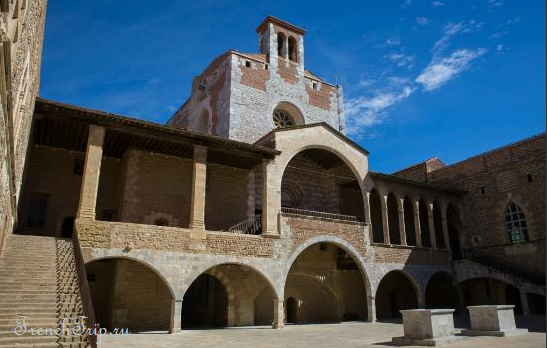
Built from 1274 on a hill inside the city, and one of the most important surviving Gothic palaces in southern Europe. Two chapels stacked one above the other, a great arcaded courtyard, the throne room, and Vauban’s later fortifications wrapped round the whole thing in red brick.
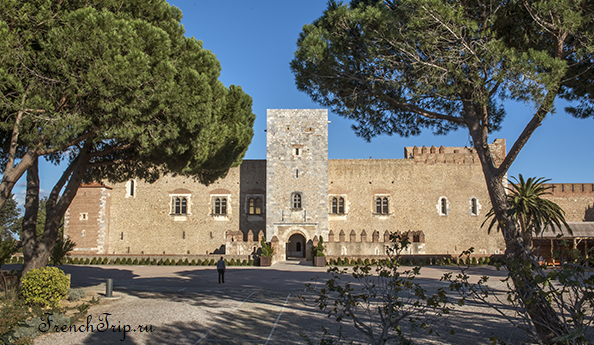
The kingdom lasted from 1276 to 1344 and covered the Balearics, Roussillon and Montpellier. It was absorbed by Aragon, and Roussillon passed to France only in 1659 by the Treaty of the Pyrenees — which is recent enough that the Catalan identity here never went away.
The centre
- Le Castillet — the red-brick gate of 1368, the emblem of the city, now the museum of Catalan popular arts and traditions; climb it for the view over the roofs to the Canigou
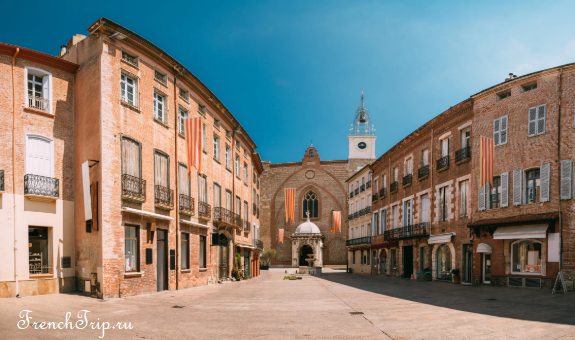
- Cathédrale Saint-Jean-Baptiste — fifteenth-century southern Gothic, with a remarkable painted crucifix called the Dévot Christ, brought from the Rhineland
- Le Campo Santo — the fourteenth-century cloister-cemetery beside the cathedral, the only one of its kind in France and the largest in Europe; used for concerts in summer
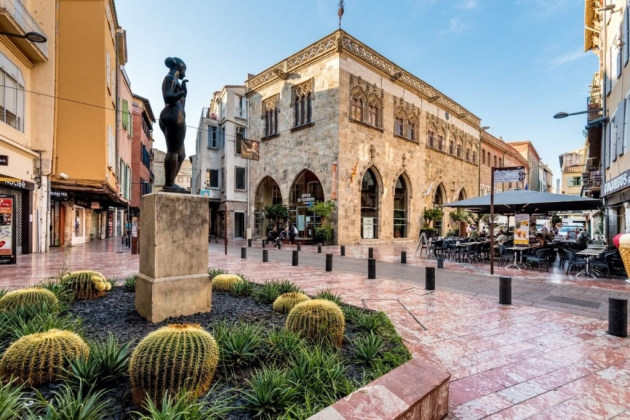
- Loge de Mer — the fourteenth-century maritime exchange on the Place de la Loge, with the Hôtel de Ville and its Maillol bronze beside it
- Musée Hyacinthe Rigaud — the portraitist of Louis XIV was born here; the museum also holds Picasso, Dufy and Maillol
Perpignan holds the French label Ville d’art et d’histoire. Thirty-four buildings in the city are listed as historic monuments and another nineteen sit on the general heritage inventory; eight buildings and five districts carry the newer “twentieth-century heritage” label, among them one of the more important Art Deco monuments in France.
The centre of the world
In 1963 Salvador Dalí declared Perpignan railway station the centre of the universe, having had a vision of cosmogonic ecstasy on the platform. He painted it, said so repeatedly, and the station now announces the fact on its façade. It is entirely serious as far as Perpignan is concerned.
The vision became the painting La Gare de Perpignan. Dalí later claimed that the Iberian peninsula had once rotated on the axis of the station, 132 million years ago, a claim he worked into a 1983 painting dedicated to the mathematician René Thom. A monument to Dalí stands above the station today, and the words “Perpignan centre du monde” are set in large letters into one of the platform surfaces.
Festivals
Holy Week is marked in a specifically Catalan way: on Good Friday the Procession de la Sanch has processed through the streets since 1416, penitents in red robes and hoods carrying misteris — tableaux of scenes from the Passion — to the sound of a hand bell setting the pace. In September the Medieval Trobades market takes over the Campo Santo for a weekend of medieval trade and costume.
Food
Catalan, not Languedocien. Look for boles de picolat (meatballs in a sauce with olives), bullinada (fish and potato stew), snails grilled on a vine-shoot fire — the cargolade — rabbit in chocolate, and Catalan cream. The wines are Côtes du Roussillon, and the sweet fortified Banyuls, Maury and Rivesaltes come from the hills nearby.
Spanish influence also shows in meat cooked à la catalane, in a thick sauce of peppers, aubergine and tomato, served with rice or beans; Spanish-style omelettes with vegetables or mushrooms are common too, and the coast supplies plenty of fresh seafood and crayfish. The hills around Perpignan are among the driest in France, and grapes grown between the Pyrenees and the sea can turn out bitter; the local answer has long been to fortify them, which is why Muscat de Rivesaltes is drunk here as an aperitif rather than a dessert wine.
Some pastries follow the calendar: turrón at Christmas, the tortell de reis (“kings’ cake”) around Epiphany, and bunyetes (or bougnettes) for carnival or the end of Lent.
Shopping
The centre has plenty of small boutiques, alongside a Galeries Lafayette department store and a small Fnac. The Place Cassanyes market runs every day and is the largest in the city, mixing plants, clothes and second-hand goods; smaller neighbourhood markets run at Saint-Martin, Place de Belgique and Haut-Vernet, and there is a Sunday flea market opposite the Palais des Expositions. Les Halles Vauban is a covered market with a food court for eating in or taking away.
Getting to Perpignan
- By train — on the main line to Spain; TGV from Paris in about 5 hours, Montpellier 1 h 30, Barcelona under 2 hours.
- By air — Perpignan-Rivesaltes, with UK and Paris flights; Barcelona and Toulouse are the larger alternatives.
- By car — the A9 down the coast. See parking in France.
- Regional trains — TER services run several times a day to Narbonne, Carcassonne, Toulouse, Montpellier and Marseille, and a western branch runs up the Têt valley through Villefranche-de-Conflent towards Prades, where it continues as the Train Jaune.
- Night train — a seasonal Intercités sleeper links Perpignan with Paris Gare d’Austerlitz via Toulouse.
Around Perpignan
- Collioure — 30 minutes, the fishing port where Matisse and Derain invented Fauvism
- Côte Vermeille — the rocky coast down to the Spanish border, with Banyuls and Cerbère
- Canigou — the sacred mountain of the Catalans, 2,784 m, with the abbeys of Saint-Martin-du-Canigou and Saint-Michel-de-Cuxa below it
- Villefranche-de-Conflent — 45 minutes, a Vauban fortress town and one of the most beautiful villages in France
- Train Jaune — the little yellow railway up into the Cerdagne, one of the great mountain lines of Europe
Also within day-trip range: Elne (13 km), Fort de Salses (16 km), Castelnou — one of the official most beautiful villages of France (18 km), Argelès-sur-Mer (20 km), the natural rock formations known as Les Orgues at Ille-sur-Têt (23 km), Céret (26 km) and the Romanesque priory of Serrabone (28 km).
When to go
April to June and September to October. July and August are very hot inland and the coast is full. The Visa pour l’Image photojournalism festival takes over the city’s historic buildings each September and is free — one of the best reasons to come.
See Occitanie and the cities of France.
Weather in Perpignan
| Month | Day | Night | Rainfall |
|---|---|---|---|
| January | +13° | +5° | 60 mm |
| February | +13° | +5° | 41 mm |
| March | +16° | +8° | 52 mm |
| April | +19° | +10° | 66 mm |
| May | +22° | +13° | 46 mm |
| June | +27° | +17° | 24 mm |
| July | +30° | +20° | 15 mm |
| August | +29° | +20° | 23 mm |
| September | +26° | +16° | 43 mm |
| October | +21° | +13° | 82 mm |
| November | +16° | +8° | 73 mm |
| December | +13° | +5° | 55 mm |
Updated: