Hostorical and medieval festivals in France
France stages its own past more thoroughly than almost anywhere: jousting at the foot of real ramparts, giants carried through northern towns, whole villages in costume for a weekend, and projections thrown onto chateaux that have been standing for five centuries. Here is what is worth planning a trip around.
Provins: medieval shows all season
Provins, a walled town east of Paris and a UNESCO site, runs medieval shows as a regular programme rather than a one-weekend festival, which makes it the easiest of these to fit into a trip. Two are permanent fixtures:
Les Aigles des Remparts — a falconry show in the theatre built into the ramparts. Eagles, hawks, kites, falcons, vultures and owls fly over the audience, with horses, a donkey and a camel in the choreography, in a staging that follows falconry from the steppes of Central Asia to the feudal courts. Afterwards you can walk through the aviary, where about eighty birds of twenty species are kept.
La Légende des Chevaliers — an equestrian show at the foot of the walls, built around the return of Count Thibaud IV of Champagne from the crusades: jugglers, stunt riders, acrobatics, siege engines and sword fights, performed with Iberian horses. It is one of the few shows of its kind in Europe.
Tickets run around 12.50€ for adults and 8.50€ for children, with reductions on the town pass, and the shows play weekends and holidays from spring to autumn. The programme changes from year to year, so check the tourist office before travelling — and buy there, which is also where you collect the combined tickets for the ramparts and the underground galleries.
In June the town holds Les Médiévales de Provins, when the whole place dresses up: a camp outside the walls, markets, parades and several thousand people in costume.
Douai: the giants
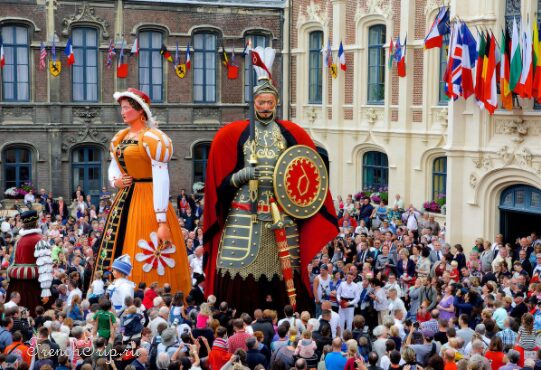
Forty kilometres from Lille, Douai holds one of the biggest events in the north: the Fêtes de Gayant, drawing more than 70,000 people over about ten days at the start of July — street shows, concerts, games, a masked ball.
The stars are the giants. Monsieur and Madame Gayant and their three children, Jacquot, Fillion and Binbin, lead a procession of dozens of figures, with some 800 performers, volunteers and musicians taking part. It moves on the first Sunday after 5 July: the giants gather at the town hall around 11:00, doves are released and sweets are thrown, and the family walks the town for most of the day before ending up in the rue de Lambres, where Gayant lives. The following day the children’s giants tour the districts, continuing into Tuesday evening. On the evening of the parade there are fireworks from the banks of the Parc Jacques Vernier.
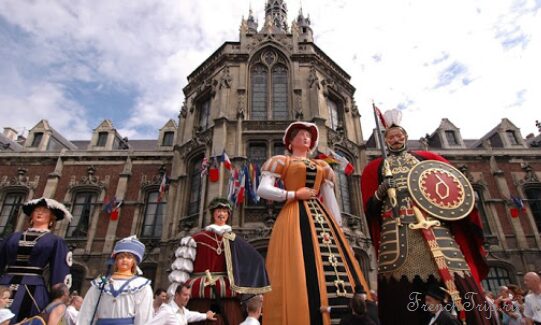
All of it is free. And Douai is not alone: processional giants belong to the whole of French Flanders and Belgium, and the tradition is on the UNESCO list of intangible heritage. Cassel, Bailleul, Dunkirk and Steenvoorde all have their own, each with a name, a history and a set of people entitled to carry it. See the cuisine of Hauts-de-France for what is served alongside.
The Loire: son et lumière
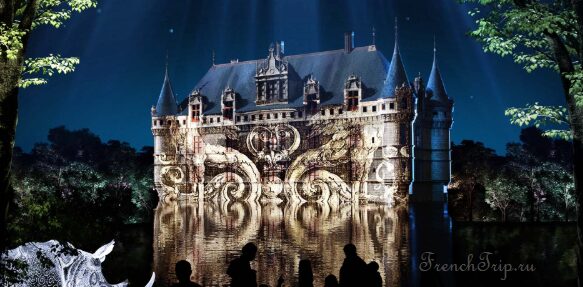
The Loire valley invented the format and still does it best. Through the summer the chateaux stage evening shows in which the building itself is the screen: Azay-le-Rideau, where the projections run across the facade and the water; Blois, in the courtyard with the famous spiral staircase; Amboise, with a cast of several hundred locals; and Chambord and Chenonceau, which light the buildings and gardens rather than telling a story.
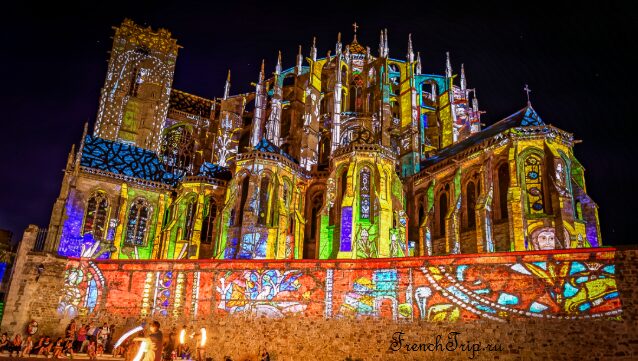
Le Mans does the same to its Roman walls — among the best preserved in Europe — and to the cathedral, in La Nuit des Chimères. It runs on summer evenings, it is free, and you walk the old town from one projection to the next.
Three more
Locronan, Brittany. The Troménie is a pardon — a religious procession — held every year, with the Grande Troménie, a twelve-kilometre circuit through the hills, taking place only every six years. The village itself is stone-built and barely altered since the 17th century, which is why it keeps appearing in films.
Carcassonne. The double-walled city stages medieval spectacles and jousting through the summer, and on 14 July sets fire to the whole silhouette with one of the largest firework displays in France.
Puy du Fou, Vendée. Not a festival but a park given over entirely to historical spectacle — Roman arena, Viking raid, musketeers, birds of prey — on a scale nothing else in Europe matches. A full day, and tickets sell out in season.
Practical notes
Dates for most of these move with the year. Village festivals in particular are fixed to a saint’s day or a given weekend rather than a date, so check the local tourist office before booking anything — and book the accommodation early, because a town of eight thousand people receiving seventy thousand visitors has no spare rooms.
See also festivals in France, carnivals in France and public holidays in France.
Updated: