Quimper
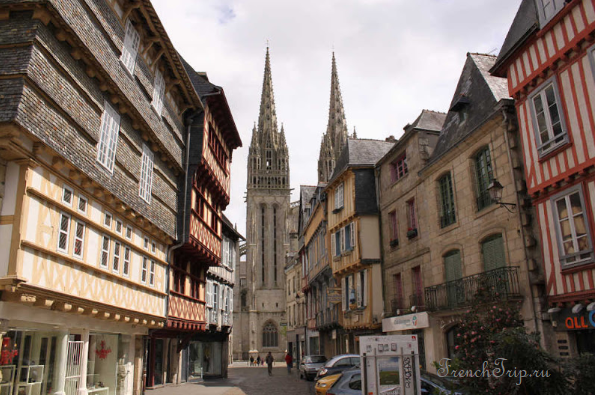
Quimper is the capital of the Finistère and the historic capital of Cornouaille — the Breton-speaking south-west, and the part of Brittany where the language and the costume held on longest. About 63,000 people live there.
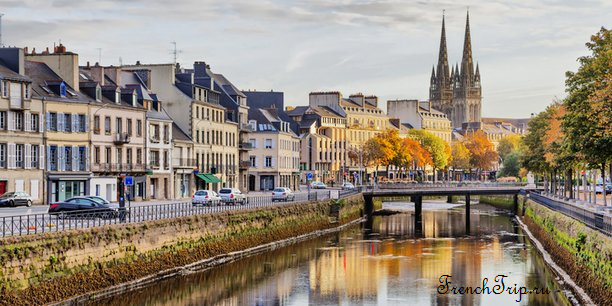
The name means confluence: the Steir joins the Odet in the middle of the town, and the two rivers with their footbridges and flowers are what you remember afterwards.
History
Tradition traces the town back to a monastery founded here by Saint Corentin, one of the seven founding saints of Brittany, with a settlement growing up around it. The site itself is older still: Quimper has a Gallo-Roman origin going back some two thousand years, and a small town quickly grew up around a Roman-era port, in a naturally sheltered position, on what is now the Locmaria quarter. Emigrants from Britain later settled further upstream, at the confluence itself.
Quimper’s choice as an episcopal seat drove its growth; the town was already the seat of the Counts of Cornouaille. From the 13th century, the building of the cathedral and of the town walls gave Quimper its shape, and the cathedral’s construction, which ran on for several centuries, made it one of the key buildings of Gothic architecture in Brittany.
Brittany’s union with France in the 16th century brought royal officials to the town, who built private mansions, and the following century saw a wave of monastery-building tied to the Catholic religious reforms of the period. Through all of this, Quimper stayed a town of merchants and shipowners, who built the timber-framed and stone houses that still line its streets.
The cathedral
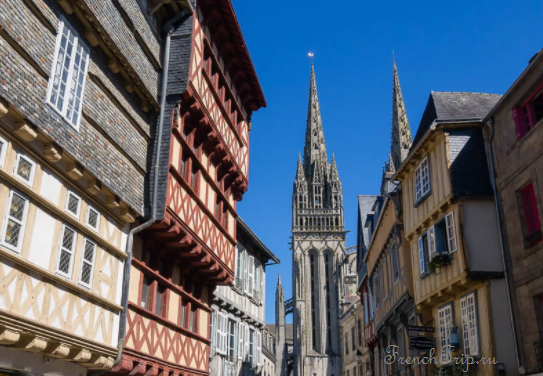
Saint-Corentin was begun in 1239 and finished — the twin spires, 76 m — only in 1856. It has a peculiarity you notice at once from inside: the choir is set at an angle to the nave, a deliberate bend that has been explained as symbolic, as a response to marshy ground, and as sheer medieval improvisation.
Between the spires rides a statue of King Gradlon, the legendary founder of the drowned city of Ys, which is said to lie under the Bay of Douarnenez a few kilometres west.
The old town
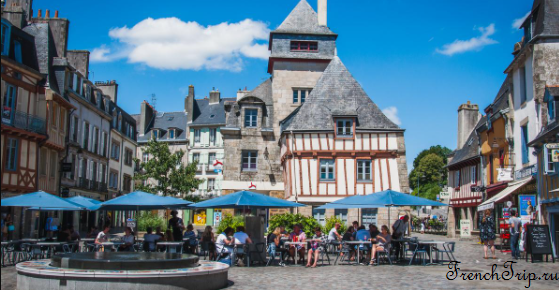
- Rue Kéréon — the main street of timber-framed houses running to the cathedral, and the classic photograph
- Place au Beurre and Place Terre-au-Duc — the crêperie quarter, and Quimper does crêpes seriously
- Musée des Beaux-Arts — an unexpectedly strong collection, with the Pont-Aven school and Max Jacob, who was born here
- Musée départemental Breton — in the old bishops’ palace, on Breton costume, furniture and faience
- Les Halles Saint-François — the covered market, rebuilt after a fire in 1979
The three quarters
Much of the centre is pedestrianised — one of the most extensive such areas in Brittany, by local reckoning — and divides into three historic quarters. Locmaria, by the river, is the potters’ quarter: its Romanesque church of Notre-Dame is among the oldest Romanesque buildings in the Finistère, and it keeps a former priory and a walled garden carrying the “Jardin Remarquable” label. The episcopal quarter, around the old bishop’s palace and the cathedral, still has roughly 40% of its medieval ramparts standing, along with the church of Saint-Mathieu and its stained glass, and small lanes such as the Venelle du Poivre (Pepper Lane). Elsewhere in the centre, streets still carry the names of the medieval guilds that worked them — Rue Kéréon, for one, was the shoemakers’ street.
Quimper holds an award in the national “Villes et Villages Fleuris” scheme for its planting along the two rivers, and the gardens and riverside paths are easy to combine with a walk through the old town.
Faience
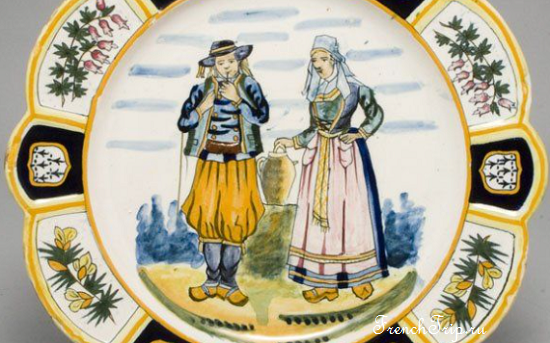
Quimper has made tin-glazed earthenware since 1690, when a potter from Provence set up in the Locmaria quarter by the river. The style everyone recognises — a Breton man or woman in costume, hand-painted, with a border of flowers — dates from the late nineteenth century and is still produced by hand.
The Musée de la Faïence and the surviving workshop at Locmaria are a twenty-minute walk down the Odet. Pieces are signed and marked; the museum will teach you to read the marks before you buy.
That workshop trades as the Faïencerie Henriot-Quimper, a long-standing name in the business. Besides the Breton couple in costume, look out for the triskell, a three-legged spiral.
Food and drink
Local cooking leans on seafood, pork and apples. Bakeries sell kouign-amann, the dense butter-and-sugar cake, alongside far breton and other Breton cakes. Crêpes are everywhere: wheat crêpes are the sweet ones, buckwheat galettes the savoury, and creperies fill nearly every street of the old town.
Cider is the local drink, alongside pommeau (a blend of cider and apple brandy). Some producers also distil a whisky from buckwheat.
Getting to Quimper
- By train — TGV from Paris in about 3 h 30; regional trains from Rennes, Brest, Vannes and Nantes.
- By car — the free Breton dual carriageways: an hour from Brest or Vannes, 2 hours from Rennes. See parking in France.
- By air — Quimper-Pluguffan has flights to Paris; Brest and Nantes have more.
Around Quimper
- Locronan — 20 minutes, and one of the most beautiful villages in France
- Bénodet and the Odet estuary — 20 minutes down to the sea, with boat trips up the river
- Pont-Aven — 40 minutes, where Gauguin painted
- Concarneau — 30 minutes, with its walled island town
- Pointe du Raz — an hour west, the cliffs at the end of Brittany
When to go
May to September. The Festival de Cornouaille in the third week of July is the largest Breton cultural festival in France — several days of music, pipe bands, dance and costume, and the one time the town is genuinely full. The Wednesday and Saturday markets run all year.
See Brittany.
Weather in Quimper
| Month | Day | Night | Rainfall |
|---|---|---|---|
| January | +10° | +4° | 140 mm |
| February | +11° | +4° | 109 mm |
| March | +13° | +5° | 78 mm |
| April | +15° | +6° | 81 mm |
| May | +18° | +9° | 74 mm |
| June | +21° | +12° | 60 mm |
| July | +22° | +13° | 63 mm |
| August | +23° | +13° | 68 mm |
| September | +21° | +11° | 74 mm |
| October | +17° | +10° | 113 mm |
| November | +13° | +7° | 144 mm |
| December | +11° | +5° | 146 mm |
This page in Russian: Quimper (Кемпер)
Updated: