Saint-Paul-de-Vence
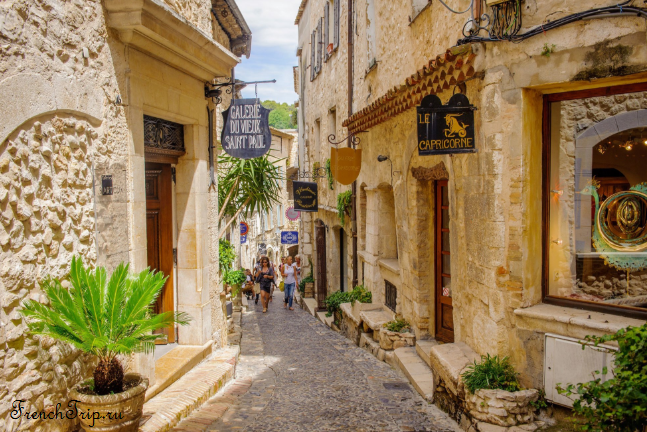
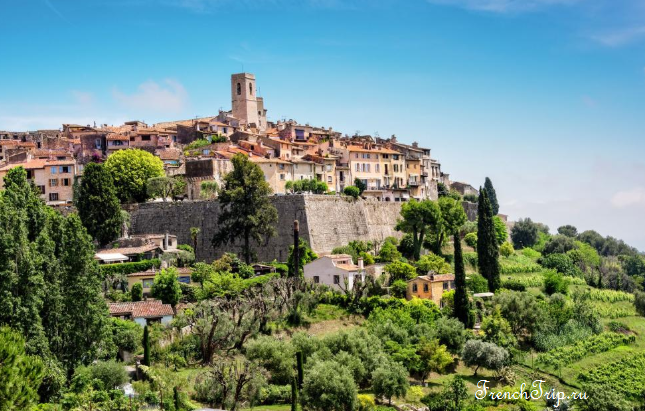
Saint-Paul-de-Vence is a walled hilltop village behind Nice, between Antibes and Grasse — one of the oldest towns on the Côte d’Azur and, since the 1920s, the one artists made their own.
Signac and Modigliani came first. Then Marc Chagall, who spent the last twenty years of his life here and is buried in the village cemetery. Painters who could not pay their bills at the inn on the square, La Colombe d’Or, settled them with canvases — which is how a village restaurant came to own one of the better private collections of twentieth-century art in France, still hanging on its walls.
History
The village began as a refuge from the sea. After Roman authority collapsed, the coast could no longer be defended against Saracen raids, and in the early Middle Ages the population withdrew inland to fortified hill villages known as villages perchés, or “stone nests”. Saint-Paul-de-Vence was one of them.
The circle of Parisian painters that grew up here from the 1920s eventually took in Pierre Bonnard, Picasso, Raoul Dufy, Maurice de Vlaminck, Chaïm Soutine and Maurice Utrillo, and writers including André Gide, Jean Cocteau, Jean Giono, Jacques Prévert and Jean-Paul Sartre. Film people are said to have followed in a later “pilgrimage” to the village — Brigitte Bardot, Sophia Loren, Romy Schneider and Roger Moore are among the names attached to it — and Yves Montand is said to have met Simone Signoret here, and later married her.
The inn where the painters settled their bills in canvases was then called Le Robinson, before it became La Colombe d’Or. Two other addresses were popular with the same crowd: the hotel La Pergola, and later La Résidence, which is now the Café de la Place.
The painter Nicolas de Staël — born Nikolai Stael in Russia, and among the major figures of post-war European art — was also drawn to Saint-Paul-de-Vence.
Be warned about the crowds
This is one of the most visited villages in France, and in July and August the main street is shoulder to shoulder. The combination of celebrity history, genuine beauty and a location twenty minutes from the coast resorts guarantees it.
Go early or late. Before ten in the morning or after six in the evening the village is a different place — and in the low season it is close to empty. If your only option is a summer afternoon, expect to queue along the Rue Grande rather than walk it.
What to see
The ramparts and the old village
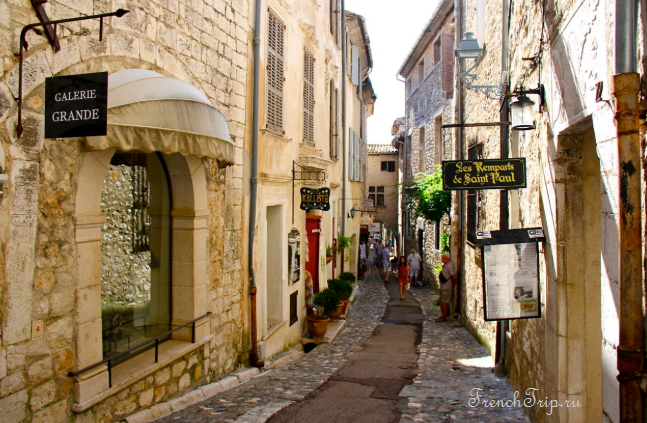
The walls were built for François I in the 1540s and survive almost entirely. You can walk the circuit in twenty minutes, and the views over the hills towards the sea are the reason to do it.
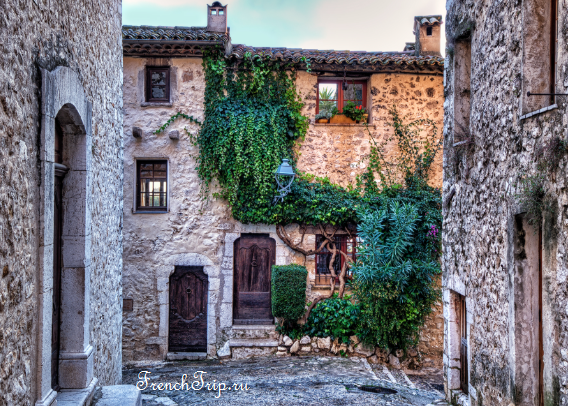
Inside, the village is a single main street with lanes off it, and houses from the sixteenth to eighteenth centuries. Nearly every ground floor is now a gallery or a workshop — some serious, some not.
Fondation Maeght
Ten minutes’ walk outside the walls, and for many visitors the real reason to come: a modern art museum built in the 1960s by the dealer Aimé Maeght, with a sculpture garden by Miró, a Giacometti courtyard and works by Braque, Calder and Chagall. It was designed as a building for the art rather than a building with art in it, and it still looks remarkable.
The building is the work of the Catalan architect Josep Lluís Sert, and the collection extends to Matisse, Bonnard, Kandinsky and Léger alongside the artists already named. It is sometimes called the “Louvre of the Riviera” — a stretch, but there is a genuine concentration of first-rate twentieth-century work in one small museum.
The church and the Chapelle des Pénitents Blancs
The collegiate church holds a painting attributed to Tintoretto. The nearby chapel was decorated by Jean-Michel Folon in the 2000s — a modern interior in a medieval shell, and worth the few minutes.
Museum of Local History
A small local-history museum in the village fills in its past in more detail.
Chagall’s grave
In the cemetery just outside the southern gate — a plain stone slab, usually with pebbles left on it by visitors, and a view over the valley that explains why he stayed.
Chagall arrived in Saint-Paul-de-Vence in 1966 and died here in 1985. The village holds a handful of his work: the large painting La Vie (Life) and the mosaic Les Amoureux (The Lovers), both at the Fondation Maeght, and a mosaic on the pediment of the local school, made after his death from one of his drawings.
Pétanque on the Place du Jeu de Boules
The square by the entrance gate, where the village plays and where Yves Montand famously did. It is not a performance for tourists; the games are real and the arguments are too.
Getting there
By bus is the easy way. Route 400 runs from Nice (Vauban) via Cagnes-sur-Mer to Saint-Paul and on to Vence — roughly an hour from Nice, and cheap. Buses are frequent but full in season.
By car, allow for the parking problem. The village is pedestrian and the car parks below it fill early; in summer expect to leave the car some way down the hill and walk up. See parking in France.
Nearest airport is Nice Côte d’Azur, about 40 minutes. There is no railway station — the nearest is Cagnes-sur-Mer on the coastal line, with the bus up from there.
What to eat
Prices inside the walls are what you would expect of a village this famous. La Colombe d’Or is an institution and charges like one — worth it for the art on the walls if you treat lunch as a museum ticket. The terraces just outside the gates are better value for the same view.
The cooking is Provençal: see Provençal cuisine.
Markets
The Wednesday farmers’ market — fruit, vegetables, nougat, brioche, jam, cheese, olive oil, flowers — sets up on the Place du Jeu de Boules; a smaller fruit, vegetable and flower market by the old wash-house runs on Tuesdays, Thursdays, Saturdays and Sundays.
Festivals
The village keeps the national Fête de la Musique on 21 June, and a bigger Fête de la Saint-Jean around the same time, followed by a dance on the Place de la Courtine for Bastille Day. Its own patronal festival, for Sainte Claire, runs over a weekend in early August, opening at her chapel and closing with fireworks. Later in the year there is a grape-and-chestnut harvest festival in October, a truffle market in December, and a Christmas market from mid-December into the new year; an olive-oil festival follows in spring.
Nearby
- Vence — the larger town 4 km up the road, with Matisse’s Chapelle du Rosaire, which he considered his masterpiece; see Vence
- Cagnes-sur-Mer — down at the coast, with Renoir’s house and the Grimaldi castle
- Grasse — the perfume town, half an hour west
- Antibes — the Picasso museum and the ramparts, 30 minutes
- Cannes and Èze — the coast either side
- La Colle-sur-Loup — a village nearby known for its ceramics workshops
- Villeneuve-Loubet — on the coast, with the Escoffier culinary museum and a tour of its medieval castle
When to go
April to June and September to October: the light is best, the village is walkable and the Fondation Maeght is not queued. July and August are crowded to the point of spoiling it. Winter is quiet and many galleries close, but the walls and the views do not.
See when to visit Provence and what to do in Provence.
Weather in Saint-Paul-de-Vence
| Month | Day | Night | Rainfall |
|---|---|---|---|
| January | +13° | +6° | 84 mm |
| February | +13° | +6° | 60 mm |
| March | +16° | +8° | 62 mm |
| April | +18° | +10° | 85 mm |
| May | +22° | +14° | 58 mm |
| June | +26° | +18° | 41 mm |
| July | +29° | +20° | 18 mm |
| August | +29° | +20° | 28 mm |
| September | +25° | +17° | 91 mm |
| October | +21° | +14° | 140 mm |
| November | +16° | +10° | 149 mm |
| December | +14° | +7° | 104 mm |
Updated: